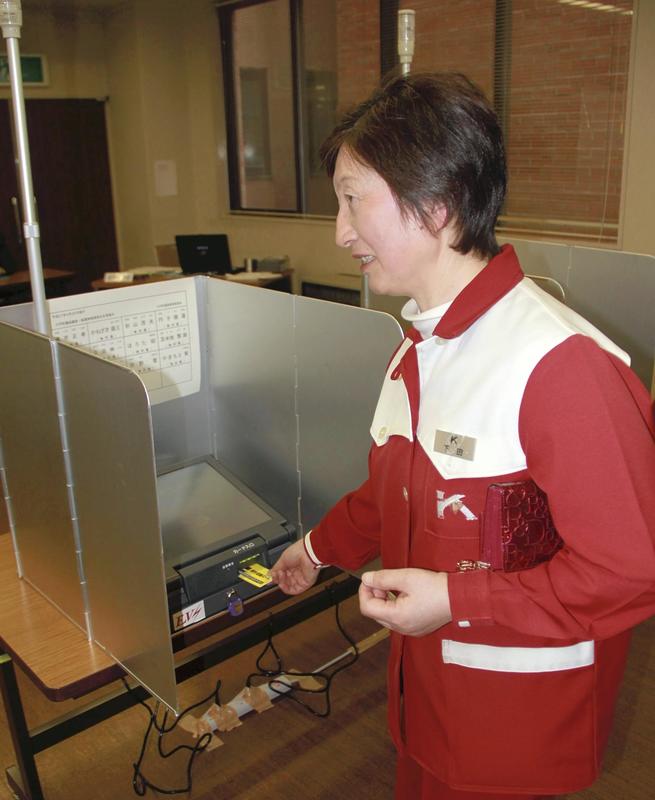
The Internal Affairs and Communications Ministry aims to allow the use of commercially available tablets and personal computers for electronic voting in local elections.
E-voting became possible in 2002 and 10 local governments and assemblies have since implemented the voting method. But e-voting has not been used since 2016.
To encourage the implementation of more electronic voting, the ministry plans to review the current guidelines that effectively limit devices to those specialized for e-voting.
As local elections have been rapidly increasing nationwide, the ministry believes that e-voting can be effective for preventing mistakes in vote-counting. During fiscal 2020, the ministry aims to improve the circumstances to make it possible for local governments and assemblies to resume the implementation of e-voting.
The guidelines stipulate criteria on devices used for vote-counting in elections in which e-voting is implemented. It effectively only allows the use of electronic devices specialized for e-voting because of durability and measures to prevent fraudulent voting.
However, compared with devices that were available in 2002, the performance of commercially available electronic devices have remarkably improved and there are now more lower-priced ones.
Thus, the ministry judged that commercially available devices can be utilized for e-voting.
Under the plan, local governments will be able to implement e-voting after downloading newly developed software into commercially available devices.
E-voting can reduce labor costs for tallying votes, which now requires a large number of workers, and it is also expected that mistakes related to local election procedures can be reduced.
There is one more merit that commercially available devices can be used for local governments' daily work after elections.
Mistakes and problematic acts in elections, such as wrong issuance of voting slips, have surged in about the last 20 years. The number of such cases increased about 13 times in House of Councillors elections, about six times in House of Representatives elections and about 10 times in unified local elections.
The ministry sought advice about election circumstances from an expert panel for studying measures to improve election conditions. The panel in 2018 encouraged the ministry to consider the introduction of commercially available electronic devices as an effective measure to prevent mistakes.
In e-voting, wrong distribution of voting slips, questionable votes and invalid votes can be eliminated. Also, vote-counting finished in 2 to 55 minutes for electronic voting implemented in the past, making quick election results another advantage.
But e-voting with special devices exclusive for the purpose is costly, making it a high hurdle for its introduction. There were cases where election costs using special devices were twice as high as those using conventional methods in which voters write on voting slips.
Read more from The Japan News at https://japannews.yomiuri.co.jp/




.jpg?w=600)