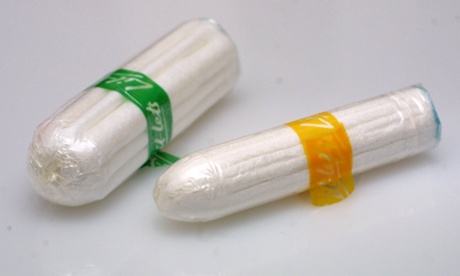
The treasurer, Joe Hockey, has asked his department to work out the cost of removing the goods and services tax (GST) from tampons and sanitary pads.
The move could pave the way for a decision on exempting such products from the 10% tax, even as Tony Abbott distanced himself from Hockey’s cautious support for changes.
“It’s certainly not something that this government has a plan to do,” the prime minister said during a press conference on Tuesday.
The fresh focus on taxation of tampons followed Hockey’s appearance on the ABC’s Q&A program on Monday evening. The treasurer promised to discuss the issue with his state and territory counterparts, prompting the shadow treasurer Chris Bowen to signal Labor’s support for the proposed exemption.
Hockey issued a two-line statement on Tuesday evening indicating he had asked officials to estimate the cost of taking such action.
“I have asked Treasury to cost removing the GST from sanitary products. When I receive those costings, I will write to the states for them to consider the issue ahead of our next meeting in July,” he said.
The opposition leader, Bill Shorten, asked the prime minister during question time in parliament on Tuesday if the government would support the removal of the GST on pads and tampons in exchange for Labor’s support for the so-called “Netflix tax” which would extend GST coverage to internet downloads.
Abbott did not respond directly to the compromise, which Labor said would swap a $25m windfall from the GST on sanitary products with a $350m gain from the Netflix tax. The prime minister instead placed the onus on the states and territories.
“The GST is a tax which is imposed for the states, it is spent by the states, and Madam Speaker, changes to the GST are absolutely a matter for the states and territories and if all the states and territories can agree obviously we are happy to hear from them,” Abbott said.
The Howard government, which introduced the GST in 2000, included the tax on tampons but excluded it from continence pads. Items such as condoms and sunscreen are exempt from the GST on the premise they are health products.
Hockey pledged to re-examine the issue after a question on Q&A from a university student, Subeta Vimalajarah, whose petition “stop taxing my period” has more than 92,000 signatures.
When asked by the host, Tony Jones, whether the GST should be taken off the items, Hockey replied: “It probably should, yes. The answer is yes.
“What happened was when it [the GST] was negotiated through the Senate by the Howard government, the Democrats had a list of things they wanted excluded and they didn’t have sanitary products on it, so it didn’t happen.”
When a Labor MP raised the topic during the opposition’s caucus meeting on Tuesday, Bowen told colleagues: “We are agreeing with Joe Hockey and are supportive if the government has a way of fixing this with the state treasurers.”
The GST Act that passed the parliament in 1999 specified exemptions for continence products “including disposable/reusable continence pads, pants and nappies required for continence use (excluding nappies for babies, sanitary pads or tampons)”.
The classification prompted outrage from women’s groups and consumer advocates, who unsuccessfully petitioned the Howard government and successive Labor governments to remove the tax on tampons.
Abbott told parliament on Tuesday that “perhaps if we had our time over again things would have been done differently” in the GST negotiations.
John Howard resisted calls from within his own government for the exception to be extended.
“Now, you can always mount an argument not to tax an individual item. I understand that,” Howard told the ABC in 2000.
“And taken in isolation, that argument can be compelling. But you can’t take things in isolation. You’ve got to look at it, every little part as a section of the whole. And that is what I’m doing in relation to this. And if you take the GST off, say, tampons, within a few days, I promise you, there will be a group of people mounting quite a respective argument in isolation to take it off children’s clothing. Everybody needs clothing.”
Michael Wooldridge, a health minister in the Howard government, drew fire from members of his own party for his insensitive handling of the issue.
“Well, condoms prevent illness,” he said in 2000 when asked why the items were exempt from the GST. “I wasn’t aware that menstruation was an illness.”