Shimizu Corporation is one of the major general construction companies in Japan. For this installment of Leaders, a column featuring corporate management and senior executives, Kazuyuki Inoue, president of Shimizu Corp., explains his strategy for expanding beyond the company's mainstay construction business to survive in a domestic market that is shrinking because of depopulation.
I worked at a branch office in Yokohama during my first 21 years at the company. My job was to oversee construction sites.
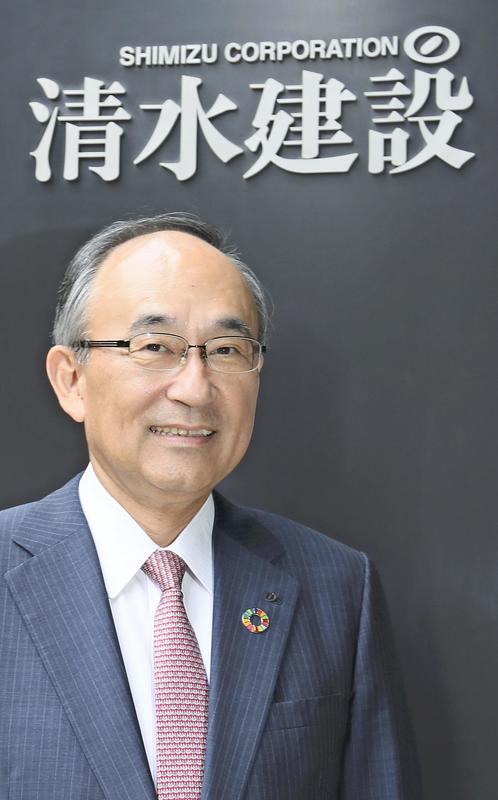
[As a site manager, Inoue was responsible for completing buildings and other structures within a designated period by bringing together various subcontractors, and for ensuring job safety.]
Soon after joining the company, I was tasked with constructing the research laboratory of a major electronics manufacturer. We completed the building and took down the scaffolding, revealing the outer wall. I was deeply moved by the sight, and said to myself: "We did it. We did a good job. "
Then all of a sudden the afternoon sun hit the wall, and we noticed that the surface appeared slightly wavy. The general manager of the building construction department said: "What's this? This work is unworthy of Shimizu. Do it over again."
We rebuilt the scaffolding and completely stripped the exterior wall. Plasterers redid the inner layer and painters sprayed on fresh coats. It took about a month to finish the work and we slightly missed the construction deadline we had promised the client.
The exterior wall turned out beautiful in the end. Through this experience, I learned first-hand how serious the company is about providing high-quality service.
I believe that coming in contact with many types of people on construction sites has helped to broaden my horizons.
One person in particular left a strong impression on me, an older construction worker who I believe was from Aomori Prefecture. Every time I tried to talk to him, the taciturn professional would only say, "uh-huh." His response made me wonder whether my instructions were getting through to him. However, no matter what work I assigned him, the results were always perfect. At the same time that he was supporting me on the job, he was also teaching me the proper attitude toward work.
When I was working on the construction of a school facility, a teacher told me: "In every organization, there are different types of people -- those who are good at their work, and those who are fully trusted by colleagues. You should aim to become the latter." The teacher was referring to a type of person whose mere presence can create a sense of unity within an organization and inspire coworkers to work harder for that person. Becoming such a person is a difficult task, the teacher said.
I believe the teacher decided to give me that advice after seeing the way I worked as a young man. The words have been etched in my mind ever since.
No construction job is ever completed by itself. You are sometimes faced with unexpected dilemmas, and must constantly make the best judgment and take the right action.
After completing a building, I am always delighted when the client says, "Thank you" or "You've done a good job." I can honestly say that such moments inspire me to continue on with my work. The more difficult the job and the more effort I put into it, the more emotional I get when we finally carry it through to completion.
Aiming for 2-day weekend
[The average age of construction workers is steadily increasing, with one-third of all workers expected to retire over the next 10 years.]
How to address the labor shortage is a major issue for the construction industry. There's nothing we can do about older workers retiring. We must ensure that members of the younger generation enter the industry to fill the void. To do this, we need to create an attractive work environment. First, it's important that we get them to understand that the job of building a structure is interesting and worthwhile. It's also essential that we raise wages and make it common practice to have weekends off.
[Construction workers generally take only one day off per week. Many are paid by the day. The idea of getting an additional day off has met with opposition from subcontractors and workers because it would reduce their incomes.]
We have introduced a system in which the company compensates workers for the losses they sustain when their days off increase because of advancements and efforts in the construction field. We also started using robots to compensate for the labor shortage. At some construction sites, robots are being used to weld, transport materials and install ceiling boards. We are expanding our efforts in this field and considering whether to sell robot technology to other companies in the future.
[The demand for construction in the country is expected to gradually shrink as the population declines.]
While some predict that construction demand will slump after the 2020 Tokyo Olympic Games, I don't think we'll see a sharp decrease from the current scale of construction investment. However, a slowdown in investment is inevitable in the long run.
[The company aims to create second and third pillars of its business outside of construction to ensure its growth.]
We will engage in the development and management of office spaces, hotels, commercial facilities and others both at home and abroad to expand our business beyond construction. We intend to strengthen our international business not only in Southeast Asian countries like Singapore, Indonesia and Vietnam, but also in North America.
We also plan to provide long-term services after we complete a building, including property maintenance and management. Erecting new buildings currently accounts for 70 percent to 80 percent of investment in the domestic construction industry, but renovations are sure to make up a higher share in the near future.
I'm looking forward to a new era in which our business has evolved beyond the field of construction.
Contributing to society
The company feels a great debt of gratitude to Eiichi Shibusawa (1840-1931), the entrepreneur known as the "father of Japanese capitalism."
Shibusawa founded the Dai-ichi Kokuritsu Ginko (First National Bank), whose office was designed and built by Kisuke Shimizu II, the second-generation head of the company. Shibusawa was impressed by Kisuke's work and asked him to build his private residence.
Mannosuke Shimizu, the third-generation head, died in 1887 at the age of 34, sparking a management crisis. His eldest son eventually took over the company, but he was only 8 years old at the time his father died. Mannosuke's wife asked for Shibusawa's help and welcomed him as an adviser.
After that, Shibusawa introduced many clients to the company. Many of the customers we have today have been with us since that time. It's fair to say that Shibusawa saved us from our predicament and enabled our company to develop.
Shibusawa instructed us to focus our operations on private-sector construction. He also advocated placing importance on the routine management and repair of buildings. His guidance has served as the foundation of our business.
Shibusawa's residence was built in today's Koto Ward, Tokyo. It's a beautiful house that blends a Western-style structure with traditional Japanese architectural elements. It was relocated to Aomori Prefecture, but the company bought it and plans to bring it back to the ward by 2022. We plan to open it to the public to pass on the historic building to the next generation.
Shibusawa authored the book "The Analects and the Abacus." In it, he elaborates on his belief that companies that contribute to society through reasonable corporate activities will receive fair returns and prosper in business as a result. I think that this principle resonates with founder Kisuke Shimizu I's emphasis on earnest dedication to monozukuri, or manufacturing. We continue to uphold our corporate philosophy based on the principles in the "The Analects and the Abacus."
-- Kazuyuki Inoue / President of Shimizu Corporation
Born in Tokyo in 1956, Inoue joined the company after receiving a master's degree in construction engineering from Waseda University in 1981. Inoue has held various posts, including deputy general manager of the Kyushu branch, director, senior managing officer, and general manager of the Nagoya branch. He took up his current position in April 2016.
-- Key Numbers: 215
Kisuke Shimizu I was a master carpenter specializing in temples and shrines who hailed from the Etchu region (present-day Toyama Prefecture). He founded the business in the Kanda area of what is now Tokyo in 1804, becoming the first-generation head of the company. This year marks the 215th year since the company's founding. Shimizu Corp. has also undertaken many renovation and repair projects at temples and shrines, including the main structure of Izumo Taisha shrine in Shimane Prefecture. According to its consolidated financial report for the year ended March 2019, net sales were 1.6649 trillion yen and ordinary income was 133.9 billion yen. The consolidated number of employees was 16,184 as of the end of March this year.
Read more from The Japan News at https://japannews.yomiuri.co.jp/