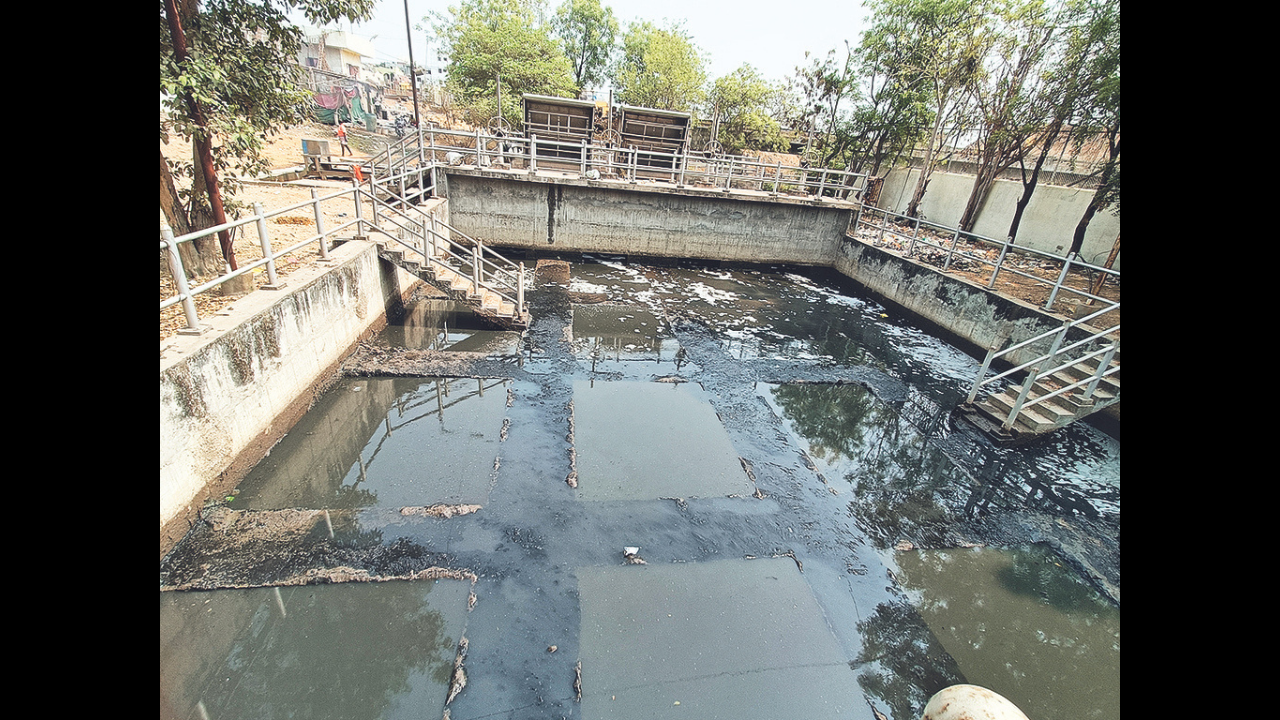
CHANDIGARH: Inspection undertaken by the Central Pollution Control Board (CPCB) has found 86% of the sewage treatment plants (STPs) in catchment of the Satluj to be non-compliant with the laid down norms, pointing to the lax attitude of the Punjab government towards discharge of pollutants in rivers.
With a large number of towns discharging their wastewater into the Satluj, rising levels of toxicity in the river waters has become a major cause of concern as it poses a great health hazard. The total catchment area of the river is about 20,303 square kilometres. The industrial town of Ludhiana which falls within the catchment area of the Satluj contributes significantly to the pollution of the river.
While responding to a question pertaining to checking of industrial effluent samples in Punjab by Rajendra Gehlot, a member of Rajya Sabha from Rajasthan, the ministry of environment, forest and climate change submitted that the Central Pollution Control Board had carried out an inspection of 14 STPs in the catchment of the Satluj in June 2021 and found 12 STPs to be non-complying.
Five of the STPs -- Balloke –II, Ludhiana, Bhattian-I, Bhattian-II, Muktsar Sahib-I and Muktsar Sahib-II – were found to be having higher levels of biochemical oxygen demand (BOD), total suspended solids (TSS) and faecal coliform bacteria while remaining nine were non-complying in respect of faecal coliform bacteria.
The ministry said that the CPCB has issued directions to the Punjab Pollution Control Board (PPCB) under relevant sections of the Water (Prevention and Control of Pollution) Act, 1974, and to the Municipal Corporation of Ludhiana and Muktsar under Section 5 of Environment (Protection) Act, 1986, for the compliance of sewage discharge standards. Between April 1, 2019, and March 31, 2022, PPCB has collected more than 600 effluent samples of hosiery -- dyeing/printing/washing --units located in Jalandhar and Ludhiana.
The ministry also stated that electroplating units in Jalandhar and Ludhiana either get trade effluent lifted for treatment in the CETP installed at Ludhiana or have installed zero liquid discharge treatment systems.
As the common effluent treatment plants (CETPs) and STPs are monitored on monthly basis by the PPCB, the central board was informed by PPCB that no trade effluent is generated by foundry units located at Jalandhar and Ludhiana
Direct bearing on health: Panel
The parliament standing committee on water resources of the Union ministry of Jal Shakti has on a couple of occasions expressed concern over the water pollution in the Ganga canal (also known as Gang canal) flowing from Punjab to Rajasthan and containing harmful and untreated chemicals discharged by the industries located in Punjab. The canal is fed from the Satluj near Ferozepur and passes through the Faridkot and Muktsar districts. The committee, in its report in 2021, had said, “This is a grave issue having a direct bearing on the health and wellbeing of villagers who are using this water for consumption and the number of cancer cases are reportedly increasing day by day.”