Volkswagen manufactures up to 7,000 engines a day in Salzgitter, Germany. There, the company produces more than 370 varieties of diesel and gasoline engines, industrial engines, marine engines and units for cogeneration plants. The production range includes engines from three to 16 cylinders, with engine power ranging from 55kW to 736kW.
The Salzgitter plant has around 6,200 machine tools ready to mill, bore, turn and grind delivered cast parts and ingots into engine blocks, cylinder heads, camshafts and crankshafts. The plant also produces various engine components like intake manifolds, oil pans, flywheels and oil and water pumps. The components pass through twelve assembly lines to complete each engine.
Cooling lubricant: an important honing material
Honing is an important part of Volkswagen’s manufacturing process, and the Salzgitter plant’s honing system for four cylinder crankcases recently needed an upgrade.
The plant needed to increase the purity of the cooling lubricant required for honing because the quality of cooling lubricant indirectly affects the quality (the subsequent performance and cost effectiveness) of the engine. The better the finishing polish, the lower the tolerances that can be achieved.
In order to improve the cooling lubricant’s quality, an additional “police filter” was installed as an automatic backwash filter. A rapidly rotating centrifuge was also set to bypass mode to remove the finest particles.
These changes to the LCF system also affected the system’s LCF pumps. The grey, cast iron particles that result during material machining are relatively heavy, sink rapidly and may therefore block the cooling ducts. For this reason, cooling must be performed at high pressure and high speed.
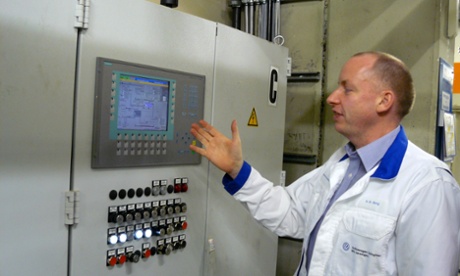
Nils-Stefan Bang is one of the people responsible for making sure that the system’s LCF pumps are working as efficiently as possible. He and his colleagues make sure that the processing machines have various operating media like cooling water, chilled water, compressed air and lubricating and cooling fluids (LCF). He is also responsible for ensuring smooth disposal of emulsions and oils laden with metal filings.
“As supply technicians, we look at the honing system almost like a black box – the focus for us is providing the given cooling lubricant with the required characteristics while consuming as little energy as possible,” says Bang.
Speed control offers flexibility
In May 2011, Volkswagen installed two Grundfos variable-speed, standard NK pumps, a frequency converter, and a new communication interface at the plant. According to Bang, this system allowed for more flexibility.
“Experience shows that it is always an advantage if a system like this is able to “breathe.” A variable-speed pump is flexible in terms of both flow rate and discharge pressure,” he says.
It also provides help during weekend operations. Cooling lubricant cannot stand for too long without moving – stagnation increases the risk of microbial contamination. A variable-speed pump adjusts the process so that the system does not waste energy or become contaminated.
An estimated 10% of all filter systems at Volkswagen are currently equipped with variable-speed pumps. Bang believes that it makes economic sense to eventually retrofit around 30% of the systems to variable-speed pumps.
“Using a frequency converter controlled pump, it is very easy for me to run or simulate a variety of operating states,” he says. “This saves a great deal of electrical energy that would otherwise be discharged in the form of heat into the cooling lubricant.”
Learn more about Volkswagen’s new variable speed pumps here.
More from the Grundfos partnerzone:
- Cooling fruits with Geoexchange
- Italian utility reduces water loss by 30% through pressure management
- Smart water distribution systems mean big savings for Bucharest
Content on this page is paid for and provided by Grundfos, sponsor of the water hub