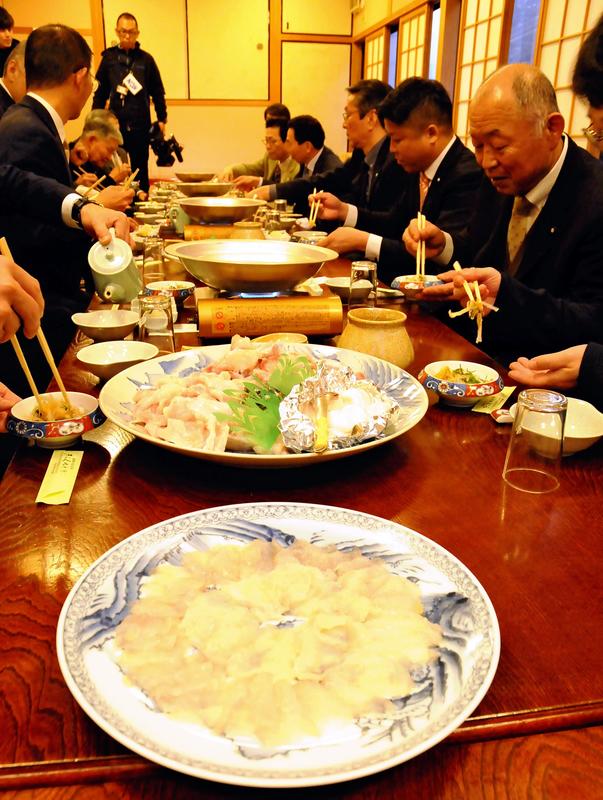
TENKAWA, Nara -- The government of Tenkawa village, located in the inland area, is making use of a classroom in a closed elementary school building in the cultivation of expensive tiger puffer fish with plans to ship them out this autumn. The saltwater fish are offered at hot spring inns in the village and are being eyed as a tourist draw. A tasting event was held in mid-February for the first time, and hotel operators hope that the dishes using the fish will become a new tourist attraction.
A former computer classroom on the first floor of a school building near the municipal government building, which closed 14 years ago, has a nameplate that reads "Torafugu [tiger puffer fish] class." Inside, roughly 130 puffer fish swim around in two 3.5 meter-diameter tanks.
According to the village, the water temperature is kept at around 20 C through the use of machinery such as air conditioners and the puffer fish are fed and raised year-round. Normally, it takes two to three years for them to reach a shipping size of 35 centimeters in length and one kilogram in weight, however, at this facility, the process can be shortened to one to 1-1/2 years. Slightly alkaline tap water that is used with the same salinity as brackish water -- 0.9% -- which is said to be good for growth and is lighter than seawater.
The poison of the puffer fish is accumulated in the body from its shellfish and starfish diet, but through a diet of an artificial substitute, it is said that they become almost non-toxic.
Tenkawa is known as the climbing starting point for the World Heritage site Omine mountain range. It's a great place to beat the summer heat and the leaves changing in the autumn is also a huge draw for tourists. The shortage of visitors in winter, however, has become a problem. Also, the selection of ingredients for dishes is limited to wild boars, deer, river fish, and wild vegetables. So, these saltwater fish have garnered much attention.
The village has introduced the method of aquaculture used at Hida Ocean Science Laboratory, a fish farming company based in the city of Hida in landlocked Gifu Prefecture that is also cultivating tiger puffer fish. Although the village originally considered building a plastic greenhouse in a vacant lot, they ultimately decided to reuse the school building, which is less expensive and allows for easier temperature management. The initial cost was about 5.6 million yen.
Yuki Shimonishi, 24, who has been studying fisheries at university, is in charge of the breeding. He was originally an employee of a private company, but in September 2018 he became a member of the state-sponsored regional development cooperative. He said, "It's rewarding to see their growth every day. If we can pave the way for the cultivation of puffer fish and establish the technology, we want to try cultivating other fish."
A total of 16 people, including local government officials, participated in the tasting event on the evening of February 14. The 15 fish, which had grown to a weight of 1.4 kilograms and about 40 centimeters in length in the span of a year, were prepared as sashimi, parboiled and cooked in hot pot.
Mayor Shigetaka Kurumatani said, "Our biggest goal is the revitalization of tourism and employment by establishing the Tenkawa brand of puffer fish." Yukio Imanishi, 66, a member of the village assembly, who runs a grocery store and handles puffer fish, said of the meal, "It's sweeter and chewier than I thought." Tatsuji Kubo, 51, who runs an inn in Dorogawa Onsen spa, said, "The only selling point in winter was our hot pot made with wild boar meat, but if served together [with tiger puffer fish], it would be a huge hit."
The village government plans to start mass production of the fish, which will be shipped in or after September, with the addition of 550 young fish in May. A full-scale facility in the village in fiscal 2021 is also under consideration and will start shipping products outside the village if all goes well.
Read more from The Japan News at https://japannews.yomiuri.co.jp/