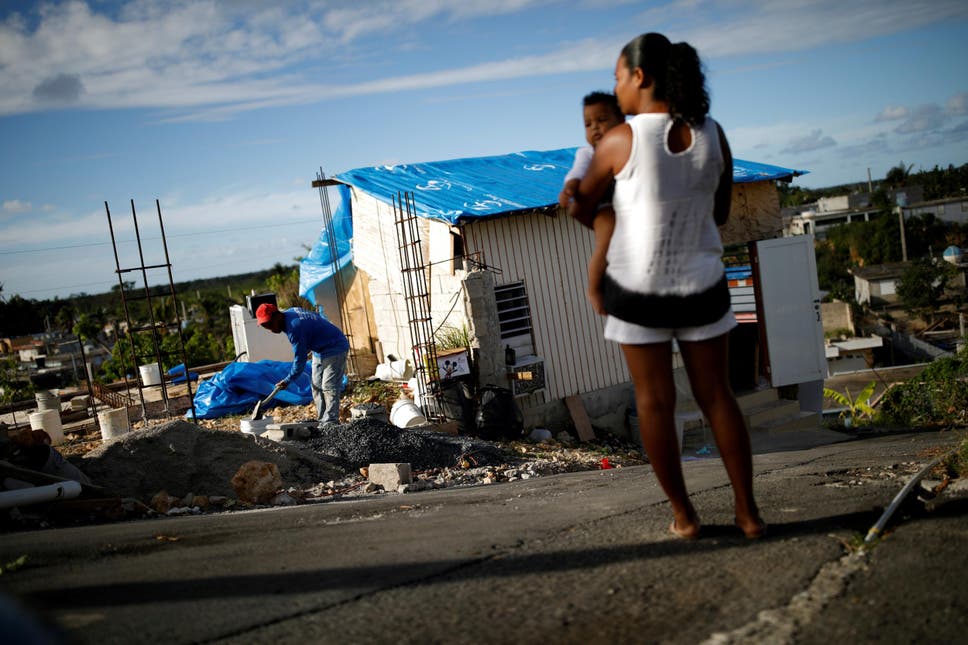
The official death toll from the hurricane that struck Puerto Rico in September last year has been increased from 64 to 2,975, a 50-times jump that has sparked a new wave of criticism for the government response to the disaster.
A new study ordered by the governor of the US territory recommended the revised toll for deaths that could be directly or indirectly attributed to Hurricane Maria and its aftermath, in a period spanning from September 2017 to mid-February of this year.
Maria was the most powerful storm to hit the Caribbean island for a century, and witnesses to the devastation said the previous official toll seemed a serious underestimate.
Nonetheless, the figure was used by Donald Trump's then acting homeland security secretary, Elaine Duke, who 12 days into the disaster characterised the federal response as "a really good news story" and spoke of a "limited number of deaths".
Mr Trump himself said in early October 2017 that he was happy with the federal response to Maria, saying it compared favourably with a "real catastrophe like Katrina".
For comparison, deaths blamed on Hurricane Katrina in 2005 range from about 1,200 to more than 1,800, most along the Gulf Coast of Louisiana and Mississippi.
Criticism of the federal response existed at the time - in a scathing reaction, San Juan Mayor Carmen Yulin Cruz appeared on CNN declaring, "Damn it, this is not a good news story. This is a people-are-dying story. This is a life-or-death story."
And US Representative Nydia Velazquez, a New York Democrat, said the study was "only the latest to underscore that the federal response to the hurricanes was disastrously inadequate, and as a result, thousands of our fellow American citizens lost their lives."
Researchers from George Washington University's Milken Institute School of Public Health derived the latest Puerto Rico figure from comparisons between predicted mortality under normal circumstances and deaths documented after the storm, a number that turned out to be 22 percent higher.
They adjusted for various factors that could account for fluctuations in mortality, most notably the displacement of some 241,000 residents who fled the island in the immediate aftermath of the storm.
They also found that the poor and elderly were disproportionately hard hit in terms of risk of fatalities.
Speaking at a news conference in Puerto Rico's capital, San Juan, governor Ricardo Rossello said his government was adopting the findings as the official account of human life lost in the disaster, "even though it is an estimate."
"We will take the 2,975 number as the official estimate for the excess deaths as a product of the hurricane," he said.
Researchers attributed undercounting of storm-related deaths to poor communications and the lack of well-established guidelines and training for physicians on how to certify deaths in major disasters.
White House press secretary Sarah Sanders said the administration supported "efforts to ensure a full accountability and transparency of fatalities" from the hurricane.
Additional reporting by Reuters