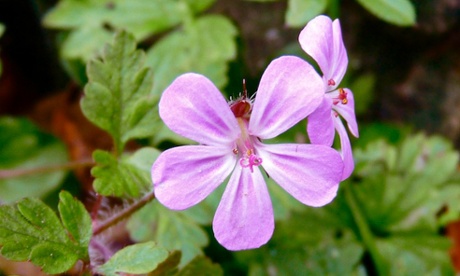
Herb robert is one of those plants we take for granted because it’s so ubiquitous, small, weedy and annual. Among the showier blooms of spring and summer, the little pink stars are just part of the general noise of flowering colour.
But as the year turns brown, into seed and rot, and life is drawn underground, colours ignored earlier now shine. As ash leaves spiral on to the path through Blakeway Coppice, a few plants of herb robert are flowering between rocks. Pink flowers, as small as they are, stand out against the mulch of leaves and moss.
In summer, pink is the colour of a hedonistic, spirited innocence. In autumn, it’s an irrepressible optimism, a fragile defiance. There are other pinks around: a few flowers of a once vibrant colony of cyclamen in the ruins of a garden now overgrown and spindle berries in the hedge between wood and field.
Although it’s found in gardens, wasteground and almost anywhere, herb robert in these stony woods of Wenlock Edge feels classically at home, the plant of rocky woodland mentioned in medieval herbals as a valuable herb with styptic qualities.
A geranium, it may have got robert from its German name Ruprechtskraut, from the redness of its stems associated with Saint Rupert, the eighth-century saint of Salzburg invoked against bleeding wounds and ulcers, treated with this herb.
The other herb robert association is with the house goblin Knecht Ruprecht, who in English becomes Robin Goodfellow. In turn, Robin (Robert) Goodfellow is the disguised name for the hobgoblin nature sprite, Puck.
As I scramble around the cliffs of Ippikin’s Rock above, the connection begins to dawn on me. The legendary Wenlock Edge bandit Ippikin, who is entombed in a cave up in these rocks as punishment for his wickedness, is an incarnation of Puck.
As I grab a thorny branch which draws blood, the link is made back to herb robert and I realise I have been lured into this increasingly precarious predicament by Puck’s little pink flowers of mischief.