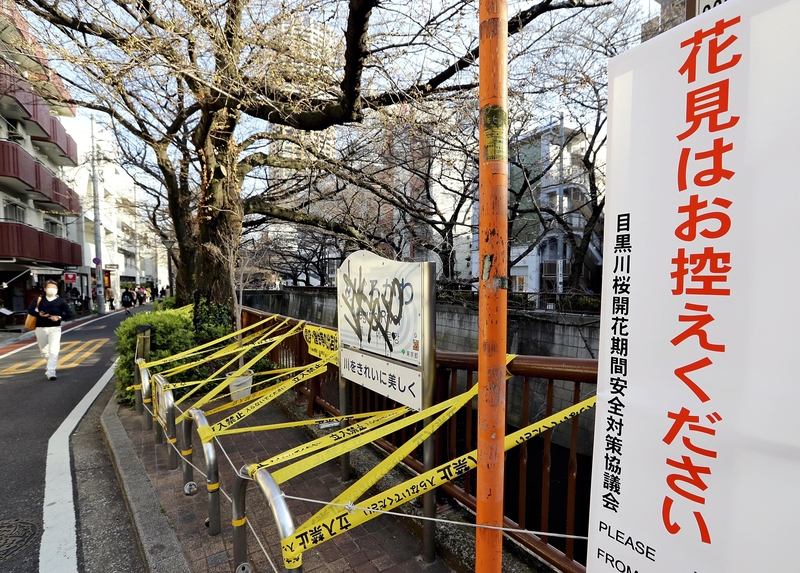
Spring is in the air and the coronavirus state of emergency will soon be lifted for Tokyo and three neighboring prefectures, but authorities are urging residents to refrain from – or at least minimize – taking part in the traditional custom of viewing cherry blossoms in public parks and gardens.
The blossoms are expected to burst into full bloom next week in the Tokyo metropolitan area, but authorities are becoming increasingly concerned crowds of people flocking to popular viewing spots could spark a rebound in coronavirus case numbers.
The cherry blossoms along the Meguro River in Meguro Ward, Tokyo, are a magnet for people who enjoy hanami flower viewing. However, signs erected on both banks of the river urge people to refrain from gathering there to admire the flowers, and yellow tape blocks off some areas that could be potential picnic sites. As a nearby resident picked up trash Thursday, he looked at the blossoms that had started flowering. "For at least 30 years, I've always looked forward to seeing these trees in full bloom each year, so it's a pity I can't do that this time," he said. "But the state of emergency will be lifted at the same time as the blossoms will be at their best, so it can't be helped."
About 800 someiyoshino, shidarezakura and other varieties of cherry trees grow along about four kilometers of the Meguro River. In recent years, images of the river blanketed in pink petals and other picturesque scenes have gone viral on social media. An estimated 3 million people visit this spot. However, in a video posted on the ward's homepage, Meguro Ward Mayor Eiji Aoki has strongly urged people to refrain from going to see the flowers.
-- Countdown to full bloom
Someiyoshino blossoms have started coming into flower earlier than usual in many areas this year. According to the Japan Meteorological Agency, the blossoms have started blooming at the earliest date ever in seven locations including Fukuoka, while Tokyo was among four places that equaled their record. Warm temperatures since February are thought to have accelerated the development of buds on the trees this year. Cherry blossoms in Tokyo are forecast to reach full bloom around March 25.
Yozaburo Shirahata, a professor emeritus at the International Research Center for Japanese Studies, said the origins of hanami in Japan go back at least 1,000 years. During the Heian period (794-1192), according to Shirahata, aristocrats would compose poems and do other activities while observing the blossoms. Hanami become a pastime enjoyed by the common classes in the Edo period (1603-1867).
"Many people getting together to eat and drink under the flowers is a unique element of Japanese culture and not seen elsewhere in the world," Shirahata explained.
-- Infection risk remains
Lifting the state of emergency has raised expectations in famed sightseeing spots that tourists will start to return. The Sakura-no-Sato Park at the foot of Mt. Omuro in Ito, Shizuoka Prefecture, will start illuminating cherry blossom trees from Friday. "I hope this will jump-start the local economy again," said a senior official of the Ito Tourist Association.
However, hanami parties bring a high risk of spreading infections. Some observers have pointed out that the long weekend from March 20 to 22 last year overlapped with the hanami season, which resulted in the coronavirus spreading. Such gatherings are expected to be banned and cherry blossom festivals canceled in popular viewing spots around Japan even after the state of emergency has been lifted.
Hanami picnics have been banned at parks managed by the Tokyo metropolitan government. Nets have cordoned off areas near cherry blossom trees at some parks, such as Ueno Park in Taito Ward, and Inokashira Park, straddling in Musashino and Mitaka in western Tokyo.
On Thursday, the Saitama prefectural government urged residents to refrain from picnics and parties while viewing the flowers at 30 prefecture-run parks and along riverbanks.
"We want people to enjoy viewing the blossoms as they walk along, and to avoid staying in one place for an extended time," a prefectural government official said.
Yasuhiro Kanatani, a professor at Tokai University, warned people to keep their guard up.
"Infections of coronavirus variants are increasing in Japan, so people need to remain careful in their daily lives," said Kanatani, an expert in public health. "If you wear a mask and maintain a distance of at least one meter from other people while you walk, it's absolutely fine to enjoy viewing the blossoms. But people should avoid eating while they walk, and having hanami parties or singing karaoke in large groups."
Read more from The Japan News at https://japannews.yomiuri.co.jp/