A plan under consideration by Prime Minister Shinzo Abe to review the broadcasting business includes a number of measures such as abolishing a provision in the Broadcast Law requiring political fairness, in a manner that would be damaging to the impartiality and public interest of broadcasting.
Careful discussion is vital on this issue as the plan may lead to lower trust in broadcasting.
A relevant debate was triggered at a meeting on Feb. 1 of the government's Council on Investments for the Future. "We must undertake bold reviews" on approaches to the broadcasting business as telecommunications and broadcasting converge due to technological innovation, Abe stated.
One of the provisions under review is Article 4 of the Broadcast Law, which requires a broadcaster to comply with such conditions as not harming good morals, being politically fair and not distorting facts. The prime minister is considering eliminating these provisions.
Abe appears to believe that deregulation of broadcasting will enable TV stations to freely convey views via such routes as the internet, thereby encouraging high-quality programs through competition.
However, the Broadcast Law demands that the quality of broadcast programs be maintained. The second paragraph of Article 4 also stipulates that a broadcaster shall establish as many programs as possible that enable visually impaired persons to listen to voices and that enable hearing-impared persons to see characters or figures. This provision assumes that broadcast programs are qualitatively different from video images distributed via the internet.
Without Article 4, the number of programs spreading extreme content or fake news may go up in a bid to attract more viewers, and the impartiality of reporting on elections may be damaged. In fact, a massive amount of fake news already swirls around when big incidents occur. There is even a risk that extremely explicit images of sex and violence would be broadcast.
Bias may increase
How would the planned law revision affect the credibility of broadcasters?
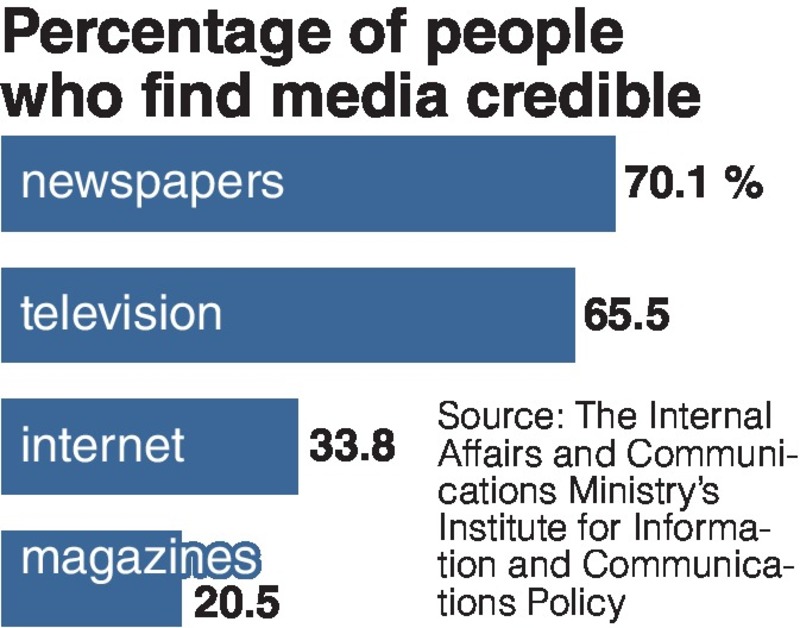
According to a survey conducted by an institute of the Internal Affairs and Communications Ministry about the credibility of media, about 66 percent of respondents said they trusted TV broadcasts -- the second highest next to newspapers with about 70 percent.
Internal Affairs and Communications Minister Seiko Noda also said at a press conference on Friday, "I am aware that broadcasters have steadily played their vital roles by independently editing programs within the framework of the Broadcast Law, including its Article 4."
In the United States, the Fairness Doctrine (see below) -- which requires broadcasters including TV stations to ensure political fairness and impartiality -- was abolished in 1987. As a result, biased reporting increased, which played a significant role in diminishing public trust in media.
Concern has been consequently spreading across the broadcasting industry itself. "If Article 4 is abolished, biased reporting would be encouraged and only congenial views might be broadcast," a person in the industry said.
TV stations make programs while possessing their own broadcasting facilities. Abe is considering separating these two sections to make it possible for a variety of businesses to broadcast their content by using the TV stations' facilities.
And yet, such separation may make it impossible to swiftly broadcast reports on disasters or emergencies due to delays in preparing such equipment as broadcasting vans. Under such circumstances, the people might never get access to key information to protect their lives.
Japan Commercial Broadcasters Association President Hiroshi Inoue expressed his concern at a press conference on Thursday, saying, "It would be a problem if a broadcasting van cannot be lent in an emergency on the grounds that it belongs to the company possessing the hardware [such as broadcasting facilities]."
--Fairness Doctrine
A regulatory policy set by the U.S. Federal Communications Commission to require broadcasters to ensure political fairness in their broadcasts. The policy was introduced in 1949, but was abolished in 1987 on the grounds that a diversification of media should be allowed against the backdrop of such factors as the spread of cable TV. After the abolishment of the doctrine, however, trust in broadcasters is said to have dropped as their competition for higher viewer ratings has intensified, boosting the popularity of programs making extreme arguments.
Read more from The Japan News at https://japannews.yomiuri.co.jp/