The public transportation system among other essential services that are necessary for the daily lives of residents will continue to operate in Tokyo even under a state of emergency, according to a plan compiled by the Tokyo metropolitan government.
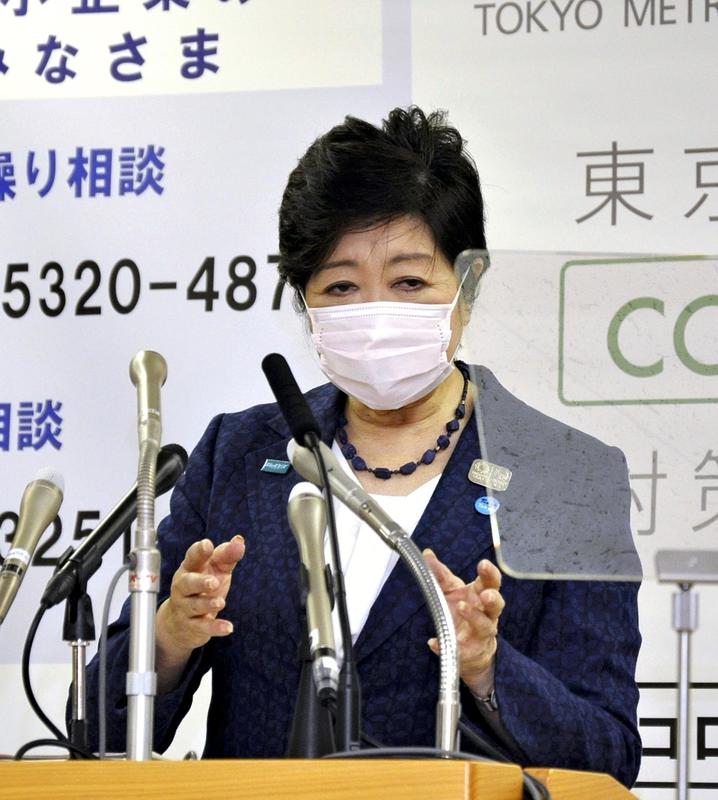
Tokyo Gov. Yuriko Koike, at a press conference on Friday, announced a plan to deal with the situation in the event the prime minister declares a state of emergency in response to the ongoing spread of the coronavirus.
The revised law, originally concerning special measures to counter new strains of influenza, has recently been enacted to cover COVID-19 infections as well.
If the prime minister issues a state of emergency under the revised law, the metropolitan government will ask Tokyoites to refrain from going out and to restrict or suspend the use of large-scale facilities and holding events. However, it will ask relevant services to continue to distribute and sell food and medicine, as well as financial institutions to continue their operations.
The metropolitan government plans to announce the contents of its measures in advance to prevent confusion among residents.
"Basically, [even under the special measures law], all I can do is to ask [the citizens to cooperate]. So, there won't be a case where transportation services completely stop," Koike said, asking the public to remain calm during this challenging time.
The prime minister will declare a state of emergency based on the government's basic policy advisory board if the following two conditions are met:
If there is (1) the possibility of serious damage to the lives and health of the people, and (2) the possibility that rapid or nationwide spread of the disease could significantly impact people's livelihoods and the economy.
Following the declaration, governors of designated areas -- based on the law -- will be authorized to call on residents to refrain from going out and instruct them to temporarily not use movie theaters or other large facilities where many people gather.
Koike has already requested people in Tokyo to refrain from going out on weekends for nonessential and nonurgent purposes and to restrict their outings on weeknights. If the declaration is issued, she will again request people in Tokyo to exercise self-restraint. Essentially, it will be the same as it currently is, but it will have legal grounds.
The metropolitan government will announce the types of facilities and events that will be subject to such measures when the central government comes closer toward making a decision to issue the emergency declaration.
After a state of emergency is declared, the governors will have the authority to expropriate drugs and other goods from companies, among other powers they will be allowed to exercise. However, they do not have the authority to ban people from going on unnecessary and nonurgent outings, suspend schools or ban the use of large-scale facilities.
The plan compiled by the metropolitan government also states that it is imperative to secure water, maintain sewage systems, electricity, gas and communications, in addition to public transportation services, to allow Tokyo to continue functioning.
"Tokyo won't be on lockdown the way other cities abroad are," said a senior Tokyo metropolitan government official.
Read more from The Japan News at https://japannews.yomiuri.co.jp/