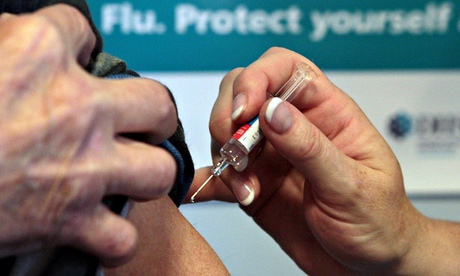
Public health officials have conceded that they have been aware for months that the current flu vaccine provides almost no protection against the main strain spreading around the UK.
The strain was first detected by the World Health Organisation last March. But Public Health England said it could not have developed a new vaccine in time to protect against the mutation, which is fuelling a rise in emergency hospital admissions and a death rate that is a third higher than normal.
The agency admitted that the flu vaccine issued this winter only provides “low protection” against the main strain of the virus spreading around the UK. The vaccine was estimated to work in just 3% of cases in lab tests, compared with a more typical past effectiveness of 50%. It said the problem was caused by a mismatch between the A(H3N2) influenza strain used to make the vaccine and the main A(H3N2) strain that has been spreading in the UK,
Nick Phin, director of the Centre for Infectious Disease at Public Health England, said officials have known about the mismatch between the strain in the vaccine and the new mutation since last summer, when it was detected in Australia. But he told BBC Radio 4’s Today programme: “We never know what strain is going to be hitting us.”
And he pointed out that it wasn’t until the beginning of December that “we started picking up problems with a mismatch ... in very low numbers. Unfortunately there is nothing we could do. The vaccine had already been produced.”
Phin added: “In Australia, a new variant emerged last summer that we found wasn’t a match with the vaccine.” But he said at that stage concerns that it would hit the UK was “pure speculation”. He also conceded that the WHO first detected the strain in March, but even that was too late to produce an effective vaccine in time for this winter. “Usually about 10 months before the flu season starts decisions are made about what should go into the vaccine, because it takes six or seven months to produce the quantities of vaccine that we would want to use.
“The recommendations made by WHO [on this season’s vaccine] came out in February. The manufacturers started work. It is a long lengthy process - five our six months. By the time we became aware of the extent of it there was very little that could be done.”
Phin said health officials faced a “perfect storm” in trying to combat the spread of flu this year because the emergence of the new virus is an H3 strain, which tends to affect older people, who are the most vulnerable group. He insisted that it was worth taking flu vaccines in future. “What happened this year is unusual,” Phin said. “This is the first time it has happened in a number of years to this extent. We recognise that we would like a better vaccine. One of the things that we do need to push for is a better vaccine, one that gives protection against a wider range of strains so that we wouldn’t see this situation again.”
John Watson, deputy chief medical officer, said: “The latest data show that levels of flu are generally decreasing in the UK. We do see ‘drift’ in the flu virus from time to time, but even so I want to reassure people that it is still the best overall way to protect yourself and your family from flu, along with good hand hygiene.
“Antiviral drugs are available and effective, and doctors should prescribe them for those at greatest risk of becoming seriously ill due to flu.”
The findings on the vaccine’s mid-season effectiveness were published on Thursday in Eurosurveillance, based on an analysis of 1,314 patients.