How to reduce the burden on public health centers on the front lines in responding to the novel coronavirus has become an important issue in coping with the pandemic.
On Friday, the Tokyo metropolitan government opened a telephone consultation center that will take over from public health centers in dealing with inquiries from people with fever and other signs they might be infected.
As health centers may be faced with even more work during the autumn and winter flu season, experts have called for proactively creating systems to support them.
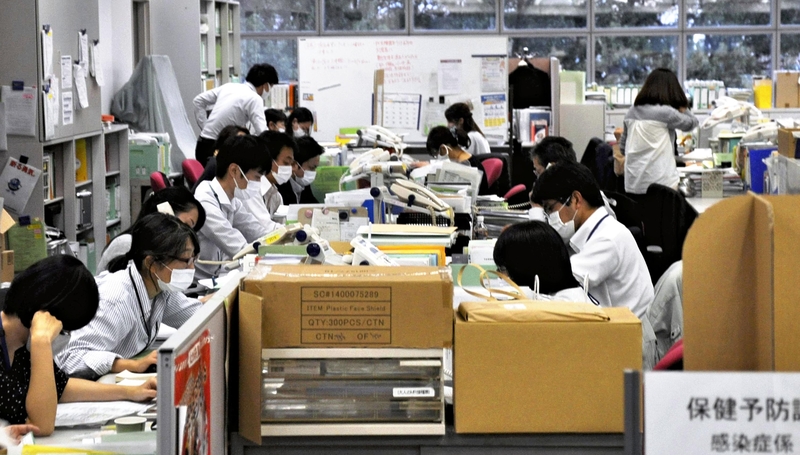
"The number of new infections has stayed high, with two to nine cases confirmed every day in Sumida Ward. We are busy even on Saturdays and Sundays. I don't feel the amount of work has gone down," said Itaru Nishizuka, director of the ward's health center.
The ward's health center has about 30 employees, whose jobs include coordinating hospital stays for newly infected coronavirus patients, contact tracing and providing guidance on PCR testing for close contacts.
Telephone consultations are another one of these tasks. While the number of consultations has dropped compared this spring's first wave, in many days in September the center received about 180 calls. Even now they get about 30 per day.
Consultations involve matters such as referring people to medical institutions that can accept people with fevers who may be infected.
Centers also get calls from people who received notifications from the central government's contact tracing app COCOA. A health center in the Tama region of Tokyo said it often got about 300 calls per day in September, more than 20 percent of which were COCOA-related.
The metropolitan government's new consultation center will take over dealing with these calls from public health centers.
The new center will serve people such as residents of Tokyo who do not have regular doctors and people who are working in or visiting the capital. A staff of up to 30 public health nurses, nurses and others hired by a subcontractor will be available 24 hours a day.
Nishizuka welcomed the metropolitan government's new consultation center. "I hope it will reduce our workload," he said.
Tokyo is also trying to increase the number of "public health doctors" who the metropolitan government hired all at once and are assigning to posts such as directors of 31 public health centers.
According to the metropolitan government, there has been around 120 such doctors over the past few years, but even before the pandemic they had been unable to meet a target of about 170 doctors. The pandemic is said to be negatively affecting working environments by normalizing practices such as overtime and coming in on days off.
"If there is a flu outbreak, the burden on public health centers could grow even heavier," a senior metropolitan government official said. Starting in November, the metropolitan government plans to hire about 100 more public health nurses, nurses and others, and to train people to conduct contact tracing and other tasks.
The Health, Labor and Welfare Ministry has asked prefectural governments and other entities to set up phone consultation centers. Ishikawa Prefecture's center began taking calls Friday. Centers are scheduled to open in Saga and Nagasaki prefectures.
-- Training crisis managers
Hamamatsu University School of Medicine Prof. Toshiyuki Ojima, an expert on public health who has served as the director of a public health center, discussed the role of public health centers going forward.
"It is important to create reliable relationships between public health centers, municipalities and the staff of medical institutes, as well as with educational and research institutions such as universities," he said.
He added that human resources needed to be developed inside and outside public health centers who can respond to crises such as infectious diseases like the novel coronavirus.
In the first wave of the pandemic, the central and metropolitan governments dispatched staff to public health centers in Tokyo's special wards, but the assistance did not go smoothly in some cases.
However, Teikyo University dispatched professors specializing in public health and their students to Kita Ward's health centers through a partnership agreement with the ward. They helped investigate clusters and prepare statistics to reduce the burden on health center staff.
On Thursday, the government's subcommittee on the new coronavirus proposed creating a support system in which the central government, prefectures and academic societies would work together to establish a framework for dispatching specialists such as public health nurses.
"If infections become serious again, in many cases the prefectures will probably take the lead in coordinating hospitalizations. But even if that happens, it's essential to explain to public health centers and others why this was done," Ojima said. "It is important to listen to the voices of the people on the ground to find a landing point."
Read more from The Japan News at https://japannews.yomiuri.co.jp/