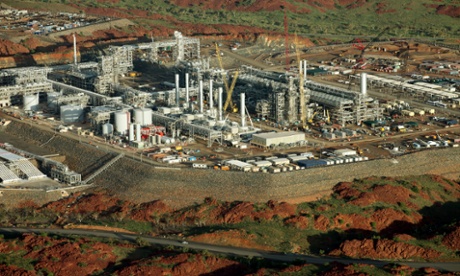
The opening of the eastern gas market to export is set to cause massive ructions to Australia’s economy. But while standard theory would suggest the LNG boom will be a win for our economy, the reality of poor taxation policy and a lack of a carbon price suggests the benefits may not be as big as might be hoped.
For decades now – perhaps ever since Gough Whitlam reduced tariffs across the board by 25% in July 1973 – free trade has been viewed as an economic good. The argument has always been that while it may hurt some businesses, the increased competition produced more efficient and productive businesses, and also lower prices for consumers.
The opening up of the eastern gas market to international markets will have a counterintuitive result of causing gas prices to rise due to increased competition. As I have written recently, this is because the Japanese market price for LNG at between US$15 and US$17 per gigajoule (GJ) is well above the $4 per GJ price here in Australia:
Accounting for freight and conversion to and from LNG would mean the domestic gas price will rise to around $9 per GJ once LNG begins being exported via Gladstone to Japan and the rest of Asia. This means high gas using households in Victoria for example could see their gas bill increase by over $400 a year.
Despite this massive increase in gas prices, free trade proponents argue the government should resist altering the gas market either by imposing export restrictions of a reserve price for domestic gas.
This week the Grattan Institute, which has published a number of papers on the changing gas market, released another report arguing that the economic benefits from unfettered export of LNG massively outweigh the cost of higher gas prices for domestic users.
Its report, “Gas at the crossroads: Australia’s hard choices” is aimed squarely at the federal and state governments, arguing that “the emerging export industry will deliver overwhelmingly positive economic benefits for Australia”. It suggests that governments should “resist” the pressures from unions and business groups to “protect Australian industry and consumers from the price rises”.
But while the report perhaps passes muster according to the economic textbook, the caveats within the report may cause us to wonder whether we in the real world will receive such benefit.
First is the profitability of the industry itself. The LNG market is closely tied to the oil price. A recent report from Bloomberg suggests that the recent slump in oil prices could be a “disaster” for some LNG projects.
In the past couple of months world oil prices have slumped due to the US increasing production and a general lack of demand due to the weak European and less than stellar US and Chinese economies. Since June the price for Brent Crude, which is the world benchmark for oil, has fallen by over 23% from US$111 a barrel to around US$85 a barrel:
Although Origin Energy has told its shareholder that it needs a price of $55 a barrel to make a profit, some analysts suggests anything under $80 a barrel starts making the profit margins tight on new LNG projects.
The connection with oil prices is also a factor in the benefits an LNG export boom might bring the rest of the economy.
While certainly a large increase in LNG exports would see companies’ profits increase, the industry itself is not expected to be a major driver of employment.
In March, The Australia Institute reported that “the entire oil and gas industry employed just 20,700 people”. It put that figure into context by noting “hardware retail company Bunnings employs 33,000 people”.
Moreover, the Grattan Institute report cites a study by Deloitte Economics that found an increase in gas prices could cost “more than 14,500 full time equivalent jobs” in manufacturing and other industries by 2021.
So while gas company shareholders will be happy, there is doubt that this boom will lead to more jobs elsewhere and crucially, even more doubt it will lead to an increase in government revenue.
And this is a crux of the Grattan Institute’s assertion about the benefits. It notes that “the argument that Australians have more to gain from trading LNG than they have to lose from higher prices assumes that appropriate tax and transfer systems are in place”.
However, one problem is that the mechanisms for companies being liable for the Petroleum Resource Rent Tax (PRRT), which includes coal seam gas, is linked to the oil price. In 2012 some gas companies suggested the oil price would need to be $150 a barrel before they would be liable to pay the PRRT on the new gas projects.
Certainly the May budget did not anticipate any major boom in PRRT revenue:
The Grattan Institute paper argues “governments need to ensure that the public really does benefit by levying the appropriate taxes and royalties on LNG exports”. That’s a nice view, but given the current governments view toward mining taxes, it is little more than a gas pipe dream.
The paper is also rather blithe on the environmental impacts.
It finds that if “half of the electricity produced from gas in 2012-13 had been produced from coal, Australia’s emissions would have been more than 15 million tonnes higher”. It notes that as a general rule gas is more expensive than coal to produce electricity, and that if gas wholesale prices were to rise it is likely that coal powered electricity would become more common.
But the report also notes that “with a carbon price of $30 a tonne of CO2 or higher, existing gas plants would be more competitive than existing coal plants. But if gas prices increase by $5 a gigajoule, gas would not be favoured over coal, unless the carbon emissions price were $70 a tonne or more, an implausible figure at present”.
Small problem though: we don’t have a carbon price anymore.
And the gas industry as you would expect is only interested in reduced emissions if it occurs through gas production. The peak lobby group for electricity transmission and gas distribution, Energy Networks Australia has recently been arguing against subsidies for solar panels, suggesting that the solar industry is big enough to “stand on its own feet”.
But as the Grattan Institute report states, the gas industry itself has been a large benefactor of government subsidy such as the $100 million “Energy for the Regions program” which subsidised the expansion of gas networks to parts of regional Victoria.
There certainly are benefits to the nation from the expanding LNG industry but if, as the Grattan Institute concludes, “all Australians have the right to share in the bounty of our natural resources”, a lot more needs to be done.
Without a taxation regime that ensures the benefits of the LNG can be shared – and also used to alleviate the cost to households – and without a price on carbon, it is doubtful the benefits of an LNG boom are going to flow through as well as the free market theory would have us believe.