The social club
How often do you share on Facebook? Research shows that 39% of online Brits share something on social media at least once a week, with this increasing to 63% for Generation Y. In fact, if you are a social sharer you are more likely to do it once a week than less so (source: nVision, 2014).
Globally, social drives around a third of website visits, with Facebook the dominant referrer and the majority of their referrals coming via a mobile device (source: Shareaholic via Statista, 2014). It doesn’t come as a surprise to anyone that social is hugely important for publishers in building an audience, but is it a useful measure for tracking audience engagement with content? Chartbeat don’t seem to think so and have pointed out several times that sharing and reader engagement are not that strongly correlated. More on this later.
The dark side of social
But there is more to sharing than the endless cat GIFs and arbitrary lists that you see on your Facebook feed. According to RadiumOne, nine in ten UK consumers who share, do so through “dark social” channels, with a quarter saying they only share this way. Globally, dark social sharing accounts for more than double all Facebook and public sharing combined (source: RadiumOne, 2014).
Dark social represents any web traffic that comes from outside sources that web analytics cannot track, such as things like links in emails, forum posts and messenger apps. It’s a more personal form of sharing; spreading things one-to-one or with small groups rather than all your Twitter followers. Therefore giving readers the option to share this way, as well as understanding the reasons behind why a consumer chooses to share in this way is as important, if not more so, than promoting and recognising motivations for public sharing.
Motivation to share
This has been fairly well researched for public sharing already but I was keen to see if there were any differing factors in the motivation behind public and personal sharing among Guardian readers.
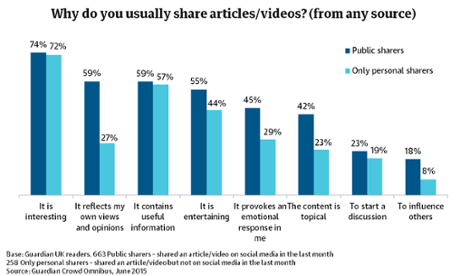
Whether public or personal sharing, the content being interesting is the biggest driver for Guardian readers. Yet Guardian readers who only share personally feel far less strongly that the content needs to reflect their own views and opinions, or that it needs to be topical.
Does sharing equal engagement?
Social interaction is often used to demonstrate a content campaign’s effectiveness, by suggesting any content worth sharing is engaged with more than normal by the reader. So if Chartbeat have reported poor correlation between sharing and reader engagement, perhaps social metrics aren’t that useful after all?
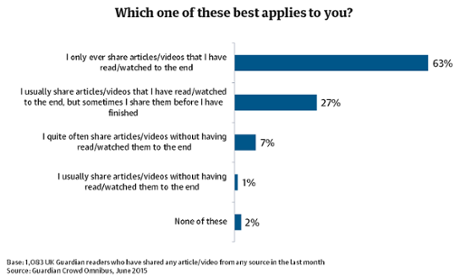
However Buzzfeed has identified a link between Facebook sharing and reader engagement, reporting that on average users that share spend 68% more time on page the than users that do not share. Additionally 63% of Guardian sharers say they only ever share articles/videos from any source that they have read/watched to the end (of course we have to be wary of claimed versus actual behavior here).
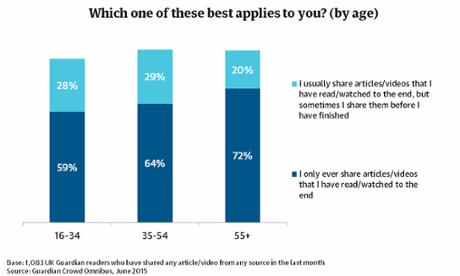
When we look at this by age, the older the Guardian’s sharing audience get the more likely they are to finish content before sharing it.
Despite conflicting opinions on the subject I still think that social sharing is a useful measure when evaluating content success. It’s a good predictor of audience amplification, and therefore reach. Data from Buzzfeed shows that their sharers spend longer with content and this is something Guardian claimed data would concur with. I think sharing is indicative of higher than average engagement with content, but publishers need to understand the drivers behind dark social better to serve the needs of their readers.