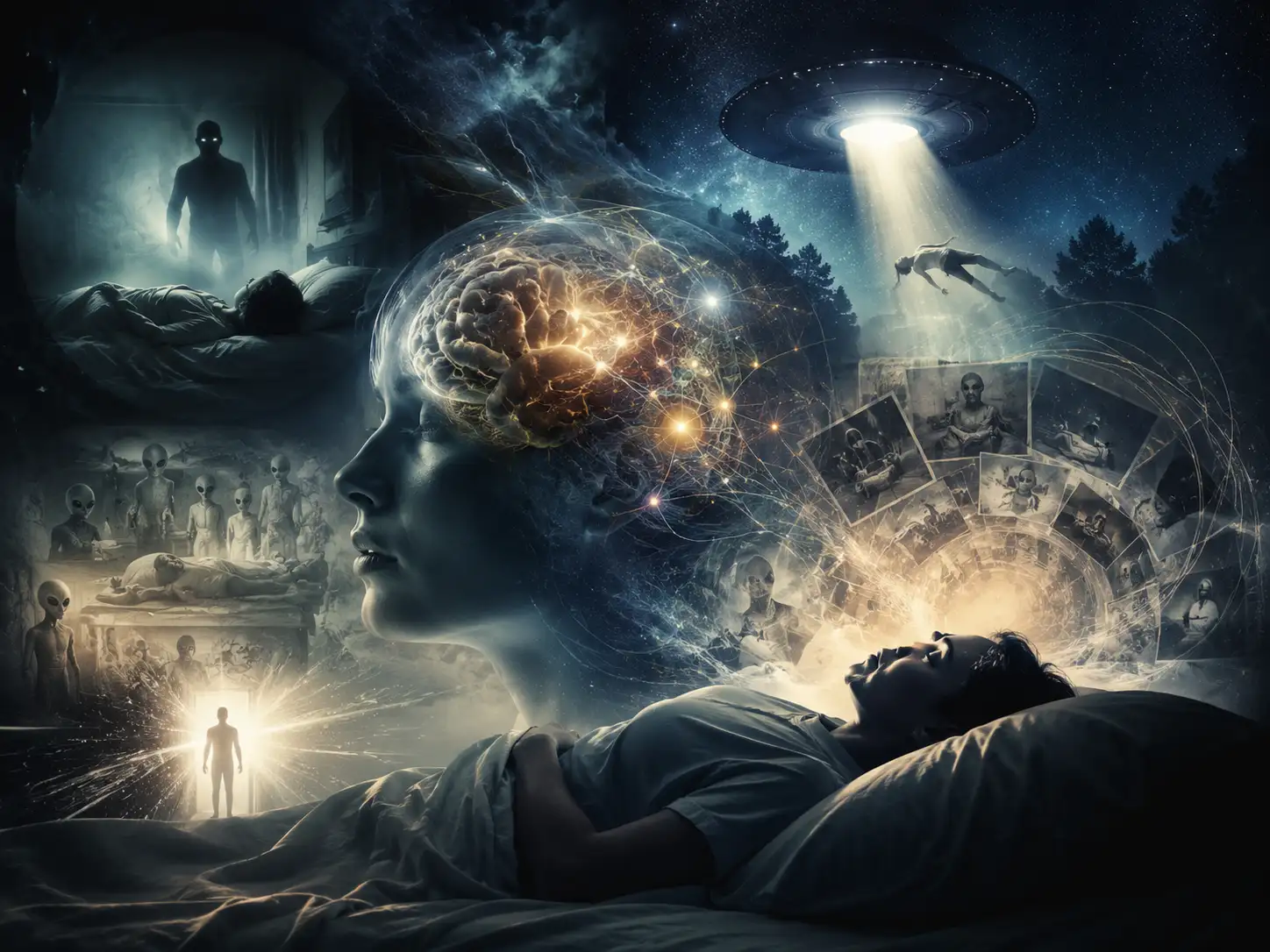
Across the world, thousands of people describe strikingly similar experiences: waking up unable to move, sensing a presence in the room, seeing shadowy figures, or even believing they were taken aboard a spacecraft. These accounts often sound unbelievable at first glance. Yet psychological research suggests something more nuanced than “truth or fabrication.”
Instead, scientists studying these experiences argue that the human brain can generate events that feel completely real, even when no external event is happening, especially in certain sleep states, memory conditions, and personality profiles.
A key line of research comes from the work of psychologist Christopher C. French and colleagues in their study “ Psychological aspects of the alien contact experience” , who have examined people reporting alien contact experiences and compared them with control groups.
When the brain creates “real-feeling” experiences
One of the strongest findings from research on so-called “experiencers” is that they are not randomly imagining things. Instead, they tend to score higher on a cluster of psychological traits that shape how strongly internal experiences feel real.
In the study, experiencers showed higher levels of absorption, meaning they can become deeply immersed in mental imagery. They also scored higher in dissociation, where attention, memory, or awareness can feel partially separated, and fantasy proneness, which reflects a naturally vivid imagination that can feel lifelike rather than purely imagined.
Alongside this, researchers also found higher levels of paranormal belief, self-reported psychic experiences, and even a greater tendency to report hallucination-like experiences in daily life. Importantly, these are not signs of deception. They describe differences in how the brain processes and organizes experience.
What stands out is that these traits overlap. People who score high in one often score high in others, creating a cognitive style where internal experiences can feel unusually vivid and externally sourced.
Memory isn’t a recording device, it’s a reconstruction system
A major piece of this puzzle comes from false memory research. Psychologist Susan A. Clancy and colleagues in their 2002 study “ Memory distortion in people reporting abduction by aliens”, used a laboratory method called the Deese–Roediger–McDermott (DRM) paradigm to study memory distortion.
In this task, people are shown lists of related words designed to trigger a missing “theme” word that was never actually presented. Later, many participants confidently “remember” the missing word as if it had been shown.
Clancy’s research found that individuals reporting alien abduction experiences were more likely, on average, to form these kinds of false memories in controlled conditions. This does not mean they are imagining alien encounters out of nowhere. Instead, it shows that memory can be constructive rather than literal, especially when people try to make sense of fragmented or unusual experiences.
Memory, in other words, is not like a video recorder. It is more like a storytelling system that fills in gaps using expectation, emotion, and suggestion.
Sleep paralysis: the strongest scientific link to alien encounters
One of the most widely supported explanations for alien abduction experiences is sleep paralysis.
This occurs when a person becomes conscious while still in a REM sleep state. During REM sleep, the body is naturally “paralyzed” to prevent acting out dreams. If awareness returns before this paralysis switches off, the person is awake but unable to move.
In this state, the brain can generate extremely vivid hallucinations.
People commonly report:
- Being unable to move or speak
- A heavy pressure on the chest
- A sensed “intruder” in the room
- Shadowy figures or beings
- Loud noises or voices
- Floating or out-of-body sensations
- Intense fear
The key psychological insight is not just that sleep paralysis produces hallucinations, but that the brain tries to interpret them. In cultures influenced by modern UFO narratives, the interpretation may become: “I was taken by aliens.”
Why the brain confuses imagination, dreams, and reality
A central theory here is reality monitoring, developed by Marcia K. Johnson and Carol Raye.
Reality monitoring refers to how the brain decides whether a memory came from:
- Something actually experienced
- Something imagined
- Something dreamed
- Something suggested later
When this system is highly accurate, we rarely confuse imagination with reality. But under certain conditions, like vivid dreaming, strong emotional states, hypnosis, or fragmented sleep, this distinction can weaken.
In such states, the “source label” of a memory can become blurred. What began as a dream or hallucination may later be stored as a real event.
Why aliens specifically? Culture shapes interpretation
Another important idea is cultural scripting. The core idea is simple: when people experience something unusual and confusing, they interpret it using the cultural narratives available to them.
In earlier centuries, similar sleep-related or dissociative experiences were often interpreted as:
- demons sitting on the chest
- witches or spirits visiting at night
- religious visions or possessions
In the modern era, the dominant cultural framework is science fiction and UFO lore. So the same raw experience, sleep paralysis, hallucination, or vivid dream intrusion, may be labeled as alien contact.
The experience itself may not change much. What changes is the story the brain builds around it.