Football’s Twitter crowds drummed their global fingers in boredom towards the close of the 2015 winter transfer window but, while there was no last-day rush for thrill-seekers, clubs’ spending finally reached around £130m, fairly normal for this time of year. The perception of it being particularly quiet is partly due to the hazy memory of January as a time of frenzy which stretches back four years now, to the barminess of 2011.
That final day, when Chelsea signed Fernando Torres for £50m from Liverpool, thereby releasing the famous helicopter to buzz Andy Carroll to Anfield from Newcastle for the forever extraordinary £35m, now prompts red faces all round. Chelsea made the headline signing this deadline day, paying a significant £23.3m for the Colombian winger Juan Cuadrado, but maintained their recently-minted practice of lucrative selling by moving André Schürrle to the Bundesliga’s upwardly mobile Wolfsburg for £24m and Ryan Bertrand to Southampton for another £10m.
Chelsea epitomised flash spending in the first years of Russian-oligarch ownership, but now embody a craftier reflection of Roman Abramovich’s style, with “partner” clubs like Vitesse Arnhem, and the accusation they hoard players to sell to balance the books.
While hefty spending has continued to stay in step with the Abu Dhabi oil fortune lavished on Manchester City, Abramovich’s lieutenants have recouped £163m in the past year from the sale of seven players including Schürrle, Bertrand, Demba Ba (£8m), Kevin De Bruyne (£18m), David Luiz (£40m), Romelu Lukaku (£28m) and, the deal which made last January’s a box-office final day, Juan Mata, £37m to Manchester United. Meanwhile Torres, putting an end to his strange and sorry Chelsea story, completed his move to Atlético Madrid this month, for nothing.
It was no great surprise at United that after last year, and the record £150m summer splurge to belatedly compensate for Sir Alex Ferguson’s exit, this month was a time of allowing excess players to leave, including Wilfried Zaha to Crystal Palace permanently and Darren Fletcher, after 362 man-and-boy appearances, to West Bromwich Albion.
United’s flurry of summer signings, cracking years of relative restraint for the Glazers enabled by Ferguson’s genius, and the overall record of a vast £835m spent by all clubs, provides the context for this quieter January.
City, after £50m made available for Mark Hughes in Sheikh Mansour’s first transfer window six years ago, have resisted febrile January deals, apart from 2011 when buying Edin Dzeko for £27m from Wolfsburg. So the purchase of Wilfried Bony to strengthen a strikers roster including Dzeko, Sergio Agüero (who cost £38m) and Stevan Jovetic (£22m), was a statement of intent, to catch Chelsea in the Premier League and not to be intimidated by Uefa’s financial fair play sanction.
That £25m signing of Bony, the biggest deal of the window, also reinforced the Premier League’s financial disparities, leaving a major hole at Swansea City, who are recognised to be well run but remain a selling club at the right price.
Since the Andy Carroll £35m in its first transfer window, John Henry’s Boston-based Fenway Sports Group has sought to align Liverpool’s spending more recognisably to its reputation for Moneyball value-analysis, which was better characterised by signing Luis Suárez, on the same final day as Carroll, for £17.2m less. Anfield sceptics are yet to be convinced, however, and will not be greatly cheered by the lack of activity this month.
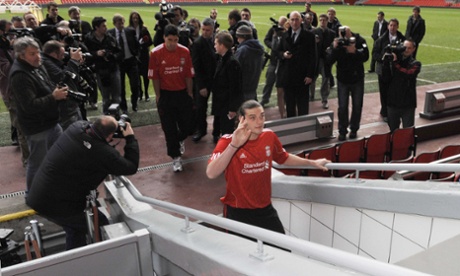
Arsenal, quietly, reinforced their defence with the £11.3m signing of Gabriel Paulista from Villarreal, while elsewhere, not too much happened. The exceptions were for new managers: Crystal Palace stocking the training ground for Alan Pardew, and Palace’s former manager, Tony Pulis, spending £4.5m on Callum McManaman from Wigan as well as acquiring Fletcher’s drive.
January two years ago was entertained by Queens Park Rangers, already odds-on doomed to relegation, splashing £20m on Christopher Samba and Loïc Rémy in a vain hope of newly appointed manager Harry Redknapp keeping them up. This time, although second from bottom, QPR, threatened with a huge fine from the Championship for spectacularly overspending financial fair play limits when winning promotion last season, desisted. Hull City did land Dame N’Doye from Lokomotiv Moscow for £3m and saw Tom Ince leave on loan for Derby, but panic was eerily absent from Burnley while Leicester City paid £9m for Andrej Kramaric, a 23-year-old Croatia striker, to boost their chances of staying up.
Overall, there is a sense of the Premier League clubs managing themselves more prudently, perhaps nudged by financial fair play rules now in force in their own league as well as Uefa’s. But spending over 2014-15, during this greatest ever £5.5bn TV deal from 2013‑16, is huge, almost £1bn. What should not be missed, beneath the headline arrivals, are all the exits, permanent or on loan, of young players, mostly British, for whom there is no room in England’s modern top flight.