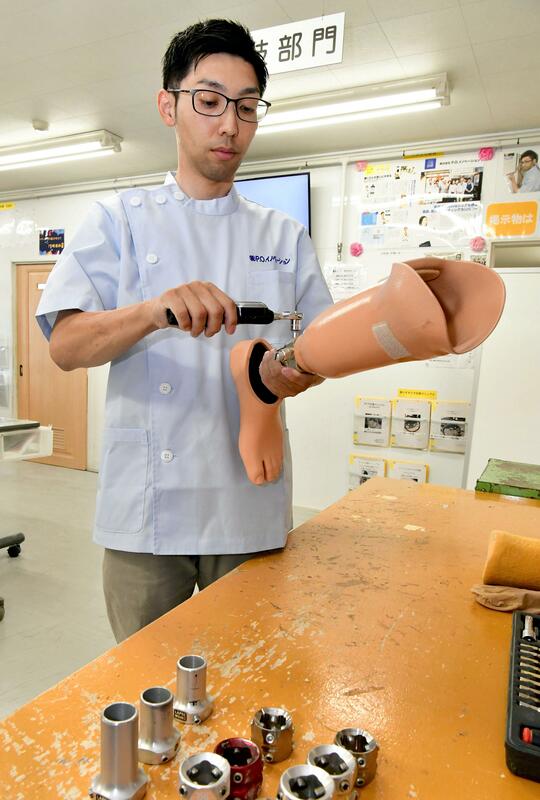
About 100 prosthetists are on hand to make repairs, and provide adjustments and maintenance for artificial limbs and other orthotic devices for athletes participating in the Tokyo Paralympics -- free of charge and with millimeter-level precision.
"I want to do my best to help the athletes reach their full potential," said Masakatsu Nakashima, 32, a prosthetist from Kitakami, Iwate Prefecture, who was dispatched to the event for the first time.
The repair service center at the Olympic Village and repair booths at venues have been operated by Ottobock SE & Co., a German medical and welfare equipment maker, since the 1988 Seoul Games. From Japan, 14 prosthetists are joining the team at the Tokyo Games.
Nakashima was assigned to the Games team from P.O. Innovation, based in Hanamaki, Iwate Prefecture, a prosthetic device manufacturing and sales company where he works, as he can repair all types of prosthetic legs, orthotics and wheelchairs.
He began to aspire to a career in social welfare when he was a junior high school student. Nakashima remembers that a prosthetist welcomed him with a smile after he injured his back playing baseball, and asked him to make a mold of a support corset for him.
Wanting to help other people, he left his hometown in Miyako in the prefecture and went to the Niigata University of Health and Welfare in Niigata Prefecture to obtain a national qualification as a prosthetist.
After graduating, he returned to Hanamaki, because he wanted to work in a town that was hard-hit by the Great East Japan Earthquake.
When he was a young and inexperienced prosthetist, he made an artificial leg for a man who had lost his leg to an illness. Nakashima said he still remembers how the man's expression changed after seeing it, saying, "Now I can go home."
That impression remains engraved in his mind to this day. When seeing patients walk out of the hospital with prosthetic legs, he feels relief that he was able to help them return to society.
Making and maintaining a prosthetic limb is a process of communicating with the user and making sure that the user is truly satisfied. In the Paralympic Games, detailed adjustments are required until the athletes are satisfied.
"There is only a limited amount of time for the Games, and there may be [prosthetic or orthotic] parts they have never seen before. They have to communicate in a foreign language. There will be many hardships, but I hope they will gain experience through hard work," said Taro Kenmoku, the president of P.O. Innovation.
"I feel a lot of pressure because prosthetic devices can affect the athletes' whole careers," he said. But he intends to carry on as usual in a natural manner. "I want to give back to the ordinary users in Iwate Prefecture what I have learned from the Paralympics," he said.
Read more from The Japan News at https://japannews.yomiuri.co.jp/