ORLANDO, Fla. _ The government rested its case Thursday against Noor Salman, the widow of Pulse gunman Omar Mateen, amid a contentious debate over whether prosecutors had withheld evidence from Salman's defense and U.S. District Judge Paul Byron.
The judge scolded prosecutors after an FBI agent testified that he knew within days of the Pulse massacre that cellphone data contradicted Salman's claim to FBI agents that she had driven around the nightclub with her husband prior to the attack.
"I've heard many, many times the drive around Pulse nightclub had occurred," Byron said.
Specifically, Byron took issue with a motion the government had filed in March 2017, two months after Salman's arrest, seeking to have her bail revoked. Byron ultimately granted that request.
The motion noted that Salman "admitted to law enforcement that she went with her husband to Orlando and drove around the Pulse night club prior to the attack."
But according to the testimony of FBI Special Agent Richard Fennern on Thursday, the government by then would have known for some time that digital evidence _ including data from the smartphones of both Salman and Mateen _ suggested the two did not visit Pulse on June 8, 2016.
The revelation prompted Salman's defense team to request a new bond hearing _ even as her trial is nearing its end.
"The government was well aware that the defendant never scouted out the Pulse," defense attorney Fritz Scheller said. "That was a critical part of their argument."
The judge denied the bond request in court, but said the defense lawyers were welcome to submit it in writing for his review: "I don't know if that rises to the level of reconsidering bond," Byron said. "If you want to do that, file a motion, I'll consider it."
The defense also suggested prosecutors may have violated rules requiring them to hand over exculpatory evidence. Assistant U.S. Attorney Sara Sweeney said the government gave Salman's defense an FBI PowerPoint presentation with all the relevant cellphone data on Aug. 1, 2017.
But by then, defense attorney Charles Swift said, he had spent thousands on his own tech expert to prove the same thing.
"I'm funded by a public entity, and I spent a lot of money on this. And the government knew," Swift said. " ... I had to spend money from people who give money to civil causes."
Swift cited the bill for the technology expert at about $7,000, and said he'd been paying the expert about $300 an hour through Thursday and was expecting he'd testify next week. Byron seemed open to granting Swift the money from the government if he asked for it, but didn't rule on it.
The claim that Salman had cased Pulse with her husband came from statements Salman gave to FBI Special Agent Ricardo Enriquez in the hours after the June 12, 2016, attack at Pulse. The statements, which were not recorded but Enriquez transcribed, are a key piece of evidence in the trial _ a confession, prosecutors say, that Salman knew her husband had been planning mass murder.
Salman reportedly told investigators that, after a June 8 visit to Disney Springs with their son, Mateen drove her around Pulse _ and spoke about his plans to attack the club.
"We drove around the Pulse night club for about 20 minutes with the windows of the car down," Salman told Enriquez, according to his transcription. "Omar was driving slowly, looking around and at one point stated 'how upset are people going to be when it gets attacked.'"
But Salman and Mateen's cellphones did not go near Pulse that day, Fennern said. There are records of them at the Florida Mall, at a falafel restaurant, and at a Kissimmee mosque. Most of their time is accounted for with receipts and cell records.
It's "highly unlikely" that they had time to drive into downtown Orlando, Fennern said.
"Her phone had never been near the Pulse nightclub," he said.
In court, but outside the presence of Salman's jury, Byron said he was "very concerned by" Fennern's testimony about when the FBI learned about the cellphone data. However, he took no action against the government, though he said the issue would come up again.
"I think I've kicked the beehive," Byron said, seeing a flurry of activity in the courtroom after he asked why he hadn't been informed. " ... That's all I wanna say, we'll take this up another time."
Earlier, Fennern testified about how he was asked, after the attack on Pulse, to trace the digital trails of Mateen and Salman.
He started with the moment Mateen entered the nightclub June 12, 2016, and worked backward.
He put together bank records with cell tower records showing their approximate locations with surveillance video from Disney Springs, Walmart, and the St. Lucie Shooting Center, and connected it to the written statement Salman gave an FBI agent in the hours after the attack.
Salman's interviews with the FBI were not recorded. Enriquez has said he wrote her words down and then asked her to initial each paragraph to confirm his writing was accurate. So confirming the information on the written statements is vital to prosecutors.
Jurors watched video Thursday of Salman standing next to her husband as he purchased ammunition at a Walmart store.
Their son _ who was 3 when Mateen opened fire inside killing 49 people and injuring dozens more _ was also there as Mateen made the purchase. Jurors saw the boy slide a Paw Patrol toy onto the checkout counter.
Assistant U.S. Attorney Sara Sweeney handed jurors copies of the written statements Salman gave Enriquez on June 12. Fennern read portions of it aloud.
"I knew Omar was preparing for Jihad when he bought the rifle, was going to the range to shoot, was spending a lot of money and bought the ammunition," the statement read. "I saw these things as a green light for Omar to do an act of violence."
Fennern also took jurors through some of Mateen's actions the day before the attack. That morning, he withdrew more than $4,000 from PNC bank. Throughout the morning, he was conducting online searches, including for the FBI and the website Jihadology.
The first witness up Thursday was FBI Special Agent Steven Boyce, who had taken the stand Wednesday afternoon to discuss Mateen and Salman's online search histories, Salman's cellphone records, and activity on the couples' Facebook accounts.
Defense attorneys will likely start calling witnesses Monday morning. The case is expected to go to jurors next week.
Salman is accused of aiding and abetting Mateen's material support of a foreign terror organization, the Islamic State group, also known as ISIS. She is also charged with obstruction of justice. If convicted, she faces the possibility of life in federal prison.
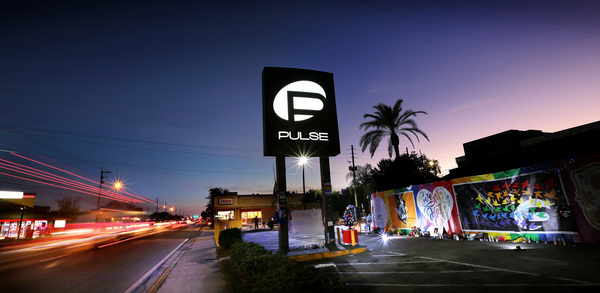
Mateen killed 49 people when he started shooting at Pulse, a gay nightclub south of downtown Orlando, on June 12, 2016. Jurors on Wednesday heard from his mother and sister, who said they never heard him talking about committing an act of terrorism, and from salespeople from whom he and his wife bought electronics, clothing and jewelry in the week before the attack.