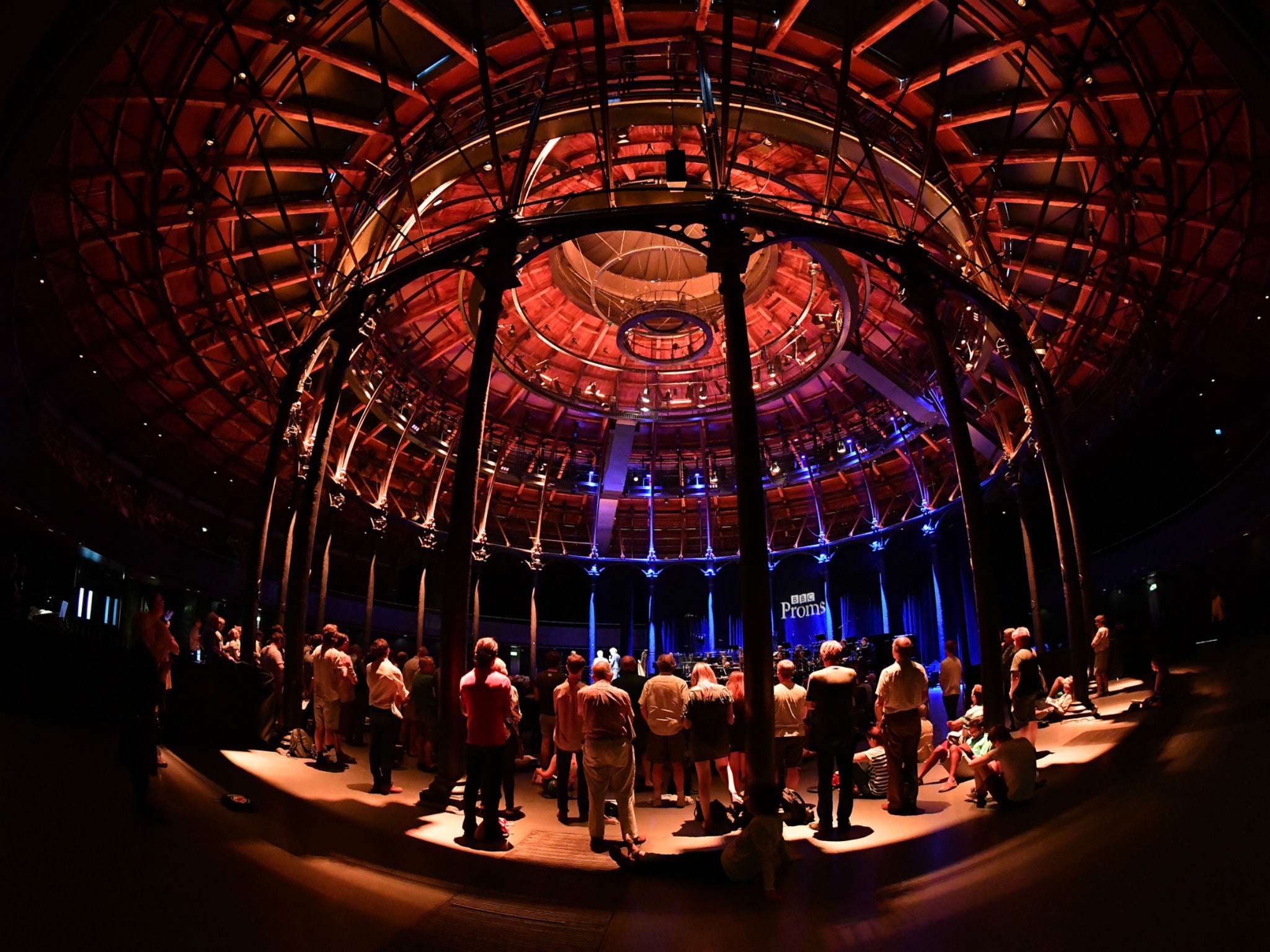
Nice to see the Roundhouse pressed into service for the Proms, this time for yet another concert commemorating the end of the First World War. Where would the Proms be without anniversaries to hang them on? They would certainly be different, and might be more interesting.
This concert consisted of three great works from the orchestral canon, and four new commissions from composers who strangely didn’t rate even minimal biographies in the programme book. It’s a fair bet that most in the audience would not have known the work of Georg Friedrich Haas, Hannah Kendall, Isabel Mundry, and Luca Francesconi – if indeed they even knew their names. But it’s always the same with the programmes for those Proms which take place outside the Royal Albert Hall: they’re seen as not quite kosher, and corners are cut.
Haas has an ultra-refined ear and a taste for compositional intricacy, and so it was with his new work the last minutes of humanity, whose dialogue was drawn from Karl Kraus’s drama of wartime savagery, The Last Days of Mankind. Susan Bickley sang the German words with appropriate fury, but how much more effective they would have been in an English translation; as it was, their visceral power to shock was largely neutralised.
Hannah Kendall’s Verdala, which commemorated the loss at sea of 600 Jamaican soldiers, was equally intricate, with the woodwinds expressing distress and anguish over a sorrowing plucked bass. Isabel Mundry’s Gefallen was the setting of a poem by August Stramm who was killed in action in 1915; the laconic pathos of the words was poignantly echoed in the wild plaints and abrupt outbursts of the instruments.
Luca Francesconi’s We Wept was a setting of some verses by a female driver-mechanic in 1917 whose emotional power stood in inverse proportion to their brevity: "We wept. Well, do you know, strangely enough/ Because the silence was so awful." Here the music brought that dread silence chillingly to life, as though the shocked earth were awakening out of a nightmare.
Under George Benjamin’s baton, the London Sinfonietta dealt with these demanding new works as though they’d had months to prepare, and for the great war-memorials in sound which formed the backbone of this Prom they strained every sinew.
Charles Ives’s The Unanswered Question was first posed by an unseen trumpeter in the wings, before the full ensemble gradually took up the anguished refrain. One could physically feel the grainy textures and grinding dissonances of Stravinsky’s Symphonies of Wind Instruments, while Messiaen’s extraordinary Et expecto resurrectionem mortuorum became a sonic forest through which we were led, by turns deafened and delighted, to the sound of gongs and woodwind and the healing balm of silence.