Many take decades to climb to the top rung of the career ladder, arriving in their 50s, but Rak Vorrakitpokatorn made the list of top executives in his 40s when he was named president of state-owned Thai Credit Guarantee Corporation (TCG) in late 2018.
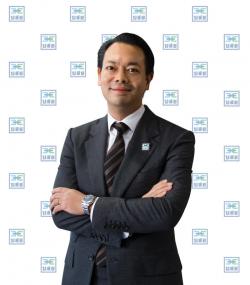
Mr Rak wants to push TCG to play a role as a social institution, not just a financial institution.
Still, Mr Rak knows that as TCG's president he must deal with numerous challenges, including changing the long-standing perception of customers and banks that TCG offers free loan guarantee service, and switching to a direct-to-customer approach rather than relying only on banks' suggestions to increase profit ratio generated by its core business.
Although TCG is a profit-making organisation, less than 5% of profit derives from credit guarantee fee income. The rest comes from investment and debt collection service, which are not core businesses.
"We must create value to be recognised by the market and stop playing a role as the free service provider," Mr Rak says. "Our staff is akin to a tailor who has never made suits that fit customers well. From now on, I want to let our product unit create custom-made suits for each client."
If TCG can generate income from the annual guarantee fee, profit will become more correlative to the loan guarantee amount, he says.
"I've asked our staff to work harder to push the credit guarantee amount to 100 billion baht [this year], but they will not get anything if the guarantee amount is not correlative to fees," he says. "But if we can generate higher fee income, the harder they work, the higher income they will earn."
Still, his dreams go beyond operating performance: he wants to push TCG to play a role as a social institution, not just a financial institution.
Mr Rak has set out three missions for TCG: being a bridge between SME operators and financial institutions for fundraising; instilling financial literacy in customers to enable them to be smart debtors; and raising their quality of life and cultivating ethics.
"Without incremental debt," he says, "positive energy to do good deeds to family and others will increase so much that it will create a good society."
The 44-year-old says he understands grassroots people, given that his father was a soldier and his mother was a doctor who needed to work in several provinces. This backdrop gave him first-hand experience of how the poor live.
He also credits his participation in volunteer camps when he was a student at Chulalongkorn University, as well as his time in the corporate world.
"When I worked at Chevron, I took responsibility for six countries including Thailand, Myanmar, Cambodia and Bangladesh, where there is an extreme poverty problem," he says. "I witnessed hardship there."
Mr Rak served at Chevron Asia South Ltd, the petroleum exploration and production unit under US-based Chevron Corporation, for five years. His last position was regional lead adviser on government policy and public affairs.
"I was informed that it was time for me to rotate to a base overseas, and I proudly told my mother about the promotion, but my mother asked me whether I still didn't make enough money," he recalls.
His mother's feedback was a turning point for him to resign from Chevron, where he was viewed as a rising talent.
"At that time, Dhanarak Asset Development opened applications for a chief marketing officer job to take charge of developing Zones A and B [at the Chaeng Watthana Government Complex]," he says. "I then decided to reduce payroll by 70% to accept the job offer. Concession and engineering works are where I have expertise."
He took up a role in clearing subcontracts of areas in Zone B and adopted a first come, first served basis to address rental problems.
"I approached Centara to rent an area for running a hotel and convention centre at the Government Complex, which can generate significant income for Dhanarak Asset," he says. "Rental fees from state agencies and small merchants are not sufficient."
Mr Rak worked at Dhanarak Asset Development, a state enterprise under the Treasury Department, for a year before moving to Islamic Bank of Thailand (IBank), where he took part in solving problems with non-performing loans.
The State Enterprises Policy Commission earlier this year approved IBank to exit the rehabilitation process after its operating performance improved and bad loans declined.
After five years at IBank, Mr Rak joined another state-backed enterprise, Export-Import Bank of Thailand, as senior executive vice-president. He was tasked with opening overseas representative offices as requested by Deputy Prime Minister Somkid Jatusripitak.
"Exim wanted a leader to expand abroad, and I was told to negotiate opening a representative office in Myanmar," he says. "The day I departed, Exim's loans outstanding had increased to 100 billion baht from 70 billion and it had three overseas representative offices in Myanmar, Laos and Cambodia."
Like other financial institutions, TCG has been disrupted by technology, but Mr Rak says he's unconcerned because there are millions of unbanked people who can be future customers.
"One of my friends warned me of taking the top job at TCG, saying that the necessity for credit guarantees would subside once blockchain was fully leveraged and artificial intelligence (AI) became more sophisticated in analysis," he says. "In fact, it's quite difficult to use big data in analysing self-employed workers or welfare smartcard holders, as technology doesn't know how much they borrow from parents or peers, so TCG is still essential.
"Moreover, there are millions of unbanked people and TCG can help them get higher loans. A mere 20-30% of small and medium-sized enterprises can access financial sources now."
Still young, Mr Rak has set a goal to become a lecturer when he turns 50.
"I want to retire from professional management at 50 to teach students," he says. "Most lecturers now teach from textbooks, but they don't have real experience in the issues they teach. I was an engineer who had working experience overseas, and I'm also a banker if I choose to teach a financial and banking course. I personally desire to teach either engineering or financial management."
With tremendous pressure from work, he has used meditation to achieve a balanced life.
He started running seven kilometres every day after he was admitted to intensive care while working under pressure at Exim Thailand.
"In the past, I'd have assignments for subordinates before 8am or even 4am," he says. "My wife told me that I was too stressed. Admission to the ICU was a wake-up call for me."