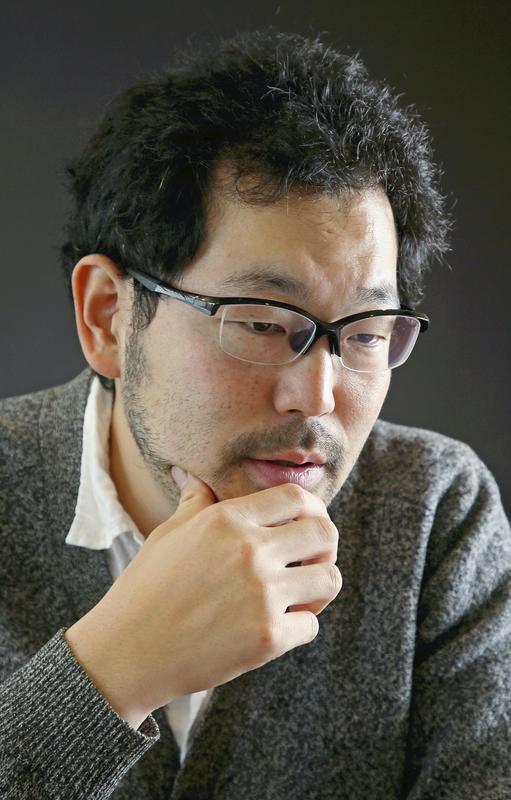
In addition to the direct impact of the Great East Japan Earthquake and tsunami, Fukushima Prefecture also suffered the ensuing meltdown at the Fukushima No. 1 nuclear power plant of Tokyo Electric Power Company Holdings Inc. Although post-disaster reconstruction work has been advancing, there are still areas where residents cannot return home. I interviewed Hiroshi Kainuma, 35, an associate professor at Ritsumeikan University, about the current situation and future challenges faced by Fukushima. Kainuma, who comes from Iwaki, Fukushima Prefecture, is the author of the book titled "'Fukushima'-ron: Genshiryoku Mura wa Naze Umaretanoka?" (Theory of "Fukushima": Why was the nuclear power village created?).
Evacuation mostly over
The Yomiuri Shimbun: What is the current situation of Fukushima Prefecture?
Hiroshi Kainuma: Following the accident at the Fukushima No. 1 nuclear power plant, evacuation orders were issued for 12 cities, towns and villages in the Hamadori region -- the coastal area in eastern Fukushima Prefecture -- but the evacuation orders have been lifted one after another for areas within 11 municipalities. For Futaba-machi, the only town whose entire area had been under the evacuation orders, the order is to be rescinded on March 4, although only for part of its area. [Note: The interview was held before March 4, and the change did take place as Kainuma anticipated.]
There seems to be a misunderstanding in some quarters that a majority of local residents are still evacuated outside of Fukushima Prefecture, with only a few people to be seen on the streets everywhere inside the prefecture. As a matter of fact, those who have evacuated outside the prefecture total only about 30,000, but 98 percent of residents of the prefecture are leading their lives in an ordinary way.
Nevertheless, there is still temporary housing even after the passage of nine years since the quake, and a lot of people are still in a state of evacuation. The number of deaths indirectly attributable to the quake has been on the rise and now totals about 2,300, mainly among elderly people. [Those deaths are] due to factors such as that they were uprooted from the areas that had been their homes for many years, and that they have been isolated from public assistance [that is normally] given through [local] public administrative services, and also that they have been isolated from the mutual support that exists in local communities. As a result, their self-help ability has weakened. Unless these three supports are rebuilt, quake-linked deaths will continue to increase in the future, too.
Permanent price slump
Q: I've heard that damage caused by negative perceptions of agricultural, forestry and fisheries products from Fukushima Prefecture still remain serious.
A: The Fukushima prefectural government has been inspecting the amount of radiation contained in agricultural, forestry and fisheries products produced in the prefecture, including rice, but no unusual numerical values have been detected. As the negative images attached to Fukushima-grown products are firmly rooted, however, distributors, with a belief that consumers would be reluctant to purchase them, have stopped putting their merchandise into the distribution channels they had used prior to the quake, and thus the prices of these products have gone down. The current state of affairs is that such practices have continued for three, or even five years, and the low prices have become essentially fixed.
Q: Is there any way out?
A: Producers in Fukushima Prefecture, trying to directly deal with the situation of negative images persisting in the minds of consumers, are continuously having their agricultural, forestry and fisheries products inspected and doggedly declaring their safety. Such facts should be commonly shared both inside and outside the country. The mechanism by which the prices have been lowered should be investigated, and ways to improve the situation should be explored. Support from outside the prefecture is also vital. I have been recommending that people do three things: "buying, going and working." To be more specific, people should buy agricultural, forestry and fisheries products, as well as sake, produced in Fukushima Prefecture. People should go on trips to Fukushima, or work in the prefecture. Working as a volunteer will do. I think such actions will support the efforts being made by local people in Fukushima Prefecture.
Embrace burden-sharing
Q: Attention has also been drawn to the disposal of the treated and purified water from the Fukushima No. 1 nuclear power plant.
A: A government panel of experts in February compiled a report making two proposals: One was discharging the purified water into the sea after diluting the treated water containing radioactive tritium; the other was releasing it as water vapor by proliferating it into the air. I myself took part in the panel's discussion. In the report, we stated expressly that from a technical viewpoint, discharging the purified water into the sea is more advantageous. Of course, discharging radioactive materials into the environment itself is not desirable. But tritium has been discharged into the sea from nuclear power plants [before]. The conclusion made by the experts' panel was that this proposal is scientifically permissible.
But there is also the element of damage caused by negative perceptions, which cannot be explained in purely scientific terms. To begin with, the "political negligence," or the fact the government had shelved the issue that the treated water must eventually be discharged, has aggravated the situation. The government should step up and strive to solve the problem.
Q: Osaka Mayor Ichiro Matsui said last year that if Osaka was asked to discharge the treated water into the Osaka Bay, there was a possibility of Osaka's cooperating with it.
A: I myself received his remarks very favorably. Of course, it is difficult, in reality, to transport a large amount of treated water all the way to Osaka. But I would like to rate his remarks highly as having been made by a statesman with regard to "fairness in burden sharing," raising the question as to whether it is right to have Fukushima Prefecture alone assume the negative burden.
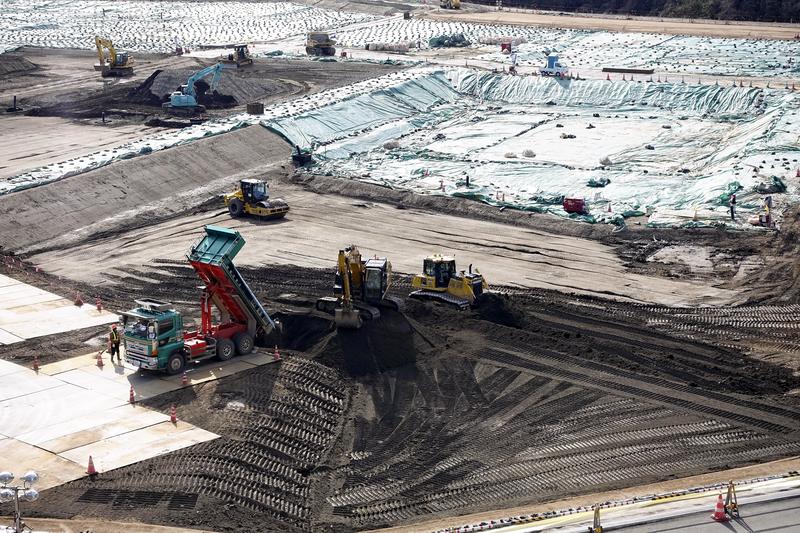
Immediately after the quake, the tendency of having the burden shared fairly among the people grew. A tax increase designed to support the post-quake reconstruction of the affected areas, which would put financial burdens on the people, was approved without a hitch. Local governments throughout the country cooperated also in the disposal of debris generated by the quake. It is from now on again that the spirit of "Let's keep fighting together" is needed, a sentiment that had been felt among the people back then but has been lost now. Fukushima has also been burdened with the thorny issue of when to move the contaminated soil out of the prefecture, meaning the soil that has been stored at interim storage facilities in the area around the Fukushima No. 1 nuclear power plant, with a 30-year time limit imposed. Should everyone turn a blind eye to this issue, as they are doing, Fukushima alone will continue to be burdened with the task.
Tell what's lost and what's recovered
Q: What challenges lie ahead?
A: The first task lies with whether the central government and Tokyo Electric Power can steadily advance the work of decommissioning the Nos. 1 to 4 reactors at the Fukushima No. 1 nuclear power plant. The current state of Fukushima Prefecture can be likened to a two-story house. As the decontamination work has been done, with the second floor cleaned at last, the work of decommissioning the reactors on the first floor has come to get under way. If any trouble arises during the decommissioning work, thus shaking the first floor, it may also cause adverse effect on the second floor, which has been put in order.
Q: Nearly nine years have passed since the quake.
A: Now is the moment when experiences are becoming history. Regarding the quake and the ensuing disaster, and the accident at the nuclear power plant, there are various memories, and experiences learned by individuals and organizations. But only a fraction of them will remain in history. It is we who will choose which ones to preserve in history. Since the time the atomic bomb was dropped, it took about 10 years for the Hiroshima Peace Memorial, or the A-bomb Dome, to become settled in its present form. Now is the time when we have passed the period filled with vivid memories and much conflicting pieces of information about the quake and the ensuing disasters, we must write a letter that will convey the present state of what we have "lost" and what we have "recovered" to the [people living in a] time 100 years or 1,000 years later.
Kainuma lived in Iwaki, Fukushima Prefecture, through high school. He completed a doctoral course in interdisciplinary information studies at the Graduate School of the University of Tokyo. His specialty is sociology. He is the author of such books as "Hajimete no Fukushima-gaku" (First guide to Fukushima studies).
Read more from The Japan News at https://japannews.yomiuri.co.jp/