I was sitting in a trim and businesslike office across the yard from a stately stone farmhouse that dates from the 16th century and was once the manor house. George Keen, one of the brothers whose farm it now is told me that the building we sat in used to be the cow-byre. He remembered as a child watching the cows being milked just where we sat, and by hand.
His mother’s family had been cheese-makers in Shaftesbury but moved here as tenants in 1899; his father’s family had moved up from the levels to farm on drier ground nearby. When the landlord needed to sell during the depression, his Keen grandfather borrowed enough to buy the property.
Grandfather had kept pigs as well as cows. When curds and whey were separated for cheese-making, the whey fed the piglets. Pig manure fed the grass that fed the cows, and the cows produced the milk that made the cheese. Grandfather had done well and paid off the loan in good time. Traditionally, it was the women of the family that made the cheese, though they also employed a live-in cheese-maker.
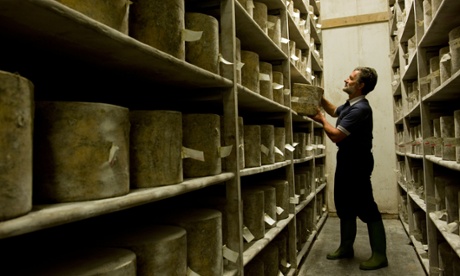
The family is one of four or five notable cheese-making dynasties operating within a few miles of each other, each exercising the craft – the techniques, exact timing and control of fermentation – that achieve the texture and acidity of cheddar as against say the more crumbly lancashire or stretchy mozzarella. And the variations of local grass and microclimate, as well as the maker’s particular method, produce the distinctive quality of each particular, local prize cheddar.
One of the skills involved is the study of cattle bloodlines and the experimentation that produces the required “hybrid vigour”. At this farm, the current blend of Friesians, Scandinavian Reds and Swiss Browns makes a colourful show along the valley. And nowadays, these 250 contented cows are milked whenever they feel the need by recently introduced sensitive robots. It seems they have been far quicker than human beings to adapt to the new ways, which they love.