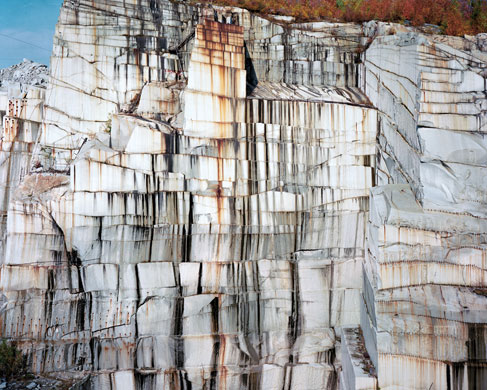
Quarries Series
Rock of Ages # 26, Abandoned Section, E.L. Smith Quarry, Barre, Vermont, 1991
"The concept of the landscape as architecture has become, for me, an act of imagination. I remember looking at buildings made of stone, and thinking, there has to be an interesting landscape somewhere out there, because these stones had to have been taken out of the quarry one block at a time." Photograph: Prix Pictet Ltd
Edward Burtynsky
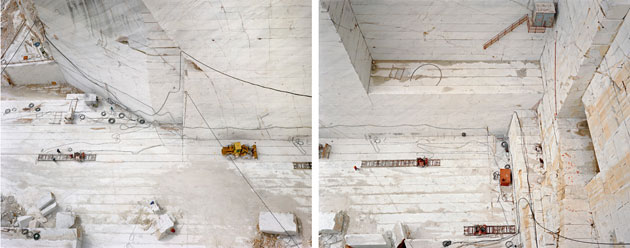
Quarries Series
Carrara Marble Quarries # 24 & 25 (Diptych), Carrara, Italy, 1993
"I feel that by showing those places that are normally outside our experience, but very much a part of our everyday lives, I can add to our understanding of who we are and what we are doing. Ultimately what I’m looking for are interesting places and moments to embody my poetic narrative of the transfigured landscape, the industrial supply line and what that means in our life.” Photograph: Edward Burtynsky/Prix Pictet Ltd
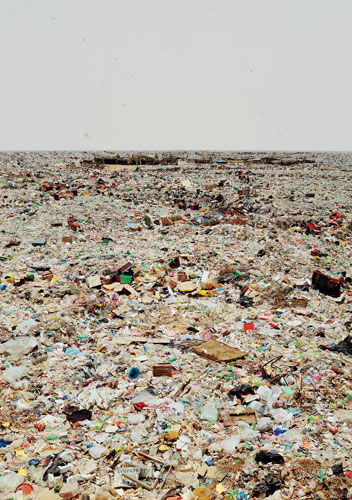
Untitled XIII, 2002
"The beholder of the 3,06 meter high and 2,22 meter wide work 'Ohne Titel XIII’ (2002) is confronted with an apparently infinite landscape of garbage. It’s the garbage dump in Chimalhuacán, Mexico City, which extends up to the horizon in this panel format.... and this work is a contemporary reinterpretation of the traditional world landscape. Andreas Gursky explains in this context: ‘It’s world-garbage’ and proves himself as photographer of the globalization." Photograph: Andreas Gursky/Prix Pictet Ltd
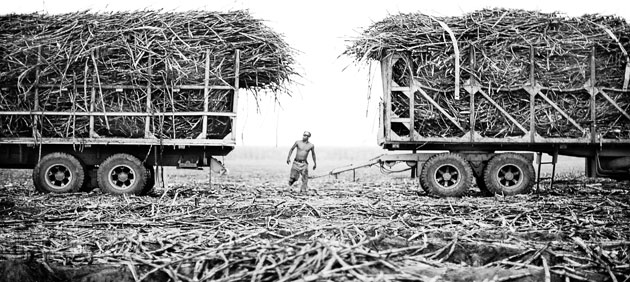
Capitolio Series
Sugarcane, Venezuela, 2008
"My work seeks to explore the relationship between politics, economics, consumption, and the Earth. I approach the topic of Earth (or more specifically man’s relationship to the earth) by looking at how consumption in the developed world creates the conditions for further destruction of the earth in the developing world, specifically Latin America." Photograph: Christopher Anderson/Magnum/Prix Pictet Ltd
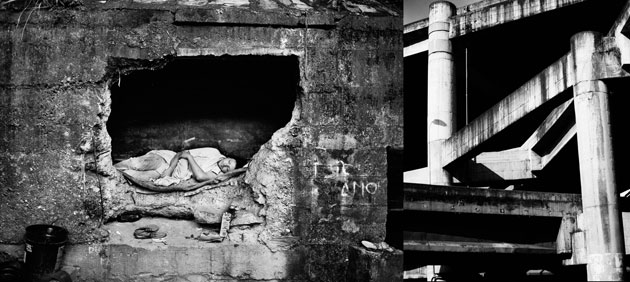
Capitolio Series
Urban Refugees, Caracas, 2008
"Venezuelan history is a long list of one leader after another who rises to power on populist anger, but can never seem to pull the country out of this cycle: resources flow north and food flows south. Quite literally, the Venezuelans depend on their earth to pay for their food and that leads to even further destruction of their environment." Photograph: Christopher Anderson/Magnum/Prix Pictet Ltd
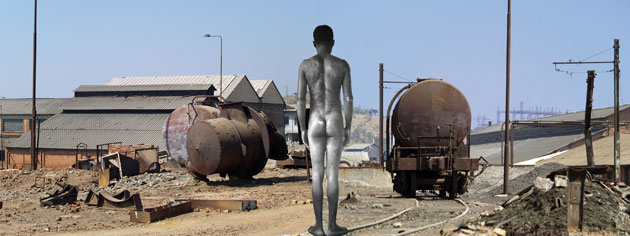
Memory Series
Mémoire, Katanga, RDC, 2006
"To some extent, my current works have a direct connection with the colonial past, which give birth to the cities of Katange province. These cities were built upon mines. The latter belong to Katanga’s history. The essence of my question lies on the daily life of Congolese people. Those are traces of the recent past, which is also present" Photograph: Sammy Baloji/Prix Pictet Ltd
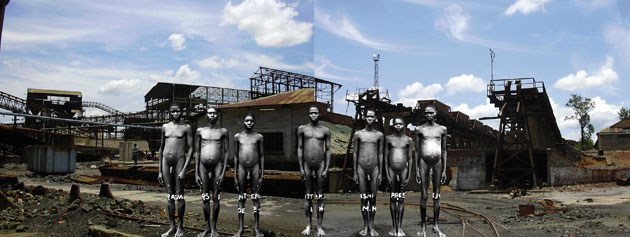
Memory Series
Mémoire, Katanga, RDC, 2006
"To superimpose past to present reveal the will to denounce past and present abuses.” . Photograph: Sammy Baloji/Prix Pictet Ltd
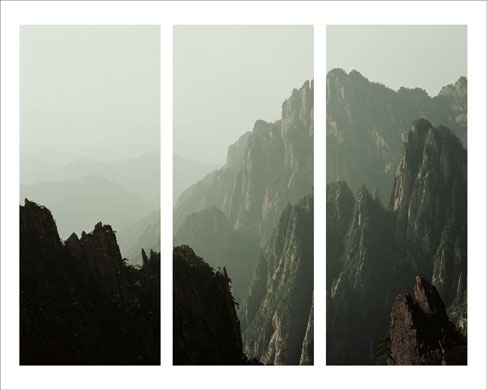
Fullmoon Series
West Sea Canyon, China, 2009
"In 2000, Almond began a series of colour photographs, known as the Fullmoons... By using only the moon as a source of light and an extensive exposure time, he creates meditative landscapes that bear a mysterious and lyrical atmosphere." Photograph: Darren Almond/Prix Pictet Ltd
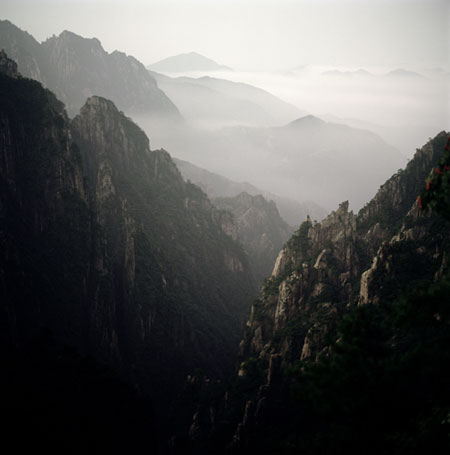
Fullmoon Series
Dragon's Eye, China, 2008
"Almond travels to remote locations that reveal an emptiness of the human spirit while challenging the sense of one’s own isolation and insignificance. Removed from the bright-lights and clamor of the city, Almond’s mystical landscapes – with their notion of melancholy - are not only shaped by the moonlight but also by the historical associations that surround them." Photograph: Darren Almond/Prix Pictet Ltd
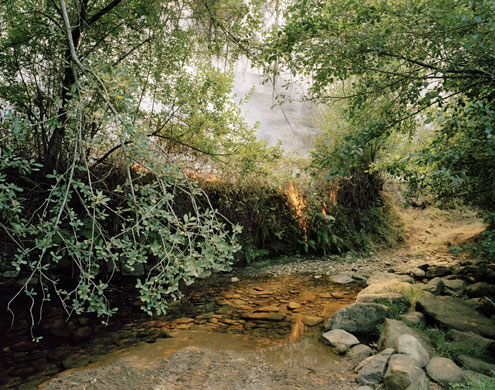
The Diminishing Present Series
Untitled, Portugal, 2008
"It is hard to believe that representations of ruin could be so seductive‚—this is especially true of those photographs shot along a creek, where the vivid greens of vegetation are just being invaded by flame, which drips off the riverbank and is reflected in the water" Photograph: Edgar Martins/Pix Pictet Ltd
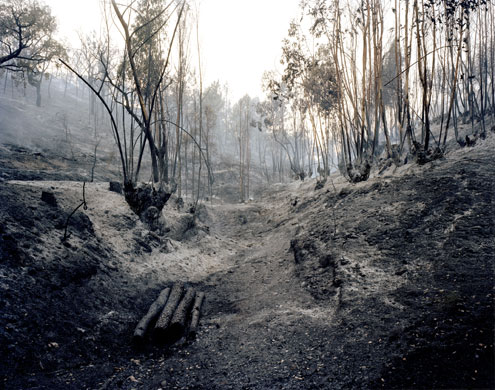
The Diminishing Present Series
Untitled, Portugal, 2008
"Whilst structured within the pictorial traditions of arcadian and romantic paintings, and for all their historical evocation and appeal to the sublime, these images reflect on both the physical death of the landscape and the death of the landscape as a pictorial ‘theme’. " Photograph: Edgar Martins/Pix Pictet Ltd
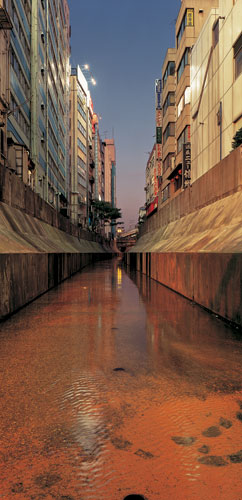
Blast, River and Tunnel Series
River Series #4,Tokyo, Japan, 1993
Naoya Hatakeyama was born in 1958 in Iwate Prefecture, Japan. His photographic works examine, in a serial manner, the city; it’s past, present and future Photograph: Naoya Hatakeyama/Pix Pictet Ltd
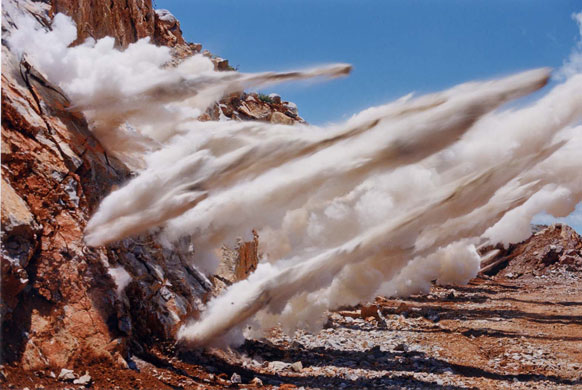
Blast, River and Tunnel Series
Blast #5707, Japan, 1998
Experimenting formally, Hatakeyama utilizes the vocabulary of photography to reflect, more generally, upon the relationship between humans and their environment. Photograph: Naoya Hatakeyama/Pix Pictet Ltd
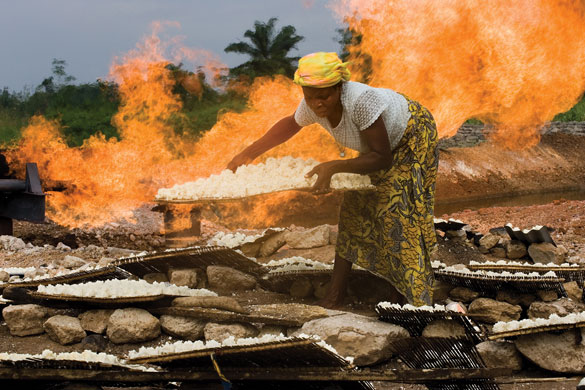
Curse of the Black Gold Series : 50 Years of Oil in the Niger Delta
Baking 'krokpo-garri', or tapioca in the heat of a gas flare, Afiesere, July 28, 2004
"It is critical to make the connection between the consumers and the producers of energy and to educate people about how both are jointly responsible for the future of our energy resources. With each passing day the repercussions of our reliance on oil become increasingly obvious: human rights violations around the world, public health hazards, environmental devastation, war, and climate change." Photograph: Ed Kashi/Pix Pictet Ltd
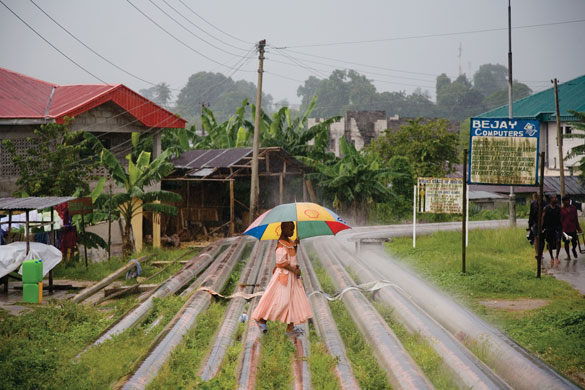
Curse of the Black Gold Series : 50 Years of Oil in the Niger Delta
Okrika a troubled area near Port Harcourt
"The planet and its citizenry have never been in greater need of the world's energy consumers to understand the injustices and dismal environmental and human impacts of our current global energy economy." Photograph: Ed Kashi/Pix Pictet Ltd
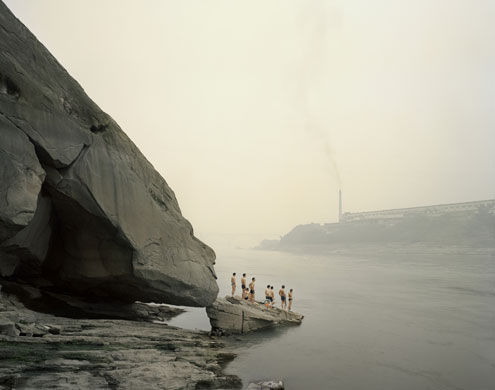
Yangtze, The Long River Series
Bathers, Yibin, Sichuan, China, 2007
"The Yangtze River, which forms the premise to this body of work, is the main artery that flows 4100miles (6500km) across china..... More people live along its banks than live in the USA, one in every eighteen people on the planet. Using the river as a metaphor for constant change, I have photographed the landscape and people along its banks from mouth to source." Photograph: Nadav Kander/Pix Pictet Ltd
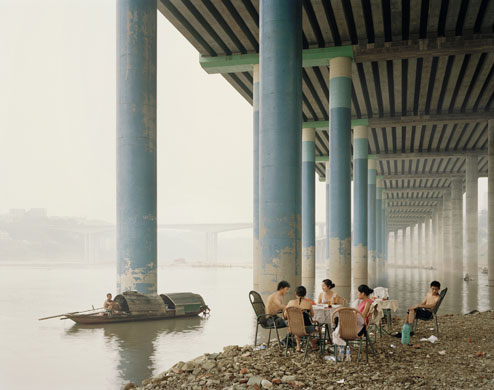
Yangtze, The Long River Series
Chongqing IV (Sunday Picnic), Sichuan, China, 2006
"A Chinese man who I became friends with whilst working on the project reiterated what many Chinese people feel: “ Why do we have to destroy to develop?” He explained how in Britain many of us could revisit the place of our childhood, knowing that it will be much the same, it will remind us of our families and upbringing. In China that is virtually impossible, the scale of development has left most places unrecognisable, “Nothing is the same. We can’t revisit where we came from because it no longer exists.” Photograph: Nadav Kander/Pix Pictet Ltd
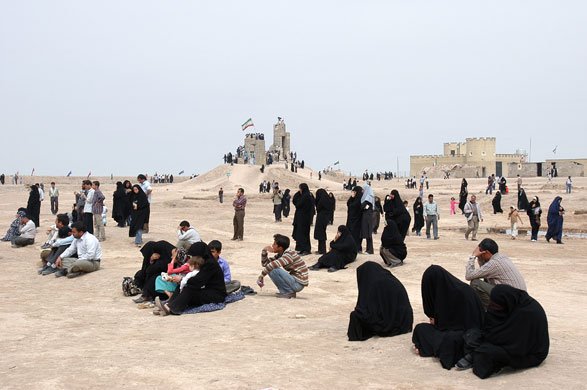
Shade of Earth Series
Shade of Earth, Talaiye, South of Iran, March 24, 2007.
"Every year hundreds of thousand Iranians visit the fronts of the Iran -Iraq war (1980-1988) during their New Year (Noruz) holiday, in the last week of March." Photograph: Abbas Kowsari/Pix Pictet Ltd
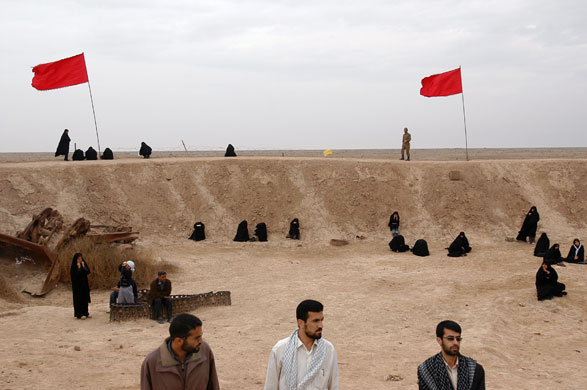
Shade of Earth Series
"Shade of Earth, Talaiye, South of Iran, March 24, 2007
This trip is called ' Rahian-e Noor', or, Caravan of Light. The pilgrims, often family members of those who died, travel with busses from all over the country to visit the places where the fighting was the heaviest. Iran lost over half a million soldiers during the eight year trench war with Iraq." Photograph: Abbas Kowsari/Pix Pictet Ltd
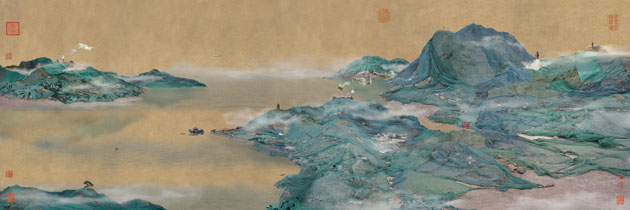
Concealment and Restructuring Series
Dwelling in the Mount Fuchun, China, 2008
"Generally speaking, my works use the form of traditional Chinese painting to express the visage of China. China is developing increasingly and produce many things under increasing construction. Meanwhile many things have disappeared. Those clump and rubbish covered with the 'shield' is general phenomena in China." Photograph: Yao Lu/Pix Pictet Ltd

Concealment and Restructuring Series
Spring in the city, China, 2007
"Photography also is very contemporary, it can regroup and re-edit the things that you saw explicitly, let people produce the delusion in front of works, you can see true and untrue image." Photograph: Yao Lu/Pix Pictet Ltd
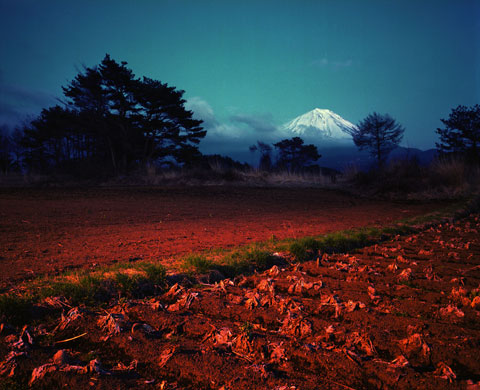
Mount Fuji Series
Fields near Kawaguchiko, Japan, 2000
"These are ten images from my book Fuji. The project was shot over a 4 year period, and all of these images are from 2000 and 2001.... The book is not a polemic, but can be seen as a commentary on modern Japan and the erosion of natural beauty in the name of progress." Photograph: Chris Steele-Perkins/Magnum/Pix Pictet Ltd
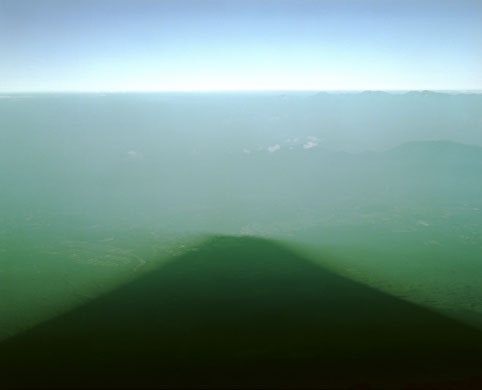
Mount Fuji Series
Shadow of Mt. Fuji on the landscape, Japan, 2000.
"The work considers the place of Mount Fuji, the iconic symbol of Japan, in our modern times, and references the works of the great Japanese artists, Hokusai Katsushika and Utagawa Hiroshige, whose series of woodblocks, 36 Views of Mount Fuji, were a record and commentary on Mt Fuji in relation to the society of their times; the early to mid 1800's. The images were constructed in a way that Fuji was ever a presence "observing" the landscape and society around it, a discipline I have continued." Photograph: Chris Steele-Perkins/Magnum/Pix Pictet Ltd
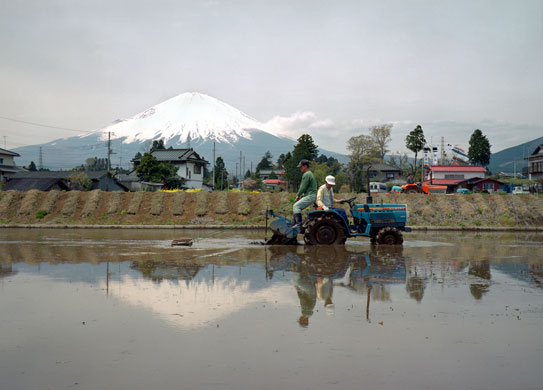
Mount Fuji Series
Preparing fields, near Gotemba, Japan, 2000.
"I think it is important that we attend to issues of sustainability and the environment that do not only look at the grand issues of Global Warming, Over population, Water Shortage and Mass Migration, but also pay attention to the insidious incursion of environmental decay and despoliation taking place within the supposedly "safe" environments of the developed world." Photograph: Chris Steele-Perkins/Magnum/Pix Pictet Ltd




.jpg?w=600)