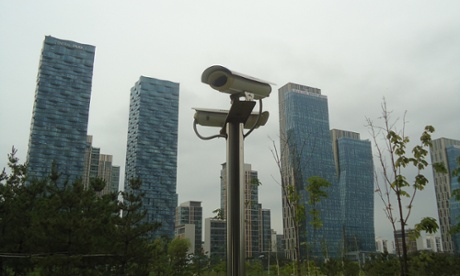
In London, the Thames Path – one of the most important pedestrian routes in the capital – has sections filled with gates, spikes and CCTV cameras, leading Jack Shenker to liken it to “a high-security prison corridor”. In Dubai, as Anna Minton explains, privatised plazas are commonplace – along with 325 miles of non-public beaches. Gated communities around the world continue to grow in number. Lavassa, in India, is to be an entirely private city.
So-called public spaces in our cities are becoming increasingly controlled and regulated by private bodies and corporations, as we see a creep of exclusivity take hold in our urban landscape. We asked you to share your photographs, stories and examples of privatised spaces: here’s a selection of your responses – from Mumbai to London.
Los Angeles, US

Pershing Square, LA
Los Angeles: a pioneer at privatising public space.
Mumbai, India
Mumbai’s obsession with cars is now a well-known story. The entire infrastructure is developed and modernized to facilitate movement of private vehicles while public transport takes a backseat. Flyovers like the JJ flyover, worli-bandra sealink, eastern freeway, etc. are not open to bikes or autos. Same is the case with roads leading to the airports; both domestic and international. The new overhead road linking the western express highway to the new international terminal is not open to autorickshaws and bikes. The swanky roads are only open to cars and taxis.
Reading, UK

Officiousness in Reading
I was in Reading's Oracle Centre, standing on a bridge, pointing my camera downwards, towards the river below (fabulous reflections!) when an officious youth in uniform approached me and told me I was breaking the law; that as I was on private property I was not allowed to take photographs. There followed an interesting discussion about whether it was possible for him to prevent me from taking photos of river water (he thought so as I was on 'his' bridge - the set of images I came away with proved otherwise!) Ha again!
Boca Raton, US

New Private Property sign with a No Trespassing rider
I couldn't help but notice these new signs this past weekend at the public beach I've been going to for the last thirty years. I remain dazed.
Águilas, Spain

Except for owners
Read the title one more time and you will have translated the message below the traffic sign. What you find behind it is a narrow street through which only the owners of a house of that residential area are allowed to drive and, therefore, park. I understand people want to protect the space surrounding them, but at the same time it's important to point out that that area is located in a public place. What if a visitor came? Could he / she park there? Some limits of certain prohibitions should be defined.
Anyway, I consider there's nothing wrong in establishing a limit whenever you don't upset anyone. Favouring security and the right to make use of what belongs to you is important too.
Ahmedabad, India

Exclusive Bio-diversity park
This bio-diversity park is maintained by M G Science Institute, one of the leading institutes in Gujarat through funds from UNEP. It is located in University campus. Access to the park is restricted for students and only when required for coursework. General public is totally out of bounds
London, UK

Follow the leader
The Broadgate estate, behind Liverpool St station, wouldn't be most people's idea of a place to go and take photographs - but it's quite an interesting "public" space; with a mix of lost tourists, City types and strays carefully laying out spare time to dissipate in the sun. On one occasion I was approached by security and much to my surprise, told I couldn't take photographs without advance permission. I had always assumed it was a public space...but not so. Quite why the prohibition on photography I'm not sure but I was escorted by security until I had passed the perimeter line. My advice to photographers is to move quickly in one direction and then circle back - the security guys probably don't bother to enforce the rules if you're subtle.

Designated not dedicated
Pedestrianised space alongside a university building.

crown estate.
A No Way street