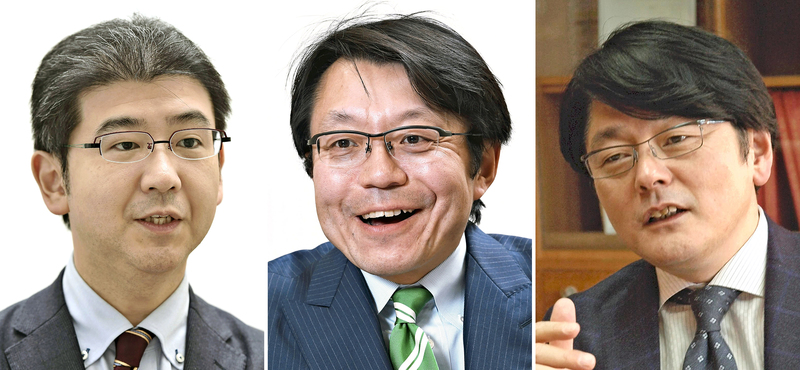
With Japan's population of 18-year-olds on the decline again in 2018, business concerns are surfacing at private universities. What kind of management reforms will be needed to survive, and how should applicants and their guardians go about selecting a university? We asked three specialists in the field for their opinions. The following are excerpts from the interviews.
(From The Yomiuri Shimbun, March 7, 2018)
===
Faculty and community blazing a trail together
Akio Omori / President of Kyoai Gakuen University
I have been with Kyoai Gakuen in Maebashi for over 20 years now, since my days as a junior college lecturer. In that time, the entire faculty has been engaged in a process of trial and error to figure out how to best overcome the challenges of being local, new and small-scale, and emphasize the school's strengths.
The junior college was reorganized into the current university, which started in 1999 as a single faculty for international social studies.
Setting the educational goal of "coping with the challenges of regional society associated with internationalization," we created a pamphlet highlighting our approach of nurturing "glocal" talent -- a word coined from "global" and "local." But there were some who asked whether this was a misprint. Our educational philosophy was not being sufficiently conveyed.
It was perhaps for this reason that, although the university was full to capacity with students in its first academic year, enrollment began to fall below capacity beginning the following academic year. We had been confident in our curriculum, which featured subjects such as international economics and cultural anthropology, as well as the opportunity for students to improve their English skills. We were shocked that we didn't have students from all over Japan lining up at our door, as we had expected.
While discussing this within the faculty, one person said, "Since we don't even have local students enrolling, we can't expect students to come from all over the country." There was no need for people to come all the way out to a newly established university in Gunma Prefecture if they wanted an internationally focused education.
Thus, we reconfirmed our philosophy, defining it as "educating leaders who will carry Gunma using an international perspective." We then carefully explained this educational goal to high schools and the regional community. As a result, the number of enrolled students began to recover beginning in the 2003 academic year. That year, in my mid-30s, I was selected as dean of our department. I believe this reflects the university's strong desire to advance its reform.
In the 2012 academic year, our students accompanied junior high school students on overseas study trips. A program for our students participating in training and other activities at overseas bases for companies was selected to receive a subsidy from the Education, Culture, Sports, Science and Technology Ministry. These contributed to recognition for our school.
Faculty members cooperating is essential for reform. At Kyoai Gakuen, since its beginning, we have held "staff conferences," or meetings attended by all faculty members (about 70), and made decisions such as increasing the number of enrollment slots and improving the facilities.
Around 2001, when we were still falling below the enrollment quota, the conference had a discussion about controlling personnel costs. The conference decided on a uniform salary cut plan if personnel costs exceeded a certain proportion of our income and made such a proposal to the board of directors. In the end, due to the effects of the reforms, the administration was able to avoid implementing the cuts, but it was a major benefit that the entire faculty was able to have the same level of readiness. A sense was created that each and every faculty member carries responsibility for the management of the university and finding ways to improve it.
After I took the office of president, we established a council with local high school teachers and company employees to nurture local human resources. We created programs for our students to have discussions with high school and junior high school students, as well as company employees, about the shortage of successors to small and medium-sized companies, among other issues.
Recently, many universities in succession across the nation have been sending visitors to see our university. This spring, there were more than 800 applicants for a total of 255 available enrollment slots, which is a new record for us. Continued reforms will help the college grow and further improve its educational prowess. I think this will lead to more powerful management.
(This interview was conducted by Yomiuri Shimbun Staff Writer Sachiko Asakuno.)
-- Akio Omori
Began as a full-time lecturer at Kyoai Gakuen Women's Junior College in 1996. He has served as professor and vice president at Kyoai Gakuen University. He has been in his current post since April 2016. He is 49.
===
More active instruction needed from education ministry
Katsunori Takahashi / Certified public accountant
I have been involved in educational corporation accounting audits for many years. In recent years, corporations that are in good business condition and those that are not have become more and more polarized. Although some corporations cannot be said to be in financial straits, their management conditions are likely already the worse for wear.
Sources of income for private universities include student entrance fees and tuition fees, as well as subsidies from the national government. Aside from those with high brand recognition, it is difficult for universities to receive donations. There is also a special national subsidy that is allocated to educational programs with special characteristics, but smaller local schools have few faculty members available, and there are cases in which the application process is abandoned due to the amount of work required.
In the past, there were also universities that engaged in financial derivatives transactions, but large-scale investment became difficult after the 2008 financial crisis caused by the collapse of U.S. investment bank Lehman Brothers. Financial institutions are also becoming stricter in their evaluations of university profitability, making it more difficult to receive loans. For these reasons, there are cases in which schools are liquidating their assets or selling off some of their unused sports grounds to stay in operation.
In the end, attracting students and securing tuition payments are the best solutions, but this is becoming more difficult with fewer 18-year-olds. Enrollment rates significantly below capacity would lead to a reduction in subsidies from the national government, worsening the vicious cycle.
In addition, educational corporations and universities have management teams and faculty members who do not acknowledge the severity of the situation. As a result, even with enrollment continuing to fall below capacity, they assume that, being an educational institution, the national and local governments will save them and so they are slow to more strongly recruit potential students. They do not review the content of their curriculums, and their situation continues to worsen.
Corporations with deteriorating business structures should first analyze why the numbers of entrance test takers and enrolled students are decreasing and why their popularity and deviation values are dropping. Educational curriculums and employment support should also be reviewed. Additionally, management needs to work to increase the attractiveness of the college and pursue publicity strategies, such as by constantly visiting high schools.
If these measures do not lead to more students, it will become necessary to consider reducing the size of the university. A college's costs can be broadly divided into three categories: the "personnel costs" of faculty and staff, the "educational and research costs" used for student education and the "administrative costs" needed for the corporation to operate. Since personnel costs account for more than 50 percent of total costs, reducing these will have the greatest effect.
However, reducing teachers, whose numbers are determined by a national standard such as by being based on enrollment capacity, is not easy. Making large salary cuts is also difficult. When one well-known private university tried to cut bonuses for faculty members and staff due to financial difficulties, they filed a lawsuit against the educational corporation. Because of this, it is essential to plan long-term measures such as reducing new hiring by reviewing the faculty work system and gradually abolishing allowances.
The Education, Culture, Sports, Science and Technology Ministry and the Promotion and Mutual Aid Corporation for Private Schools of Japan have so far respected the independence and autonomy of private universities and in some ways have not given sufficiently strong instructions. Something that should be considered from now on is strengthening their authority to create a mechanism allowing for more proactive intervention in corporations with business difficulties.
(This interview was conducted by Yomiuri Shimbun Staff Writer Sachiko Asakuno.)
-- Katsunori Takahashi
Graduated from Keio University. Representative partner at Shinsoh Audit Corporation. Member of the committee for accounting audits of educational corporations at the Japanese Institute of Certified Public Accountants. He is 51.
===
How to avoid going to 'at-risk' universities
Shiki Kurabe / University entrance adviser
When I am advising high school students and their guardians from all over the country on university selection, they are invariably surprised when I mention that colleges sometimes go bankrupt.
When the guardians were in university, the bankruptcy of a university was unthinkable. I let these guardians know there is an element of risk in the selection of a university.
If a university goes out of business, students are forced to transfer and will incur new tuition and moving expenses. There are cases in which students are no longer able to pursue the course of study they originally intended to, which can affect their career paths.
Graduates are unable to receive support and have the negative stigma of having attended a university that went bankrupt recorded in their academic history.
Even if they do not go bankrupt, universities with deteriorated business conditions have downsides. It is possible the budget will be insufficient to support the needed facilities and human resources, resulting in a worsened learning environment and student support services or fewer lectures.
I am often asked by high school teachers how to tell if a university is "at risk." In some communities, lists of universities where students should not be sent are created and shared among guidance counselors.
That said, how do you tell whether a university is at risk? The first essential step is to read and understand the data on the numbers of students at a university, which the Education, Culture, Sports, Science and Technology Ministry requires to be made public. The numbers are available, for example, in an information disclosure area of each university's website.
In particular, the main numbers to pay attention to are the enrollment quota fulfillment rate and the dropout rate.
When the enrollment quota fulfillment rate falls below 100 percent, it means the school was not able to accept enough students, and the lower the figure, the worse the condition of the university. If the dropout rate is high, this raises the concern that students who lack the desire or ability to learn are being accepted into the school and that the education in the school is not great.
Since dropout rates vary according to the level of the school, it is best to compare a school with its counterparts at the same level.
Another point to note is the number of entrance exams and open campuses held.
"At-risk" universities hold these events much more often than their more secure counterparts. A school that is still holding entrance exams, including AO (admissions office-style) exams, on a weekly basis even in March has not filled its student quota. There are even some universities that extend rather forcible invitations to high school students who visited open campuses, even offering to exempt them from parts of the entrance examination if they apply.
In addition, schools engaging in excessive levels of advertising due to insufficient enrollment are likely to be sinking significant portions of their budget into such activities, meaning that large amounts of the tuition paid by students may be going toward purposes other than their education. There are also cases where a lot of part-time lecturers and staff are not often available to offer consultation to students.
Because of this, I also recommended that students visit their prospective university on weekdays. Unlike with choreographed open-campus events, this allows the opportunity to see students and staff in their everyday state.
Caution should be used with colleges that disclose miniscule information. Students and guardians should use the figures as a reference when considering schools.
(This interview was conducted by Yomiuri Shimbun Staff Writer Tomohiro Sawai.)
-- Shiki Kurabe
Worked as a private university employee and at a cram school before becoming a director at the incorporated nonprofit organization "NEWVERY," which conducts university reform assistance and other activities. He also served as a judge for the education ministry's subsidy projects for universities. He is 39.
Read more from The Japan News at https://japannews.yomiuri.co.jp/