The independence of the judiciary requires judges to engage with the executive and the legislature, the lord chief justice said on Monday night. How times change. Shortly after Lord Lane became lord chief justice in 1980, he agreed to meet the then home secretary, William Whitelaw, at a dinner party arranged under conditions of secrecy in a private room at a London club. Further meetings were planned but Lane called the whole thing off after a newspaper leak.
Lane had regular and less clandestine meetings with Douglas Hurd, who became home secretary in 1985, but still preferred to communicate with the Home Office by letter. Because Lane’s missives were often handwritten, they were sometimes misclassified as letters from the public and not answered for weeks.
Early in 2005, an approach was made to Lord Bingham, the senior law lord, on behalf of Charles Clarke, home secretary at the time. Bingham’s court had recently ruled against the government’s anti-terrorism laws in the so-called Belmarsh case and Clarke had apparently been hoping for guidance on what sort of replacement the judges might find acceptable. Bingham was sceptical about the promise that their meeting would be “purely social” and refused to attend.
Lord Thomas of Cwmgiedd, who became lord chief justice in 2013, attended three seminars this year arranged for his benefit by the Institute for Government, an independent thinktank. The meetings were private but it is known that they were also attended by senior civil servants. Thomas returned the compliment by delivering an open lecture at the institute. The background, he explained, was there was only one judge who had served as an MP or minister (Mr Justice Cranston) and that few MPs continued to practise as lawyers. We have moved from a lord chancellor’s department staffed by lawyers to a Ministry of Justice whose officials have little experience of the courts.
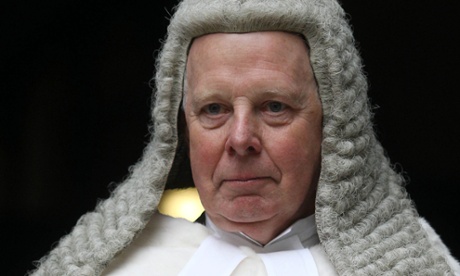
But direct judicial engagement was not inconsistent with separation of the powers, Thomas continued. Recent examples had shown that “the judiciary, the executive and parliament can work well together while still respecting their functional boundaries”.
As is so often the case, those boundaries may be difficult to pin down. Thomas insisted that the judges would not give advice to ministers or legislators on “the merits of proposed legislation or the meaning or likely effect of provisions in draft legislation”. Nor could they advise on its constitutionality or compatibility with human rights.
What the judges could do, though, was to advise on the technical and procedural aspects of reform. Their aim was “to ensure that if the proposal goes ahead it will work as well as it possibly can; or to identify the pitfalls, so that if possible they can be rectified”.
One example he gave was the way in which defendants sentenced to prison are given credit for the number of days they have spent on remand in custody. Under an act passed in 2003, judges were required to work this out themselves. There were often mistakes – not usually the judge’s fault – and these had to be corrected on appeal. Legislation passed in 2012, after full consultation with the judiciary, reintroduced automatic credit for time on remand and the problem went away.
But there must be other cases where the dividing line between technicalities and merits is harder to pin down. The obvious example is judicial review – itself subject to the criticism that it blurs the line between merits and processes.
At the very moment that Thomas was delivering his lecture, the justice secretary, Chris Grayling, was asking MPs to overturn Lords amendments to his planned judicial review reforms. Grayling secured comfortable majorities for proposals, slightly modified, which he said would prevent “judicial review on technicalities”.
Lawful decision-making – and whether judicial review was too readily used – were apparently discussed at one of the private seminars Thomas had attended at the Institute for Government. In public, however, he confined himself to one barb:
I must …respect the present difference between the houses of parliament about the scope of judicial review in a bill currently before them. It would be wrong of me to seek in any way to influence the outcome by saying anything further about judicial review, save that it is an aspect of our constitution that has give rise to much misunderstanding.
I suggested to Thomas that it would be difficult for the judges to advise ministers on the technicalities of a bill designed to limit their powers and whose aims they did not share. The lord chief justice carefully avoided commenting on judicial review and changed the subject to extradition law. Whatever view one took, he said, the law was complex and needed to be drafted carefully. Nobody wanted the law to be uncertain and getting the technicalities right was something on which the government needed expert help.
Improving the quality and accessibility of law appears to have been the subject of another seminar. Thomas thought that information technology could be used to produce a modern statute book in which amended laws could be read without the need to refer back to the original legislation.
And the third topic seems to have been making litigation cost-effective. Further work was needed, he said, to ensure that the required disclosure of emails and other documents did not overburden the parties and the court.
Summing up his lecture, Thomas said “the executive and parliament must, within the clear framework of our constitution in which the independence of the judiciary is fundamental, work together to make the law clear, technically correct and accessible” –and that “systems designed to facilitate access to justice and uphold the rule of law actually achieve those aims”. There could be no “silent partners of the constitution”, he concluded.
My own view is that Thomas is right to create this framework for development, as he called it; and right to speak about it. But his predecessors were also right to be reticent. As Thomas himself fully understands, the judges must not be seen to be playing politics. If that happens, they will lose the independence on which the British constitution depends.