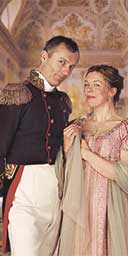
The Peter Hall Company's summer season is becoming as much a fixture of Bath life as the Pump Room. This year it kicks off by wittily teaming two famous sex-war comedies. The shock lies in discovering that Hall's production of the Shakespeare is far more radically revisionist than Thea Sharrock's of Noël Coward.
Coward's enduring 1930 comedy reveals what John Lahr excellently calls "the egotism of the talentocracy". Amanda and Elyot, meeting on a hotel balcony, abandon their respective spouses and take flight. For Coward, a moralistic hedonist, they represent the superiority of charismatic self-absorption over dull conventionality. Amanda and Elyot fight like cat and dog, but they have the armour-plated bohemianism Coward so adored. At the end, like so many of his protagonists, they tiptoe away from the chaos they themselves have created.
For the play fully to work, however, one needs actors who - as Amanda says - are like "two violent acids" bubbling about in the same bottle. Greta Scacchi is sombrely beautiful, but her Amanda sadly lacks the character's capricious volatility. It is left to Michael Siberry's Elyot to bring out the post-coital danger and high dudgeon in their relationship, which he does in a superb display of muscular camp. Charles Edwards, pompously querulous, and Olivia Darnley are very good as the rejected spouses, while Peter Mumford's Parisian designs have a cubist angularity and Sharrock's production has a well-oiled smoothness. But it takes two for Coward's sexual tango to take flight.
You might expect Hall's Much Ado to make up what is missing in the Coward. The play is, after all, famous for the "merry war" between Beatrice and Benedick, which over the years has produced such famous couplings as Ashcroft and Gielgud, Dench and Sinden, Cusack and Jacobi. Here, the sumptuously vivacious Janie Dee and the acidly perplexed Aden Gillett spar and bicker with great conviction before achieving the self-realisation of love.
But Hall's precious insight is that Much Ado is a comedy only in name. In reality, it is a tragedy manqué, filled with bitterness and anguish.
Hall's achievement is to foreground two characters who are normally absorbed into the comic pattern. The first is Philip Voss's Leonato, who undergoes an astonishing transition from benign host to manic father who, the moment Hero is accused, threatens to kill her. Leonato's language is as violently intemperate as Lear's, and, in Voss's revelatory performance, one is reminded of Shakespeare's obsessive, Verdian preoccupation with father-daughter relationships.
Hall also rescues from the shadows the Aragon prince, Don Pedro. As played by Charles Edwards, he has a homosexual fixation with Claudio - which explains why he is so keen to see his wedding ruptured. But Edwards also reminds us that Don Pedro is brother to the villainous Don John. After Hero's miraculous "restoration", he realises he has been duped, snarls angrily at the dancers and is left, at the curtain, in splenetic, vengeful isolation. After this, it will be difficult to go back to the idea of Don Pedro as a suavely detached aristocrat. By extension, Hall reminds us that all Shakespearean comedy contains the seeds of tragedy: one thinks of Malvolio in Twelfth Night, Antonio in The Merchant.
Along the way, in this production, there is much fun in Sam Kelly's Dogberry, who is the archetypal jack-in-office puffed up by a uniform. Kevin Rigdon has come up with a beautiful design of a mellow, sun-weathered Sicilian courtyard. But Hall's triumph is to have redefined a much-misunderstood play and shown that Shakespeare, long before Chekhov, invented tragicomedy.
· In rep until August 6. Box office: 01225 448844.