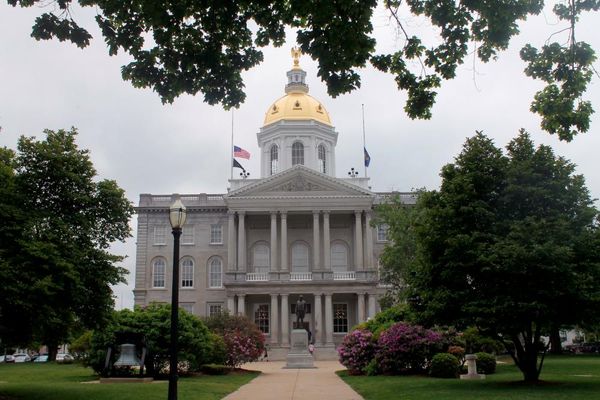

SPRINGFIELD — Saying the state suffered immensely because of an “ideological battle,” Democratic Gov. J.B. Pritzker on Wednesday vowed an “honest” budget plan with no “quick fix” — and an immense push for the state to enact a progressive income tax.
Despite calls for change, Pritzker’s budget includes revenue from big-picture items that still need approval, like legalizing marijuana and sports betting. It also includes putting off pension payments — extending the state’s pension payment “ramp” by seven years to reduce short-term costs, which may worsen problems in the future.
And it proposes a world in which his plan to enact a progressive income tax would save the state.
“It’s time for a change,” Pritzker said during his first budget address. “Workers deserve an income tax cut and a property tax break. A fair tax system will allow us to eliminate the structural deficit that has plagued our state for nearly two decades.”
Pritzker’s proposed budget includes $38.9 billion in revenue and $38.75 billion in expenditures.
RELATED
• Read the text of Gov. J.B. Pritzker’s first budget address
• Read the 2020 budget proposal
To address the state’s massive bill backlog, Pritzker proposed “three alternative options,” including cutting state government spending and raising no revenue; raising revenue with our current income tax system and imposing “more flat taxes which fall disproportionately on the working poor and the middle class.”
For the third option, he offered his plan for a progressive income tax in the state — which will require a constitutional amendment — and called it the best solution. And he said he “intends to immediately begin negotiations over proposed fair tax rates with leaders from the House and Senate.”
The governor’s budget address, in a sense, is a preview of some big battles ahead, with Republicans and business groups in no way on board with a change to the income tax system.
“I expect different opinions and viewpoints over the best way to achieve an equitable tax system, and I sincerely welcome that conversation. I have already asked a few legislators who oppose the fair tax to offer their best ideas to improve it, and I am confident they will come to the table in good faith.”
But he called his blueprint “an honest proposal.”
“The costs are not hidden, the revenues I propose are not out of reach, the hole we need to fill is not ignored. There’s no fantasy line item called ‘Working together or executive management,'” Pritzker said. “Instead this budget proposal reflects some of my most deeply held values – and the hopes of voters who sent us here – but tempered by the knowledge that we must hold the line on spending in the context of the revenue available and the diminished condition of our state government.”
For now, as the state continues to dig itself out of a massive hole, Pritzker recommended legalizing cannabis, which he said would create jobs and bring in $170 million in “licensing and other fees”; legalizing and taxing sports betting, which he said could bring in $200 million; and a tax on insurance companies to help cover the costs of the Medicaid system, to generate $390 million in revenue, he said.
Licenses for marijuana, however, can’t be sold until recreational use of marijuana is legalized in Illinois, which shows that the governor will make a big push this session to get a comprehensive legalization measure passed. While Pritzker remains committed to recreational use of marijuana, the exact plan for how to do that — and its timeline — remains unclear. The governor’s office said the state could gain revenue from marijuana business licenses within the upcoming 2019-2020 fiscal year should a legalization bill pass during the spring legislative session. The next fiscal year runs from July 1 through June 30, 2020.
And despite moving quickly on some issues that had no Republican support — like raising the minimum wage — Pritzker, too, vowed bipartisanship and “civility” in his first budget address.
“I’m not shy to say I’m a Democrat. But I know we will get more done for Illinois by listening to each other, which we will do with respect and civility,” Pritzker said to applause from both Democratic and Republican lawmakers.
Speaking after the address, Illinois House Republican Leader Jim Durkin said Pritzker’s plan “was mostly addressed toward his constituency.”
Durkin said the legislative leaders met privately before the speech: “It was clear to me that there was going to be some sharp divides on how we manage this year’s budget,” he said.
Durkin said he is mostly concerned about delaying pension payments.
“This is what got us into this problem with our pension system today, shortchanging the systems, also having statutory pension holidays,” Durkin said. “I don’t believe that’s right. My caucus doesn’t believe that’s right.”
Durkin said he told the governor that his pension plan should be reviewed.
“It wasn’t received well,” Durkin said, adding suspending payments is a “non-starter” with Republicans.
Illinois Senate Republican Leader Bill Brady, R-Bloomington, said the governor’s first address showed there are issues in which Republicans “disagree fundamentally,” including a change to the state’s tax system.