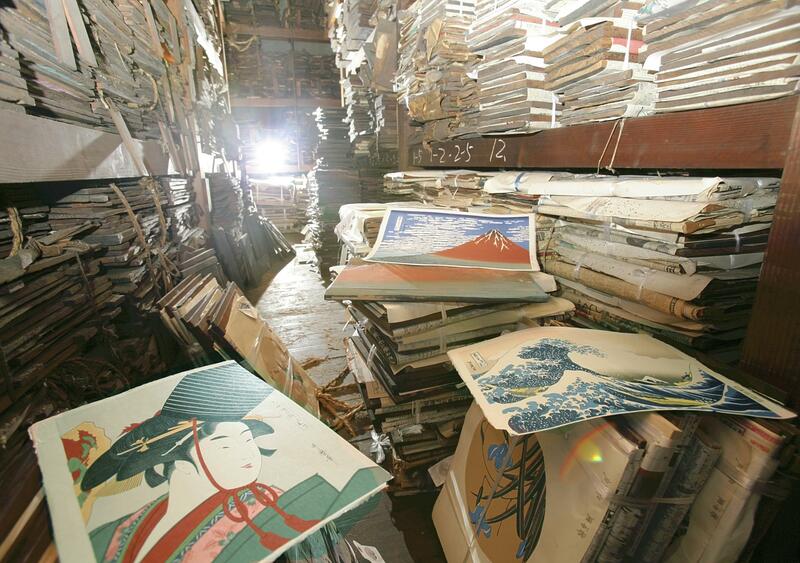
Tokyo is currently home to 80% of the nation's publishing companies, while Kyoto trails far behind. But such was not always the case. Until the 18th century, it was Kyoto that was the center of the publishing world. Nearly 10,000 books were released annually in the city at the end of the 17th century.
Publishing in Japan dates back to the Nara period (710-784) with the completion of "Hyakumanto Darani" (1 million pagodas and Dharani prayers) in 770 in Nara, the capital at the time. One million woodblock prints of a Buddhist prayer called Dharani were produced and encased in 1 million small wooden pagodas, then distributed to 10 Buddhist temples. It is believed to be the world's oldest printed material for which the year of printing is known.
Although woodblock printing was invented in China, no printed materials remain from the ancient times there because many things were burned every time there was a change of dynasty.
In 794, Japan's capital was moved to Kyoto, and that became the exclusive domain for printing and publishing. Naturally, most of the printed matter was Buddhist sutras. Reading sutras is an integral part of Buddhist training, and as they are believed to possess magical powers, printed copies were distributed to many priests.
In medieval times, literature was added. Kyoto Gozan -- the five eminent Zen-Buddhist temples in Kyoto at the time -- and the even more prominent Nanzenji temple, which is in a class of its own, published woodblock print books one after another, which were known collectively as Gozan-ban (the Gozan edition). These included not only Buddhist sutras, but books on Chinese history, collections of Chinese poetry, or other texts that had nothing to do with Buddhism.
In those days, Zen Buddhist temples served as gateways for the introduction of the latest Chinese culture. Many Zen Buddhist monks traveled to China to study and brought back various cultural items, including diverse books and printing technology. In addition, Chinese paintings and the culture of tea ceremony were imported to Japan via this route.
In the West, Johannes Gutenberg's invention of the printing press around 1445 is regarded as one of the great events that changed the course of history. But China got there first. Letterpress technology was already known in the 11th century, and came to Japan via Korea.
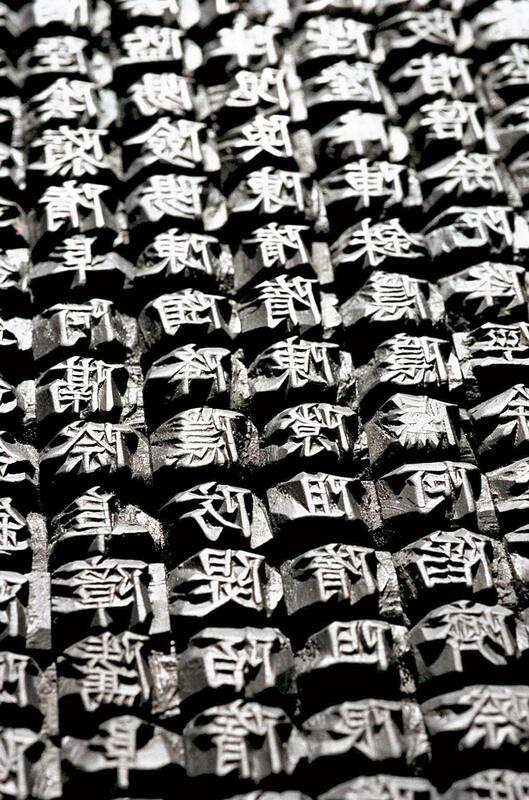
But letterpress printing never became mainstream in countries where kanji characters were used because of the vast number of type pieces required for printing -- there are said to be about 50,000 kanji characters, as opposed to 26 letters in the English alphabet.
Still, a number of publishing projects were tried in the early years of the Edo period (1603-1867) in Kyoto using the new technology of letterpress printing.
Before starting the Tokugawa shogunate in Edo (present-day Tokyo), Tokugawa Ieyasu was based in the Fushimi district of Kyoto, and presented the Enkoji temple with 100,000 woodblock typefaces. Books printed by the temple using the typefaces came to be known as the Fushimi-ban (the Fushimi edition).
Among the books were texts on the art of war in ancient China and textbooks on imperial rule -- just the kind of books the Ieyasu at that time would have read.
Eventually, local tradesmen got involved. Books representative of their participation are those published by Suminokura Soan, a wealthy merchant in the Saga area in Kyoto, in collaboration with calligrapher-potter Honami Koetsu and others. They are called the Saga-bon, or Saga books, and are deluxe tomes of classic literature that include the "Ise Monogatari" (The Tales of Ise).
Commercial publishing in Japan started in the early 17th century in Kyoto. Booksellers recruited printing craftsmen who had become independent from temples to publish the books, then sold them at their own stores. The books covered a wide range of genres -- classical literature, new novels, joruri puppet plays, books on enlightenment and morality, picture books, kimono catalogues, travel guidebooks, maps. The list went on.
Japan's high literacy rate supported the industry. Projecting on the high side, Yasuo Saito of the National Institute for Educational Policy Research estimates that the literacy rate in the late Edo period was 50% to 60% for men and around 30% for women.
Read more from The Japan News at https://japannews.yomiuri.co.jp/