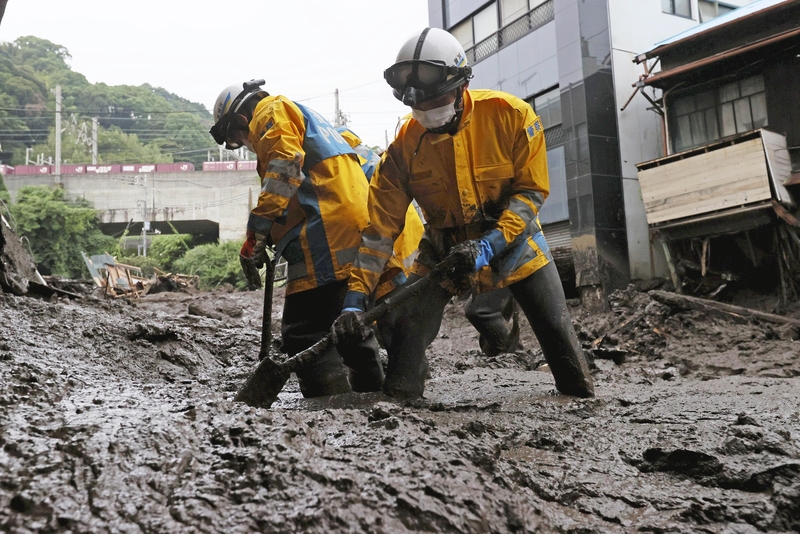
SHIZUOKA -- Mudflows moved at great speed while devastating a residential area in Atami, Shizuoka Prefecture, and the amount of remaining sludge and intermittent rainfall have impeded rescue efforts.
Japan has thousands of mountain rivers where landslides like the one that happened in Atami could occur, and residents must be aware of the perilous nature of such areas.
-- Pair of landslides
"Dark brown water was flowing fast," a resident said about the fatal landslide that occurred Saturday. "Soil and sand surged down toward me," said another, overwhelmed by the force of the mudflow.
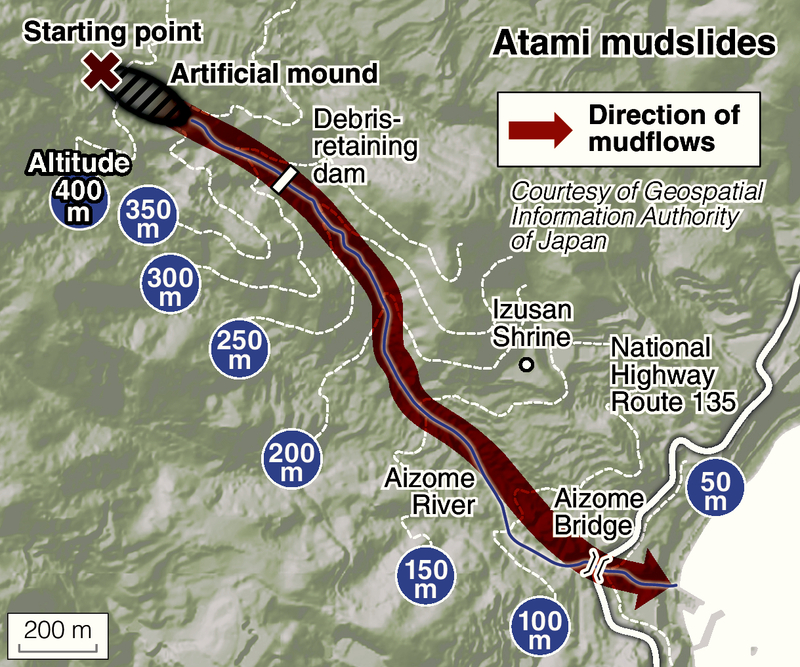
The first mudslide occurred near the upper reaches of the Aizome River at about 10:30 a.m.
According to the Shizuoka prefectural government, the mudslides were about 2 kilometers long and had a maximum width of about 120 meters. More than 100,000 cubic meters of earth are believed to have collapsed, sweeping away approximately 130 houses and buildings.
Yuki Matsushi, an associate professor at Kyoto University's Disaster Prevention Research Institute, analyzed video taken by residents and aerial photos and concluded that at least two landslides occurred, with speeds reaching up to between 29 kph and 32 kph -- making it almost impossible for people to run away from the mudflow.
"It appears that the first mudflow made the area wet, which allowed the second flow to increase in speed easily," Matsushi said.
-- Too large to stop
The Aizome River is designated as a mountain stream with a high risk of landslides occurring, and there is a prefecture-built debris-retaining dam about 400 meters downstream from the point where the mudflow began. The dam is 10 meters high and 43 meters wide, and can retain 4,200 cubic meters of soil.
"The enormous amount of mud easily exceeded the dam's capacity," a prefectural government official said.
A prefectural government field survey conducted on Sunday morning found small cracks on the slope near the mudslide's starting point. Groundwater flows from the collapsed slope and increases with rainfall. The scope of the collapse is too large to stop with only emergency procedures, such as piling up sandbags and blocks.
"Anything can happen depending on the rain," said an employee from the prefecture's Atami civil engineering office.
Since Monday, Shizuoka Prefecture has commissioned the private sector to conduct visual monitoring during the daytime and inform Atami city of any sign of collapse near the site through the local fire department. In the case of possible imminent danger, a warning will be issued via smartphone using a notification called Area Mail Disaster Information Service, among other measures. Cameras have been installed to monitor at night, too.
Read more from The Japan News at https://japannews.yomiuri.co.jp/