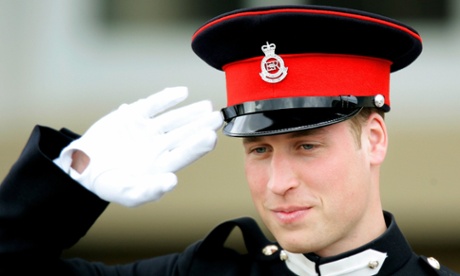
Prince William was not good enough to qualify for Sandhurst’s top honour, a former army officer at the military academy has revealed at a trial at the Old Bailey.
Lieutenant colonel (retired) Roy Parkinson told jurors at the trial of four Sun journalists that the Duke of Cambridge was in the “top third” of his year, but he was never in the running for the institution’s coveted “sword of honour”.
Parkinson told the court that a report in the Sun in 2006 was incorrect when it claimed the royal was “odds on” to win the award, which is given to the military academy’s best cadet each year and in 2006 – the year William trained at Sandhurst – was won by a female colleague.
“It was never true,” said Parkinson of the Sun’s report. “He was in the top third … To be in the running at all you have got to be a junior under officer.” Parkinson said there were “something like 16 of them” in William’s year.
“And was Prince William ever one of those?” asked prosecutor Michael Parroy. “No,” said Parkinson.
The retired lieutenant colonel was giving evidence at the Old Bailey where four Sun journalists are on trial over allegations they were involved in a plot to pay public officials for stories. The four, including the paper’s royal correspondent Duncan Larcombe, deny the charges.
Parkinson was an instructor at Sandhurst and acted as the spokesman for the academy in 2005 and 2006. He told jurors how security had to be “beefed up” at the military school when Prince William and Harry were in training.
The trial heard earlier from a former Sandhurst instructor who said the institution prepared for the arrival of the princes with extra precautions put in place.
These included what the judge called “sham” training schedules to act as a decoy, with the real programmes printed out and circulated to a limited few.
However, Parkinson said there were several attempts by members of the press to break into the grounds, and one occasion when an Afghan refugee eluded security by hiding on a bus from Germany that was carrying a football team due to play at the college.
“He jumped out of the bus in the middle of Sandhurst,” said Parkinson. “It was quite a shock.”
Parkinson told jurors Sandhurst knew someone was leaking the genuine training programmes because photographers would turn up on exercises, including one in the Black Mountains where they were staked out in “very inaccessible area” waiting to snap the princes.
“It was very worrying because we knew someone was leaking the training programme. Will and Harry had their own security detail but because we knew someone was leaking the training programme, security had to be beefed up for everyone – not just on this exercise but on them all,” he said.
Separately, the jury was told that Prince Harry was given special treatment during his training at Sandhurst, being allowed to leave the campus to visit his girlfriend.
In a witness statement, freelance photographer Andy Bush said he spent eight days at Bovington Camp – a military training ground in Dorset – in July 2006 as part of a “watch team” for the Sun.
“While in the area I noticed that Prince Harry was regularly leaving the camp between 16.00 and 18.00 hours each evening,” said Bushe. Through a process of elimination he worked out where the prince was going, leading to a story in the paper headlined: “Guess where Harry’s secret Love Nest is”.
“I think it would be of interest to some people in that it shows that Prince Harry received special treatment in that he was allowed to leave Bovington Camp during training,” said Bush.
On trial are the Sun’s deputy editor Geoff Webster and executive editor Fergus Shanahan, the paper’s chief reporter John Kay and royal correspondent Larcombe. All four deny conspiracy to commit misconduct in public office.
The trial continues.