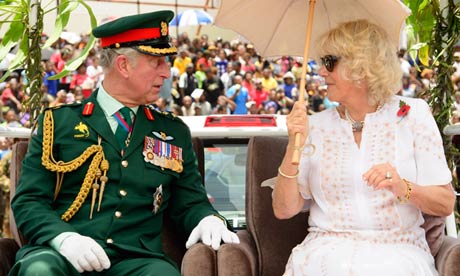
Prince Charles and the Duchess of Cornwall were given a warm welcome on Saturday as they arrived in Papua New Guinea to begin a two-week Antipodean tour to mark the Queen's Diamond Jubilee.
The Prince of Wales spoke in the local language called Tok Pisin as he introduced himself as the "nambawan pikinini bilong Misis Kwin" – the number one child belonging to Mrs Queen. Similarly, when the Duke of Edinburgh visits he is addressed as "oldfella Pili-Pili him bilong Misis Kwin".
Tok Pisin is a creole language and is the most widely spoken in Papua New Guinea with between one and two million exposed to it as a first language. Tok is derived from the English word talk and Pisin from pidgin. Much of its vocabulary has a charm of its own, as the following testify:
• liklik box you pull him he cry you push him he cry – an accordion
• bigfella iron walking stick him go bang along topside – a rifle
• skru bilong han (screw belong arm) – elbow
• gras bilong het (grass belong head) – hair
• maus gras (mouth grass) – moustache
• gras bilong fes (grass belong face) – beard
• bel hevi (belly heavy) – the heavy sinking feeling that often accompanies extreme sadness
• magimiks bilong Yesus (Magimix belong Jesus) – helicopter
• pen bilong maus (pen belong mouth) – lipstick
• bun nating (bone nothing) – a very thin person
• tit i gat windua bilong em (teeth have window belong him) – a broken-off tooth
• sikispela lek (six legs) – man with two wives
• susok man (shoe sock man) – urbanite
• frok-bel (frog belly) – obese person
• pato-lek (duck legs) – waddling person
• emti tin (empty tin) – person who speaks nonsense
• flat taia (flat tire) – exhausted person
• smok balus (smoke bird) – jet airplane
• poket bruk (pocket broken) – out of money
• bagarap (bugger up) – broken, to break down
• haus moni (house money) – bank
• haus sik (house sick) – hospital
• belhat (belly hot) – angry
Adam Jacot de Boinod is author of The Meaning of Tingo and creator of the iPhone App Tingo