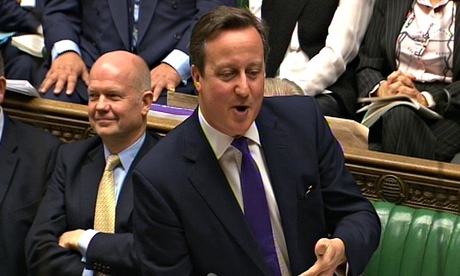
It’s good theatre, but what’s the point? On Sunday, the deputy prime minister, Nick Clegg, told BBC Radio 5 Live that he thought prime minister’s questions had reached their sell-by date. “The whole thing is ridiculous,” he said, “the whole thing should be scrapped. It’s an absolute farce.”
The timing of Clegg’s remarks is no coincidence. The coalition now exists in name only: the election is the only thing on anyone’s mind at Westminster. Clegg used merely to have to sit awkwardly through PMQs while David Cameron defended policies the Lib Dems didn’t totally believe in; last week, the prime minister took to openly mocking his coalition partner for their standing in the polls. Clegg’s only fightback is to try to reposition himself as the man he was in 2010. The outsider looking in, the only politician guaranteed to talk sense.
Clegg has a point about PMQs, which began life in 1961 as two weekly, 15-minute sessions on Tuesdays and Thursdays before Tony Blair replaced them with one 30-minute session on a Wednesday in 1997. The proceedings generally take place to a childishly noisy background of cheering, heckling and farmyard noises from backbench MPs, with the main exchange between Ed Miliband and Cameron lasting 10 minutes or so, as the leader of the opposition only gets to ask six questions.
Even those 10 minutes are rarely enlightening, as the art – politicians do see it as an art – of PMQs is to avoid embarrassment. Frequently, this means answering a completely different question from the one asked, or providing some accomplished waffle. Or both. Miliband recently asked Cameron about waiting times in A&E. “Cancer waiting times have gone,” Cameron replied. Miliband tried again. “What about the NHS in Wales that is Labour-controlled?” the prime minister replied. PMQs had suddenly become leader of the opposition’s questions. Getting straight answers is nigh impossible.
It’s not hard to come up with ways to improve PMQs. Banning backbenchers from braying would be a welcome start. Individually, MPs all say that the heckling is a bad thing, but put them in the chamber together and they don’t seem to be able to help themselves. Bizarrely, having the TV cameras in the Commons only encourages them to behave worse: so much for the surveillance society. The Commons could also usefully dispense with the half dozen or so whip-planted questions from Tory backbenchers along the lines of “Five people got a job in my constituency last week. Would the prime minister agree that this is proof of the success of his long-term economic plan?” That time could be much more usefully used by the opposition.
Yet even in its current, deeply flawed format, PMQs is an institution worth preserving. It ensures that the prime minister of the day has some command of all areas of policy and is held accountable, at least partially, for them. There is nothing any prime minister would like more than to get rid of PMQs. Even the most accomplished performers have dreaded them; that alone should be reason enough for them to be retained. Without them, we lose a fragment of democracy.