India's citizens are witnessing a remarkable inversion of democracy: a government choosing its voters rather than the other way around. Even as public discontent grows across the country, Prime Minister Narendra Modi's ruling Bharatiya Janata Party (BJP) has strengthened its grip on power by manipulating the electoral process itself. The result is a stark reminder of what can happen when institutions meant to safeguard democratic integrity instead work to undermine it.
The means by which this inversion was achieved were deceptively mundane. In the run-up to the state elections held in April and May, India's Election Commission -- effectively appointed by the government and already facing accusations of pro-BJP bias -- launched a "special intensive revision" (SIR) of voter rolls. Officially, the exercise was intended to improve their accuracy and integrity. In practice, as the political scientist Gilles Vernier has argued, it amounted to "the greatest disruption of the electoral process India has ever seen".
Updating voter rolls is not inherently controversial. Democracies, after all, must periodically account for population movements and demographic change. But the SIR's door-to-door verification process was rushed and implemented unevenly, resulting in an unprecedented voter purge. By late May, more than 65 million names had been removed from electoral rolls in nine states and three union territories. Some estimates suggest that the final figure could reach 100 million.
Until recently, voters whose names already appeared on electoral rolls were presumed eligible unless officials could establish legally valid grounds for removing them under the 1950 Representation of the People Act and the 1960 Registration of Electors Rules. The SIR process changed that, requiring previously registered voters to prove their eligibility by providing extensive documentation -- even their parents' birth certificates.
The burden of proof was thus shifted onto voters, including many who had cast ballots in many previous elections. For millions of poorer Indians, obtaining the required documentation proved difficult or impossible, leaving their eligibility to the discretion of local officials.
Nowhere were the consequences more apparent than in West Bengal, an opposition-controlled state that the BJP has long sought to capture. More than nine million voters were reportedly removed from the rolls, often for minor discrepancies such as spelling errors or inconsistencies in a parent's age.
Notably, these strict standards have been applied only in West Bengal. The deletions were concentrated in opposition strongholds and Muslim-majority constituencies and disproportionately affected women, who were more likely to support the opposition. While roughly 3.4 million West Bengal residents filed appeals within the brief period allowed, only 1,607 names -- fewer than 0.05% -- were restored, with most appeals remaining unresolved when voting began. At the same time, nearly half a million new voters were suddenly added to the rolls through an equally opaque process. The integrity of the voting process has also come under scrutiny. An analysis of voting data from two constituencies, for example, found substantial discrepancies between reported turnout figures and the number of votes that could have been cast during polling hours.
It is hardly surprising, then, that the BJP secured its first-ever victory in West Bengal, enabling it to form the state government. The incumbent chief minister lost her own constituency by roughly 15,000 votes, a margin smaller than the number of around 60,000 voters reportedly removed there. While BJP supporters hailed the outcome as an "electoral tsunami", it could simply reflect the cumulative effect of multiple forms of electoral fraud.
The consequences are not limited to the ballot box. In West Bengal, the new government has declared that individuals removed from voter lists will be ineligible for welfare benefits, including food and housing assistance, health care, and cash transfers. What began as a voter-verification process is now being used to determine who is entitled to public services.
India's Supreme Court has failed to check these abuses. The court has taken no action in cases where the BJP's margins of victory were significantly smaller than the number of voters removed from the rolls, nor has it intervened when voter-roll exclusion has been used to deny people their basic rights.
Meanwhile, Mr Modi's government is setting its sights on redrawing constituency boundaries, a move that could further cement its electoral dominance. As Mr Vernier notes, the danger is not simply that elections may be manipulated, but that the rules governing them are "set unilaterally by the very actors who stand to gain from them". When that happens, he warns, elections "cease to be the mechanism by which power is contested and instead become the mechanism by which power gets entrenched".
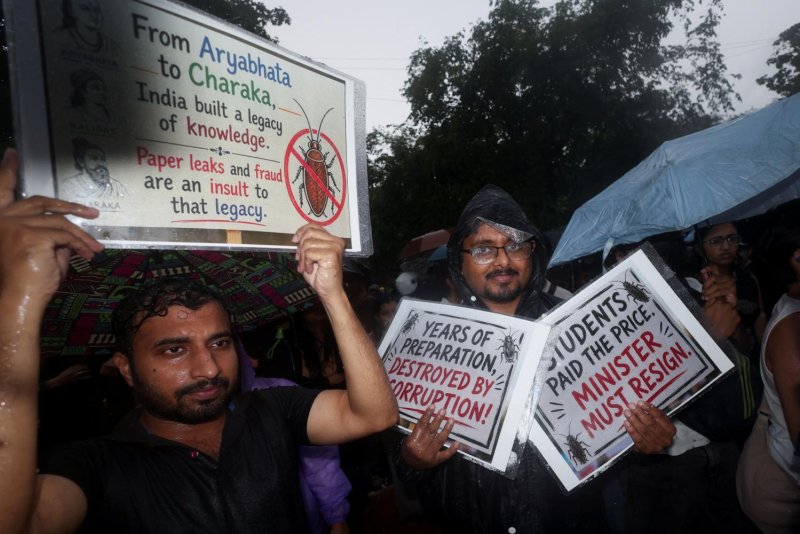
For all the BJP's apparent electoral popularity, however, signs of public discontent are mounting. Workers in industrial centres have protested against stagnant wages, while farmers have taken to the streets over rising diesel and fertiliser prices. Earlier this month, large student demonstrations swept New Delhi and several other cities, demanding Education Minister Dharmendra Pradhan's resignation following a series of scandals involving the National Testing Agency, which oversees university admission exams.
Some of these protests have been organised by the Cockroach Janta Party, a youth movement that began as an online joke after Chief Justice Surya Kant referred to unemployed young people as "cockroaches" and "parasites". Its stated mission is to "build a party for a generation raised on promises, notifications, and low battery warnings. A generation that is overqualified, frustrated, angry at what's broken, and financially confused."
The movement now has more social media followers than India's major political parties combined. But for this discontent to translate into real change, the ongoing election fraud must be stopped.
India's experience should serve as a warning to other democracies. In the United States, President Donald Trump and his allies have already called for the federal government to review state voter rolls. With aspiring autocrats worldwide watching closely, India could become a blueprint for authoritarian entrenchment or -- if its citizens prevail -- a warning for those who underestimate the resilience of democratic resistance. ©2026 Project Syndicate
Jayati Ghosh, Professor of Economics at the University of Massachusetts Amherst, is a member of the Club of Rome's Transformational Economics Commission and Co-Chair of the Independent Commission for the Reform of International Corporate Taxation.