The new curriculum guidelines for elementary, junior and senior high schools have made it mandatory to learn about the culture of the Ainu ethnic group ingenious to Japan, and references to Ainu have increased in school textbooks. Although not many schools teach the history and other aspects of Ainu in classroom lessons, there are some where students learn about the Ainu people and culture through an advanced approach.
-- Learn with pleasure
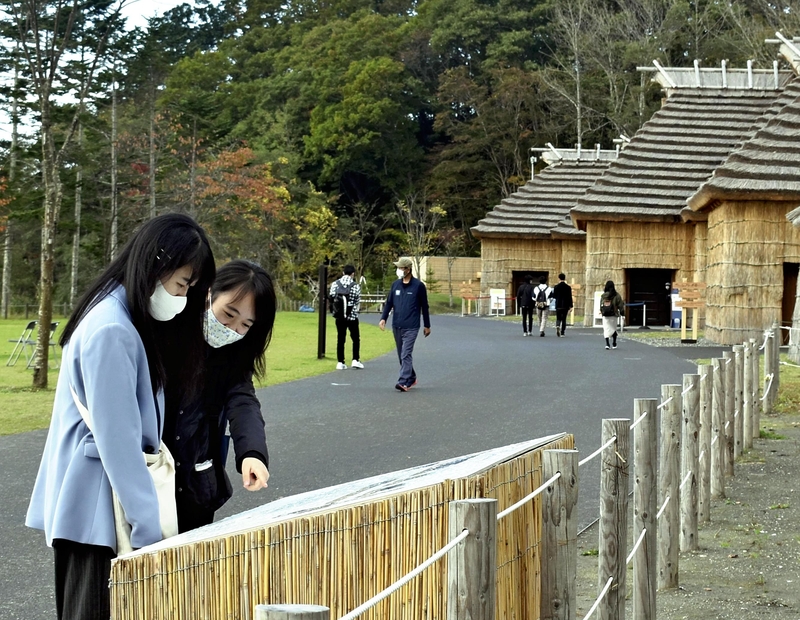
"Please look at the common and different points between pit dwellings and Ainu houses."
A teacher said this to 54 sixth-grade pupils of Sapporo municipal Momiji no Mori Elementary School who, on a school trip, visited the Symbolic Space for Ethnic Harmony Upopoy in Shiraoi, Hokkaido, on Sept. 15. Upopoy comprises the National Ainu Museum and the National Ainu Park. After being instructed by the teacher on what should be observed, the 54 pupils fanned out to observe traditional Ainu cise houses that had been restored for exhibition.
During their two-hour stay at Upopoy, the pupils enjoyed listening to songs and watching dances and exhibits at the national museum. A male pupil said, "I became able to know that kamuy (god) and humans have a close relationship."
Upopoy has been attracting groups of elementary and junior high school students daily as a school trip destination since its opening in July and the number of such school outings is likely to top 700 before the school year ends next March. "We want visiting pupils to feel and enjoy [Ainu culture] through experiences that they cannot have at school," said a public relations official of the Foundation for Ainu Culture, which operates Upopoy.
-- Expertise handed down
Nibutani Elementary School in Biratori, located about 90 kilometers east of Shiraoi, has a more than 20-year history of having its pupils experience Ainu culture. This year all 12 of its pupils attempted weaving attus fabric made with inner tree bark. The attus of Nibutani is designated by the Economy, Trade and Industry Ministry as one of Japan's traditional crafts. In a classroom lesson held on Sept. 16, the pupils wove multicolored attus with the use of small weaving devices and pasted them together to make coasters. They followed the instructions of Rumiko Fujiya, a 71-year-old successor in the skill of making attus.
Sixth-grader Yuki Nakajima expressed her joy, saying: " I could make [a coaster] as nicely as had been instructed. I want to make it again."
Fujiya expressed her hope, saying: "The Ainu culture has been in the media recently, making it easier to talk about it. I hope that this experience will lead to pupils weaving [attus] in the future."
-- Convey basic facts
"The pronunciation of these parts is a feature of the Ainu language," 59-year old instructor Hidetoshi Narita said as he pointed at words ending with "p," "t," and "k" during a classroom lesson held on Oct. 13 at private Keio Shiki High School in Shiki, Saitama Prefecture.
Keio Shiki is the only high school in the Tokyo metropolitan area where the Ainu language can be learned. The students can choose to study Ainu language as one of the 24 languages available for the required subject of "Language and Culture." On this day, 15 second-year students learned pronunciation and other aspects of the Ainu language.
Asked about why he chose to study the Ainu language, Keitaro Kimura, 16, said: "Despite the fact that [the Ainu people] have developed a culture of their own, I never had the chance to associate with it. I wanted to know what it's like." Narita also wanted the students to learn basic knowledge about the Ainu culture as well as facts of the Ainu as an ethnic group.
During the lesson, Narita referred to the history of hardship the Ainu had to endure since the Ainu assimilation policy was carried out in the Meiji era (1868-1912) in addition to the fact that the Ainu were stipulated as the aborigines of Japan for the first time under a law enacted last year for the promotion of policies for the Ainu people. "Languages will be forgotten unless they are used," Narita said. "Rather than that, I'm happy if my lessons will provide chances for students to learn about what kind of people the Ainu people are."
-- More references in school textbooks
Starting this year, according to the Education, Culture, Sports, Science and Technology Ministry, the Ainu and their culture are being studied in 13 elementary school textbooks across five subjects, including social studies and national language. The Ainu and their culture will also be included in 35 textbooks across six subjects for junior high schools starting next school year. In Hokkaido, Ainu-related matters are taught as a regional history, but even with an increase of Ainu studies materials, most classrooms in Honshu and southward are making little to no use of them.
Meanwhile, interest in the Ainu has mounted in recent years mainly among young people. Prof. Hiroshi Nakagawa of Chiba University, who supervises the usage of the Ainu language in connection with a popular manga comic titled Golden Kamuy, said, "The interest in Ainu has increased with the establishment of Upopoy, so it is all the more indispensable to disseminate information on the Ainu now so that they can be known by many more people."
Read more from The Japan News at https://japannews.yomiuri.co.jp/