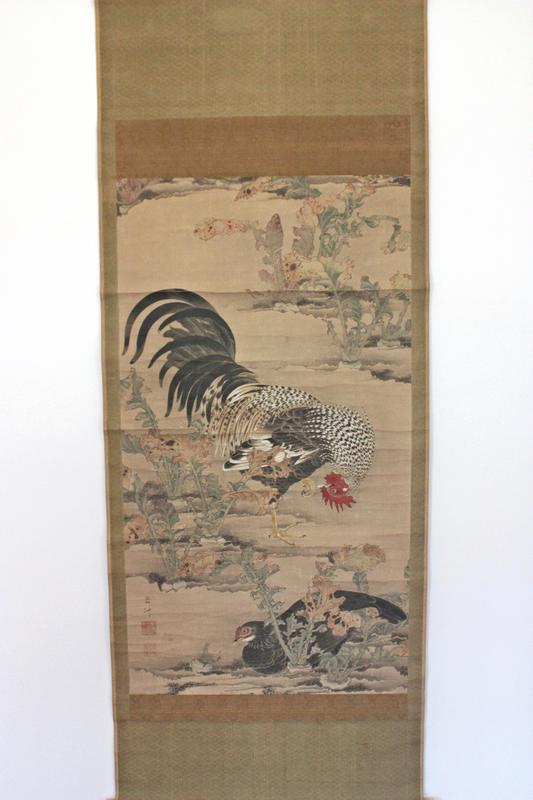
KYOTO -- A colored painting believed to be a previously unknown work by Ito Jakuchu (1716-1800) has been discovered, a museum in Kyoto said Tuesday.
The painting, "Kabu ni Sokeizu" (Rooster and Hen with Turnips), is part of the collection of the Fukuda Art Museum, which said the work is likely to have been created by Jakuchu during his 30s. Jakuchu was a successful artist in the mid-Edo period (1603-1867).
"Jakuchu's early works are few and far between. The discovery is very important because this painting shows signs of the characteristics of his masterpieces," said one expert.
Jakuchu mainly painted flora and fauna. One of his most famous works is a series of colored scrolls called "Doshokusai-e" (Colored paintings of flora and fauna), created when he was in his 40s.
The newly discovered work is 1.11 meters tall and 0.68 meters wide. It depicts a rooster bending his head downward and a crouching hen surrounded by turnips with damaged leaves.
The museum appraised the painting at the request of its owner, who lives in the Kansai region, and presumed it was an early work by Jakuchu for multiple reasons, such as the detailed expression of the fowls' feathers. The painting also has the same "Keiwa" stamp as the "Secchu Yukeizu" (A rooster in snow) in the possession of the Hosomi Museum in Kyoto, which is believed to be one of Jakuchu's earliest works. It is believed that he used the artist name, Keiwa, during his 30s.
"Compared to 'Secchu Yukeizu,' this painting is somewhat technically immature in its use of colors and the rendering of the ground. It could be a work by Jakuchu at an even younger age," said Hideyuki Okada of the Fukuda Art Museum.
Read more from The Japan News at https://japannews.yomiuri.co.jp/