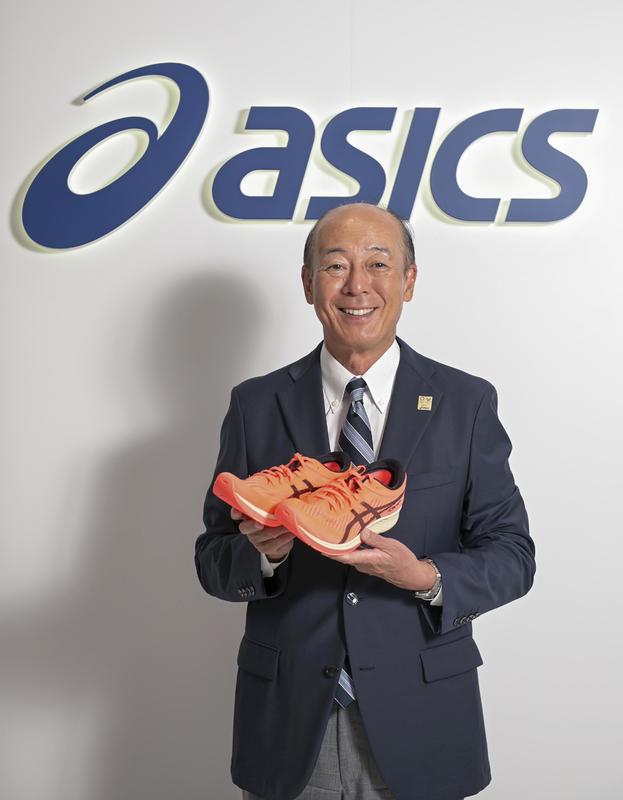
The coronavirus outbreak has served as a reminder of the importance of health. Asics Corp. President Yasuhito Hirota spoke to The Yomiuri Shimbun about how Japan's largest sporting goods manufacturer is showing its presence in the global market amid the pandemic.
I love to run. In February, I completed the KIX Senshu International Marathon held in southern Osaka Prefecture. My interest in running piqued after watching the Tokyo Marathon in 2007 when I was working at Mitsubishi Corp. While watching the race, I thought I could probably complete one, too. The first running shoes I bought were Asics.
The Tokyo Marathon was cosponsored by the brand. In hindsight, I feel like I played right into their strategy. That's why I was happy when then Asics Chairman and President Motoi Oyama asked me to become the president of the company.
-- Hirota had been involved mainly in administrative divisions such as public relations and general affairs at Mitsubishi Corp. He got to know Oyama through his activities in the business community when he was the manager of the Kansai office. In 2018, he became the president of Asics.
I joined Asics not because I was told to make shoes or sell apparel products, but because I was asked to manage the company. The main task of company management is to build a strong organization, create a plan, implement it, and monitor its progress. This basic cycle can apply to all companies. Asics is a company that develops goods, has them manufactured, and then purchases and sells them. Although trading companies are very different [to manufacturers] it didn't feel like there was such a big gap.
In addition to shoe design and engineering, I had to learn a lot of things including how designs are turned into actual products at the factory and how to deal with sports organizations and athletes. I made many discoveries in the process. For example, sports shoes consist of numerous components and each component has its own function.
As far as running shoes go, new products are supposed to be launched only after I've tried them. I actually run in the shoes and return them with records and comments. I'm not a technical expert, so I'm not sure how accurate my assessments are, but I enjoy discussing the details with the development team.
-- Full responsibility
-- Asics recorded sales of 428.4 billion yen in 2015. The company strengthened its overseas business amid a global running boom, which helped the company to more than triple its performance over 15 years. However, growth has been sluggish since then.
When I took office, the first and most important mission was to get Asics back on track. This is what I was told by Oyama, and the whole company was aware of the issue.
Asics' headquarters in Kobe is in charge of managing the entire group and manufacturing products, and the company has sales subsidiaries around the world, including in North America, Europe and China, in addition to Asics Japan, which is responsible for domestic operations.
A gap had existed between the head office and the sales subsidiaries. The stance at head office was "We're the people who make the products and you're the ones who sell them," and vice versa at the subsidiaries.
When business was good, there was no problem, but if things were going badly, the head office would say, "We made a great product, so it should sell, but the way it's being marketed is bad," while the sales team would say, "We're trying our best to sell the products, but we can't because the products are bad." I actually witnessed such clashes in some meetings.
I had to immediately change that. At the company, a manager was assigned to each function, such as planning, production and sales. To change the system, I assigned a manager to each product category, such as running, so that each manager consistently takes responsibility for the entire process from product development to sales.
-- The new structure began in January 2019, but Hirota announced the changes in August 2018, a little over four months after he became president.
The reform plan was compiled quickly not because of me but because of Asics' strength. Once it was decided that something would be done, various ideas emerged and action was taken. This is a company where things move fast.
At the same time, we decided to focus on the running business in North America, which is our main market. As the trend toward enjoying sportswear as a form of fashion spread, we lost our footing and gave up the rights to sponsor the New York City Marathon and the Los Angeles Marathon. We also lost our position as the market leader for shoes in specialty running equipment stores.
Now, we hire sales staff with expertise and have them visit specialty shops across the United States. We've also regained the sponsorship of the Los Angeles Marathon. I think we've been able to show how serious we are.
-- Tokyo Games
One thing that surprised me when I came to Asics was the high ratio of overseas sales: 75% of our sales came from overseas.
-- Nike and Adidas are the two most prominent brands in the global sporting goods market, followed by Puma, Under Armour and Asics.
The sales of Nike, the world's largest sporting goods company, are about 10 times higher than ours. For now, We can't be as involved in all sports like Nike and Adidas. So we focus on our areas of strength, which include running, tennis and volleyball, and concentrate efforts in these areas all around the world.
Asics dominates certain markets in certain countries, like basketball in Japan, rugby in Australia and South Africa and cricket in India. Our fashion brand Onitsuka Tiger is popular in China and Southeast Asia and now it is one of our main businesses.
-- Asics is a Tokyo Olympics and Paralympics Gold Partner, the highest level of Olympic sponsorship in Japan, which gives the company the rights to use the Olympic and Paralympic designations and official emblems for promotional activities. Sales promotion plans have had to be revised after the postponement of the Games.
Sales slowed down in the first half of the year due to the pandemic, but things have turned around in China, Western countries and Japan in that order. In addition to being able to organize inventory during store closures, the increase in online sales has given us an opportunity to think about how to develop e-commerce going forward.
As for the postponement of the Tokyo Games, we're taking a positive approach: We now have more opportunities to launch new products before the Olympics begin.
Successfully holding the Games will mean overcoming the coronavirus or managing to live with it. In either case, it would be an unprecedented achievement that would highlight the joy of playing and watching sports.
Sports equipment is a luxury of sorts. But for sports such as running, all you need is a pair of running shoes.
Amid the coronavirus pandemic, an increasing number of people are interested in running and walking. I want to promote the wonderful appeal of sports.
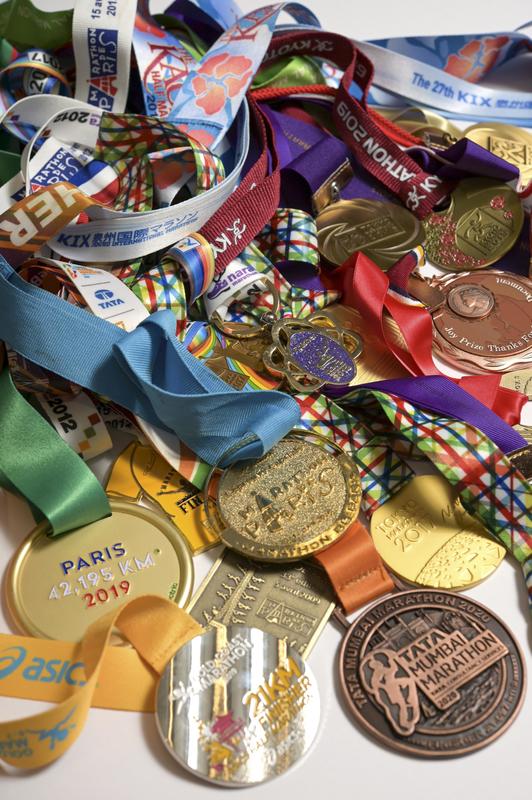
-- Marathon completion medals
Hirota said he was not good at sports in his childhood. He started running with a personal trainer when he was 50 years old. He completed a 10-kilometer race in Kanagawa Prefecture in 2008 and set a goal of running a 10-kilometer or half marathon race every month and a full marathon once or twice a year. He has completed 26 full marathons so far, including four in Paris. In 2017, aged 61, he achieved his personal best of 3:53:27.
-- Hirota was born in 1956 in Aichi Prefecture. He graduated from the School of Political Science and Economics of Waseda University and joined Mitsubishi Corp. in 1980. In 2014, he became a member of the Board and executive vice president of the company. He joined Asics in January 2018 and became president in March 2018.
Read more from The Japan News at https://japannews.yomiuri.co.jp/