
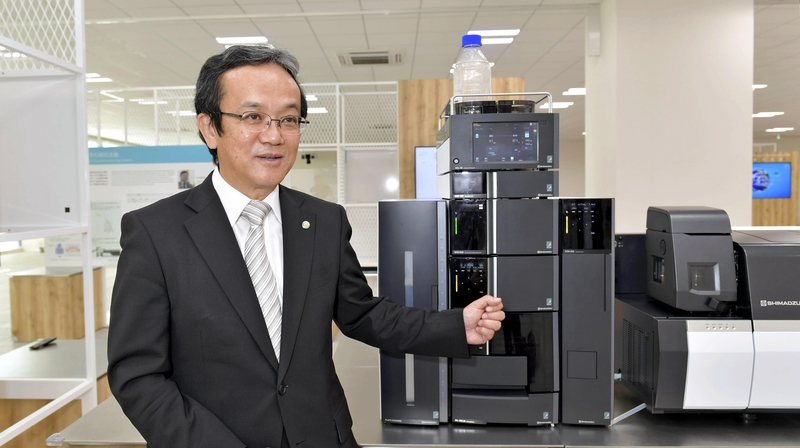
Shimadzu Corp., a manufacturer of analytical instruments and other equipment, whose researcher Koichi Tanaka was awarded the Nobel Prize for Chemistry, has recently made headlines for developing a novel coronavirus detection reagent for PCR testing. Shimadzu President Teruhisa Ueda spoke to The Yomiuri Shimbun about how he is steering his R&D-oriented enterprise.
-- Liquid chromatography
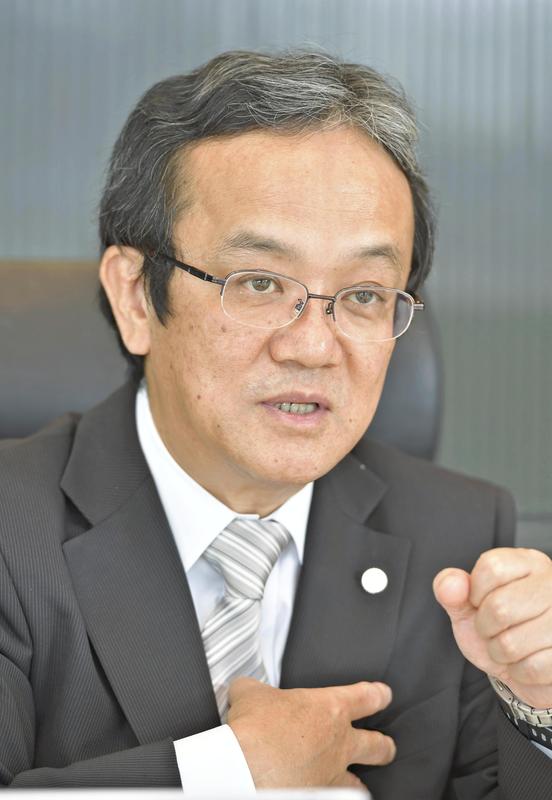
-- Ueda was an engineer who specialized in liquid chromatography (LC) and he has worked with pharmaceutical companies and university researchers. LC instruments analyze the components contained in liquids and are Shimadzu's main products.
I've felt drawn to Kyoto ever since I first visited the city for a school trip in junior high school. I then spent six years in Kyoto as an undergraduate and graduate student at a university. My thesis was studying LC, and when I was a graduate student, a representative for a Shimadzu distributor came to show a new product. The product automatically analyzed the data. I thought it was very impressive and it motivated me to join the company.
My experience in dealing with various complaints from our knowledgeable customers has been an asset. A U.S. pharmaceutical company was infuriated because it had spent a week processing and preparing blood samples from laboratory animals, but it couldn't get the results. I went to [the U.S.] for three days and inspected all 15 units we shipped. Our quick and attentive response was appreciated, and that pharmaceutical company became our primary customer.
We often received complaints from researchers from Japanese pharmaceutical companies as well because the data [collected with Shimadzu's devices] was too inconsistent. Some of those researchers later became professors for the pharmaceutical department at a university and became our joint research partners.
It's very encouraging to hear researchers say, "Shimadzu is the only [company] that can handle our unreasonable demands." When I was a section chief, I remember spending all day -- from morning to evening -- thinking about how to solve the problems our customers had.
When I was the head of development and presented a new product at an exhibition, I heard one person say, "Nothing beats Shimadzu in LC," and I felt so lucky to be an engineer.
-- Even after becoming the company's president, Ueda has kept up-to-date with the latest research as the head of the technicians' group.
Until I was the head of product development, it was OK for me to only focus on my area of expertise. I felt like I was the most knowledgeable person about LC. However, when I became the head of the quality assurance department in 2004, the scope of my responsibilities dramatically expanded. There are 10 departments that develop analytical instruments alone, such as surface analysis products using electron beams and water quality analysis products using ions, and different departments have different organizational cultures. I worked hard but also struggled for about three years.
But after becoming president, I now need to pay attention to not only the analytical instruments but also understand the company's entire product line, including medical equipment such as X-ray diagnostic imaging systems and components for aircraft and semiconductor equipment. While it's good to learn about the products by reading papers and other materials, it's faster to actually see the products being developed.
It's also important to listen to experts. We often hold in-house seminars where we invite professors from universities with which we are conducting joint research. Through listening to their lectures about their research, I'm sometimes able to understand difficult problems.
-- Quick action
-- In April, Shimadzu released the 2019 Novel Coronavirus Detection Kit, which can analyze a sample in one hour to detect the infection. In June, the company realized that it can use saliva as a sample with its reagents and maintain the same level of accuracy as a nasal swab sample.
The reagents used for the test were based on the ones used to detect a virus that causes food poisoning. Since we had the technical foundation, we were able to develop [the new reagents] in a short period of time.
In October, we announced a testing method [that we developed] in collaboration with Tohoku University to confirm infections through exhalation. It's still in the research stage, but we aim to put it to practical use within a few years. Currently, we are only able to quarantine someone after they have tested positive. In the future, we want to help diagnose diseases, such as the risk of developing a serious disease, and also help with treatment and nutrition management.
In addition, we want to help improve how accurately cancer, dementia, depression and other conditions are diagnosed. We are currently working with Hisataka Kobayashi of the U.S. National Cancer Institute to study the practical application of cancer photoimmunotherapy. This therapy combines cancer cells with a special chemical and then exposes them to a light source, which will rupture the cell, and a person's own immune system can prevent the cancer from coming back. The advantage of this method is that it has fewer side effects than conventional treatments using drugs, surgery or radiation. Our company will provide the technical support required to improve the visualization and recording capabilities of the instruments.
Analytical instruments are also being used by food manufacturers more and more. In the past, sensory testing had been practiced, which requires people to actually taste the food, but there is an increasing trend for companies to seek to identify nutritional content in foods. There is also a growing interest in certain health foods, such as those that can prevent lifestyle-related diseases. Currently, we are collaborating with [tea company] Ito En Ltd. to examine catechin and other substances contained in matcha to see if it has an effect on preventing dementia.
Shimadzu is strengthening its collaborations with companies and research institutions in Japan and abroad, and we have about 10 joint research projects in progress at any given time. We recently reached an agreement with Horiba Ltd., which is based in Kyoto like us and works on analytical instruments. We might be considered rivals, but Horiba's President Masayuki Adachi and I are about the same age and we have been talking about collaborating on a project for some time.
-- Corporate culture
-- Shimadzu's founder Genzo Shimadzu started out as a Buddhist altar maker and became the first private citizen to fly a hot air balloon in the early Meiji era (1868-1912). Genzo II, who developed storage batteries and X-ray equipment, was referred to as the "Japanese Edison."
The founder wanted to use science and technology to revive Kyoto, which he felt had been abandoned after the capital was moved to Tokyo. Genzo II, who was granted 178 patents during his lifetime, committed himself to the motto: "We will make anything you wish." This idea of taking on the challenge of new technology is deeply rooted in the company's DNA and has remained a part of its culture.
No one within the company is blamed for the poor sales of new products. If we research something thoroughly, it nurtures engineers and helps build technical skills. If we had been overly selective and focused, we would not have been able to introduce the reagents for PCR testing as quickly as we did. Although our aircraft and industrial equipment business was badly affected by the coronavirus, we were able to avoid a sharp decline in our business performance because of increased demand for PCR reagents and other products.
Our researcher Tanaka won the Nobel Prize in 2002. His award-winning discovery of the method of mass spectrometric analysis of protein was not intentional, but the result of mixing the wrong powder. Looking at Tanaka's steady stream of experiments, it's clear that Shimadzu's DNA has been passed down to him. Shimadzu may not have any more Nobel Prize winners, but we want to create a nurturing environment [for researchers]. I want to value those who can create new and unknown technologies.
Looking back, it took nearly 50 years for LC to become a major product, and the management team at the time had the foresight to see that LC would eventually become important. Although investors are interested in our current performance, I would like them to look five to 10 years down the road.
-- Ueda was born in 1957 in Iwakuni, Yamaguchi Prefecture. He received his master's degree at Kyoto University in 1982 and joined Shimadzu Corp. He took up his current post in June 2015 after being a board member since 2011 and a head of the Analytical and Measuring Instruments Division.
Read more from The Japan News at https://japannews.yomiuri.co.jp/













