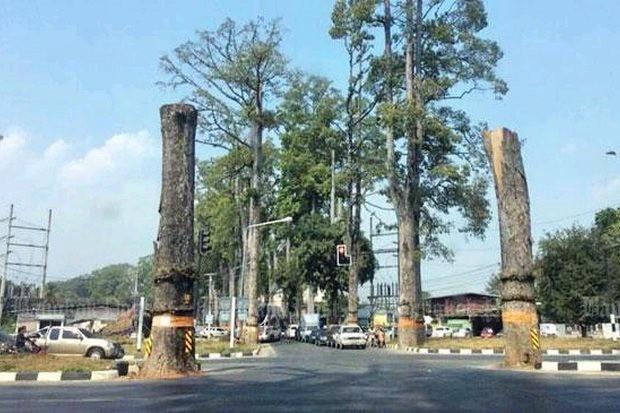
The sight of the iconic yang na trees standing dead in Chiang Mai's Saraphi district is plainly outrageous.
The ugly cut, which lopped the top halves off two old trees, took place in the middle of this month.
The poor lopping which was made by the Chiang Mai provincial administrative organisation (PAO) prompted Srisuwan Janya of the Stop Global Warming Association to petition the Chiang Mai Administrative Court. The activist asked the court to issue an order restraining the local body from cutting off any more of the iconic trees along the Chiang Mai-Lamphun road.

Mr Srisuwan also asked the court to rule that the cutting of the trees was illegal, to order the POA not to cut down any more yang na trees along the road, and to stop replacing old trees with newer, smaller ones.
The PAO defended the act, claiming the trees had been dead and at risk of falling down, which can be dangerous.
This is not the first time the local authorities have thought about cutting yang na trees. From time to time, local officials have pushed for the felling, citing the need to extend the road. But every time they made this suggestion, they were forced to withdraw the idea.
The yang na are perennial trees (dipterocarpus alatus), and the ones concerned were planted in 1899 during the reign of King Rama V. For more than a century, they have stood as a Chiang Mai landmark, with nearly 1,000 trees along the 10-kilometre route. The tree is a protected species with a high market value.
And once again, the idea is being debated in an "either/or" format; either the trees or public safety.
A few days after the dead trees hit the news, a netizen who claims to have lived near the trees posted on the "Changwat Chiang Mai" Facebook page, lending her support to the PAO. She complained that her house and car were damaged when large branches fell last year due to strong winds. So, the trees must go.
"For those who told us to avoid [the trees], how can we when we live here?" she said.
But it is not necessary to limit the choices to "either" and "or."
The yang na tragedy has much to do with carelessness on the part of state authorities, particularly those at the local highway agency.
There are suspicions that some officials wanted the trees dead so they could go ahead with road construction.
Mr Srisuwan said the state road constructors have carelessly covered the ground with cement to accommodate motorists. But cement has for years prevented plants from obtaining oxygen and nutrients. Such a blatant act leads to a slow death by the iconic trees.
The activist also filed complaints against the Chiang Mai highway agency. He insisted the cement must be removed, if the plants are to survive.
The authorities must make genuine efforts to rehabilitate these yang na trees. They must examine how many trees have been damaged and implement measures to save them from an unjustifiable death.
As the rehabilitation work requires knowledge, the authorities must not do it alone but reach out for help from professional arborists, or at least park officials.
Chiang Mai PAO officials and those involved in road maintenance should learn from their mistakes and allow knowledgeable people to take a crucial part in the decision-making and planning process to ensure the trees get the care they need.
The poor treatment of the trees that went on for so long means that some of the yang na may have to be replaced. If that is the case, any decision to remove an iconic tree must be transparent, and those involved must take accountability.
There must be both short- and long-term planning to make sure the trees are not harmed. This means the town planning agency must get involved to make sure the city's development and expansion will not have an adverse impact on the iconic trees.
Bypass roads, if necessary, must be built. Better yet, the town planners, together with PAO officials, must work out an alternative transportation system that will make it possible for commuters to avoid using private vehicles.
As a piece of Chiang Mai's history, the yang na must be preserved.