This is the third installment of a series exploring ways the auto industry plans to survive in the novel coronavirus era.
The first few months of the novel coronavirus pandemic walloped Japanese automakers, as global production plunged about 60% in May. Since then, many automakers have ramped up production again, partly thanks to solid sales in China, where infections have not increased greatly. However, the road to the point of being able to boost production has not always been smooth.
In a message delivered at a Nov. 6 press conference to announce Toyota Motor Corp.'s interim financial results for fiscal 2020, Toyota President Akio Toyoda proudly described the efforts behind his company's rebound.
"The numbers we announced today are the result of the hard work of many people. They are in no way simply an outcome that came about by itself," Toyoda said.
Toyota has revised significantly upward its forecast for its business results for the fiscal year ending in March 2021. The full-year forecast for operating profit was increased from 500 billion yen to 1.3 trillion yen.
Toyota shrugged off the worst of the coronavirus pandemic thanks to the RESCUE supply chain database built in 2013. This system centrally manages information about the number of components needed for each vehicle type and suppliers of those parts. Information on about 400,000 parts is recorded in the database.
About 30,000 components go into each automobile. If even one of these parts is missing, the vehicle cannot be made. Toyota established the database after the automaker had to halt production for an extended period following the March 2011 Great East Japan Earthquake. The system allows Toyota to quickly arrange a replacement supplier if there are concerns of a parts shortage.
The coronavirus outbreak has resulted in restrictions on people's movements and factory shutdowns around the world. Since February, Toyota also was forced to briefly close plants in some countries. However, Toyota kept shutdowns due to parts shortages to a minimum and reduced the outbreak's impact on its business performance.
Quick decisions made
The time between a vehicle being ordered and being delivered can be quite long. This lead time is even longer for vehicles exported overseas. A glut of vehicles in storage increases expenses, which could put a squeeze an automaker's management.
In mid-March, Ryuichi Umeshita, a Mazda Motor Corp. executive officer in charge of sales, was growing increasingly uneasy about the lockdowns being imposed in places such as Europe and the United States. After discussing the issue with Mazda President Akira Marumoto, the company swiftly decided to cut production.
"If we don't turn off the tap, this could prove fatal," Umeshita said.
Mazda sells new vehicles in about 130 nations and territories around the world. About 60% of these vehicles are exported from Japan, so any mistake in observing demand trends could result in a large buildup of stock. "If we think a major problem could emerge, we need to quickly make decisions," Umeshita said.
Simple, clear guidelines
Automakers also have been taking meticulous steps to prevent their workers from catching the coronavirus.
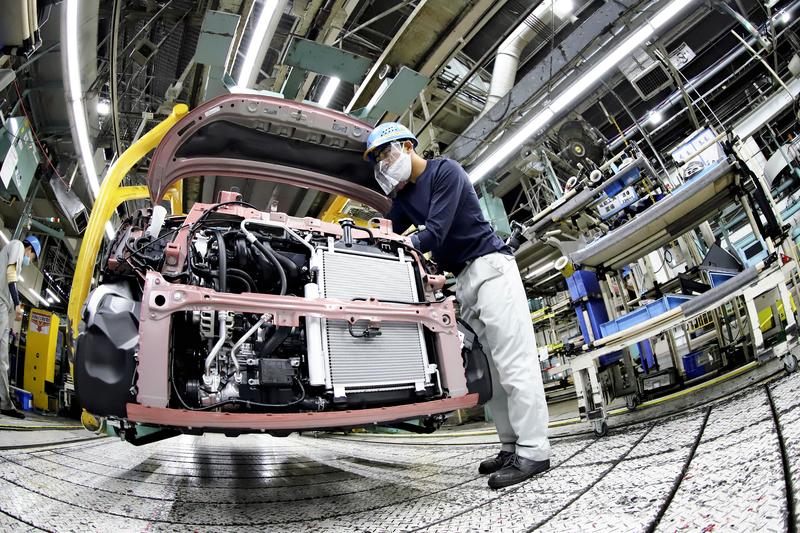
Mitsubishi Motors Corp.'s Mizushima plant in Kurashiki, Okayama Prefecture, is a major manufacturing facility that churns out about 330,000 vehicles annually, mainly the eK Wagon minicar and the RVR sport-utility vehicle. "Infection prevention maps" have been posted in about 70 sites inside the factory, including production lines and rest areas. These maps detail rules tailored to prevent infections in each area.
Employees maintaining a safe distance from each other while working is an effective way to prevent viruses from spreading through a workplace. However, this is not practical on production lines. The positions where workers stand when affixing parts and the work sequence are precisely determined, and these details cannot easily be changed.
Mitsubishi decided that workers who are within one meter of others must wear a face shield, workers within one to two meters of others must wear a mask, and workers who stay at least two meters apart would be encouraged – but not required – to wear a mask. In addition, Mitsubishi made a map that indicated each worker's position with a color or symbol so other plant employees could tell at a glance what precautions they should take. Partition curtains were installed at locations where employees cannot avoid being in close proximity.
Hand sanitizer is available at 300 places inside the plant, and the number of people allowed in rest areas and dining areas is restricted. The head of the plant's assembly line said, "Having our infection prevention measures clearly visible has made all our employees more aware of these precautions, and made it easier to take responsibility for their own actions and remind others to be careful."
So far, not a single case of the novel coronavirus has been detected among the Mizushima plant employees.
Read more from The Japan News at https://japannews.yomiuri.co.jp/