Japan has suffered a series of major disasters during the Heisei era, and it is possible an earthquake directly beneath Tokyo (see below) or a massive earthquake in the Nankai Trough (see below) will take place in the future. How can we minimize the damage and rapidly restore social functions?
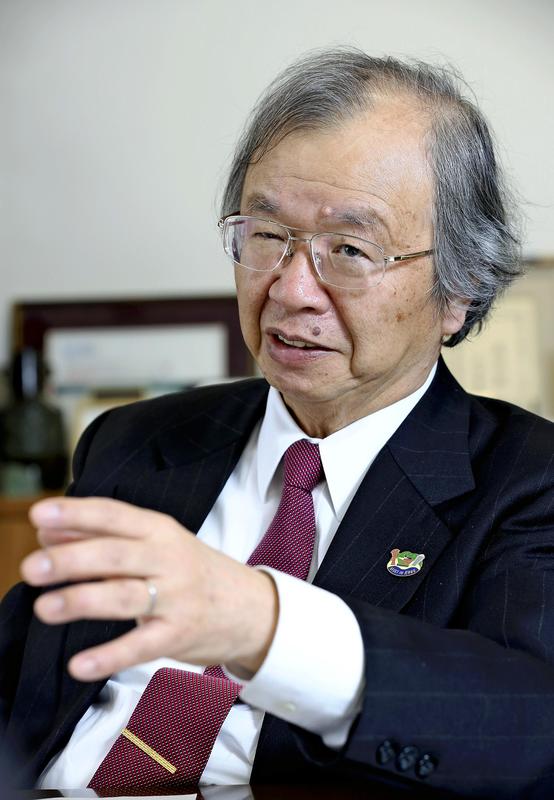
The Yomiuri Shimbun interviewed Yoshiaki Kawata, an expert on major disasters, who was an early advocate of the concept of "disaster reduction." He now argues for the importance of "disaster resilience" to reduce the time for recovery and reconstruction. The following are excerpts from the interview.
Challenges for an aging society
The Yomiuri Shimbun: It's been two years since the Kumamoto Earthquake, in which tremors reaching 7 on the seismic intensity scale struck twice. Indeed, there have been many disasters over the past 30 years.
Kawata: The Heisei era has been an age of earthquakes. In the Great Hanshin Earthquake of 1995, the majority of those who died were crushed by debris, so the government has strengthened earthquake-resistance reinforcement measures for public buildings and residences. In the Kumamoto Earthquake, the ratio of deaths caused directly by the earthquake to homes totally destroyed declined to one-tenth that of the Great Hanshin Earthquake.
However, there were over 210 earthquake-related deaths, more than quadruple the 50 direct deaths. There are many elderly people who fall ill and die due to long-term evacuation.
In the Kumamoto Earthquake, there were a notably large number of aftershocks. Many people were living in their vehicles because of risks like building collapses, and there were delays in local authorities learning about conditions outside of designated evacuation areas. Reducing the various physical and mental stresses of the evacuation environment can be said to be a major challenge for an aging society.
Q: The majority of deaths in the Great East Japan Earthquake were caused by the tsunami.
A: It was a major tsunami, but the average distance people ran to reach higher ground to escape it was 438 meters, which is not a difficult distance for the average person to run in an evacuation. If the major tsunami warning that was issued had led to everyone's prompt evacuation, many more lives would surely have been saved.
The basis of disaster prevention ought to be "self-reliance," by which each individual acts on their own judgment to protect themselves. However, the challenge is how to handle people who have difficulty with self-reliance. Many of those who died or went missing during the Great East Japan Earthquake were 60 or older.
Q: The 1959 Ise Bay Typhoon resulted in more than 5,000 dead and missing people. After the disaster and until the Great Hanshin Earthquake, there were no disasters that resulted in more than 1,000 victims.
A: This is partly because flood control measures have improved since the Ise Bay Typhoon. Fortunately, Japan was then undergoing an economic boom, and it would be fair to say that the many dams built in river basins contributed to the reduction in flooding. Even in the Heisei era, there have been few cases of disasters with more than 100 victims, and we have developed a disaster prevention capability for small and moderate disasters.
If it were to occur in 2020?
Q: What problems would there be in an earthquake directly underneath Tokyo?
A: The overconcentration in Tokyo is the most frightening thing. Downtown Tokyo still has areas with a high density of wood-frame houses. In these areas there is a risk of the same kind of damage that we saw in Kobe in the Great Hanshin Earthquake, such as buildings collapsing and fires spreading.
In places like Kasumigaseki and Marunouchi in Tokyo, which are the centers of government and business, this overconcentration of people and things, as well as the information network, means they will all be hit simultaneously, developing into a "complex disaster" in which damage to the different parts of the system tangle together. If we take a passive approach in which everyone is waiting on information from the damaged areas, the initial response will fail.
For example, if an earthquake were to occur during the 2020 Tokyo Olympics and Paralympics, knowing certain information in advance -- such as how many people are at each competition venue and how many people are staying at which hotels -- is within the scope of everyday disaster prevention.
Q: The government's Central Disaster Management Council Working Group, in which you served as chief investigator, estimated that a massive earthquake in the magnitude-9 class along the Nankai Trough would cause 320,000 deaths and economic damage of 220 trillion yen in a worst-case scenario.
A: Simply warning of the danger is meaningless. We also demonstrated disaster reduction effects, that if evacuation started in the early stages and people fled from tsunami to evacuation shelters, fatalities would be reduced by 80 percent. In Kuroshio, Kochi Prefecture, where the largest tsunami is predicted to hit, they have built one of Japan's largest tsunami evacuation towers. By looking up at the tower everyday, the residents have come to realize that a tsunami really could happen, and they now participate in evacuation drills.
Power of resistance needed
Q: What is the concept of "disaster resilience" that you emphasize as a part of "disaster reduction"?
A: Major disasters are inevitable. If we do not pursue "disaster resilience" to minimize damage and reduce the time for recovery and reconstruction, the damage will spread. Even if some social functions are interrupted by the disaster, we must not allow overall function to deteriorate.
There is a limit to the public assistance the central government and local authorities can provide. We are required to have the power of "resistance" to disasters so that communities will be able to make decisions on their own. To that end, we must, for example, make sure that all residents understand their roles at evacuation shelters and repeat drills. If you're not doing this on a regular basis, you won't be able to do it during a disaster. I want people to take the awareness and practice of everyday disaster prevention seriously, such as by reinforcing buildings and stockpiling food.
-- This interview was conducted by Yomiuri Shimbun Staff Writer Masanori Matsumoto.
(From The Yomiuri Shimbun, April 14)
-- Earthquake directly beneath Tokyo
The probability is believed to be 70 percent within the next 30 years. Some areas will experience the maximum of 7 on the seismic intensity scale, and the majority of the metropolitan area will be struck by tremors with an intensity greater than upper 6. In the worst-case scenario, estimates project 23,000 deaths, 610,000 buildings totally destroyed or burned, and 8 million people having difficulty returning home.
-- Massive earthquake in the Nankai Trough
A massive earthquake with an epicenter in the Nankai Trough, a sea floor trench extending from the coast off Shizuoka Prefecture to the coastal waters of Shikoku and Kyushu. The probability of occurrence is 70 percent to 80 percent within the next 30 years. At the maximum of 7 on the seismic intensity scale, worst-case estimates project 323,000 deaths, 2.386 million buildings totally destroyed or burned, and 9.5 million evacuees in affected areas, in the week following the disaster.
-- Yoshiaki Kawata / Director and Professor of the Research Center for Societal Safety Sciences at Kansai University
Kawata assumed his current post in 2012 after serving as the director of Kyoto University's Disaster Prevention Research Institute and at other institutions. He is a specialist in major disasters, disaster prevention and disaster reduction. He served on the government's Reconstruction Design Council in response to the Great East Japan Earthquake.
Read more from The Japan News at https://japannews.yomiuri.co.jp/