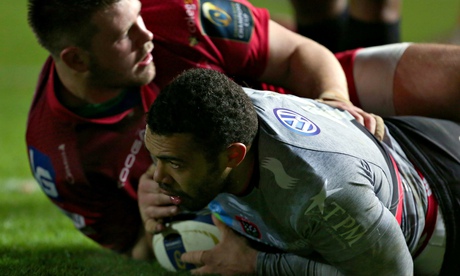
The European Champions Cup proved refreshing in at least one regard: only two of the final round of matches had nothing riding on them while most of the groups had already been decided at the same stage of the Heineken Cup a year ago.
The make-up of the quarter-finalists suggests a tilt away from the Guinness Pro 12 with the Aviva Premiership benefiting. Only Leinster have made it through from the four-union league, realising fears expressed there during the long negotiations to make European club rugby’s premier tournament more meritocratic that the outcome would be an Anglo-French affair with a Celtic tassel.
The last time Ireland, Scotland and Wales provided only one quarter-finalist between them was in 1997-98 which, coincidentally, was the year when England last supplied four clubs to the knock-out stage. It was also the season when the number of pool matches increased from four to six and Wasps became the first team under that system to qualify for the last eight having only won three matches, and just one at home, profiting from Toulouse’s late collapse.
Adding to the Pro 12’s discomfort was the fact that the two group runner’s-up who missed out were Toulouse and Leicester, although they did not provide the majority of the sides that finished bottom with Montpellier, Sale and Castres propping up their pools. The league had four of the five third-place finishers three years after supplying half of the quarter-finalists.
It is early to say that it represents a significant shift to the lands of plenty. Two of last season’s Pro 12 quarter-finalists, Ulster and Munster, will not be teams anyone will relish being grouped with next season, even if the latter may then be without their talisman, Paul O’Connell, who is considering retiring after the World Cup.
Munster looked well set after the opening two rounds, but then lost at home to Clermont Auvergne who showed the unusual single-mindedness and focus for a French club away from home, something replicated by Racing Métro at Northampton last weekend. They were routed at Saracens but they were by then clinging to the wreckage after being doubled by Clermont. They ended with a salvo against Sale and will not fade quietly away.
If Munster were in one of the most challenging pools, Ulster only had to contend with one A-lister, Toulon. They had topped their pool on the final day of last season’s group stage by defeating Leicester at Welford Road, but they were handily beaten at Welford Road last October and did not get close to Toulon home or away.
Ulster were hit hard by injuries, but with a ground whose capacity is being extended to 18,000 and the means to reinforce the squad, Ulster look in a better position than Leicester whose position in the East Midlands was highlighted this month when Northampton signed the Tigers’ back rower Jamie Gibson, a player in his prime. The Saints, never mind their failure to top their Champions Cup group, have overtaken their rivals and next April will be at the ground where Leicester exited last season’s Heineken Cup at the quarter-final stage, Clermont’s Stade Marcel Michelin.
Leicester’s director of rugby Richard Cockerill faces a challenging few months with a top two finish in the Premiership looking unlikely: making the first four will be challenging enough and the board at Welford Road has in the past not been afraid to make a big call when it feels the wind is blowing in the wrong direction, as Dean Richards found out.
What are Leicester’s problems compared to those facing the Welsh regions? It said something about the Pro 12 that the team leading the league, Ospreys, managed just one victory in their Champions Cup pool, and that was at home to Treviso in the opening round. They operate on a salary cap of £3.5m and are not equipped to fight on two fronts, lacking strength in depth. The Scarlets finished at the bottom of their group, defeating Leicester and Ulster at home but overpowered on the road.
The regions, who have supplied only one quarter-finalist in the last five seasons (Cardiff Blues and Newport Gwent Dragons made it to the last eight of the Challenge Cup, a tournament which, without a seat at the top table for the winners, has not tickled the fancy of the French), remain supporters of the Champions Cup, arguing it will help them gain financial strength, even if it will take a few years for that to happen: they face having only one team in the Champions Cup next season with league positions now counting.
A Scottish side has only twice reached the knockout stage of the European Cup, Edinburgh in 2004 and 2012. Glasgow started strongly, handing Bath their heaviest defeat of the season, and showed at the Recreation Ground last Sunday that they would not be out of place in the top eight. They will long lament their failure to beat Toulouse at home.
One potential effect of the creation of the Champions Cup that has yet to be tested is the stated belief that making the Pro 12 more competitive would help teams in Europe. More important is strength in depth and how many of the expected exodus from the southern hemisphere after the World Cup will be playing in Ireland, Wales, Scotland or Italy? Toulon have signed Samu Manoa from Northampton on a reported fee of £650,000 a year which amounts to more than 20 per cent of a region’s salary cap.
It may be, with all their Champions Cup teams having to play away in the last eight that the Premiership will not provide one semi-finalist, while the Pro 12 has one. The European club scene has long been a three-three split: France, England and Ireland with the players and the crowds, Wales, Scotland and Italy some way behind.
Back in 1997-98, when Cardiff were the only team from outside England and France to make the Heineken Cup quarter-finals, the Irish provinces lacked popular appeal. That changed, as it has to now in Wales and Scotland.
• This is an extract taken from the Breakdown, the Guardian’s weekly rugby union email. Sign up here.