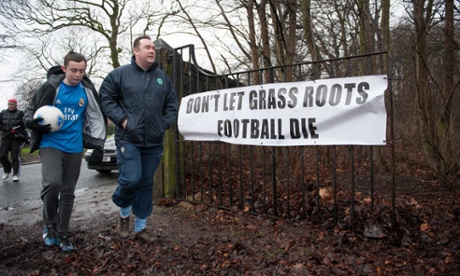
The argument over whether enough of the Premier League’s riches cascade down to the rest of the game is as old as the breakaway division itself. Twenty-three years on from its creation, however, the contrast between the game as it is played at the very top and the grassroots that nourish it below is more stark than ever.
The Premier League has become a global entertainment brand capable of bringing in more than £8bn over three years in broadcasting income. Meanwhile, grassroots facilities are under greater pressure than ever from council cuts and the wider societal problems surrounding inactivity and getting children to play sport are becoming more entrenched.
In recent years the Premier League has brought forth a sometimes bewildering array of schemes to show that it is doing its bit, showcasing them in draughty school halls and inner‑city estates.
Premier League 4 Sport uses a combination of Premier League and Sport England cash to bring 12 sports such as tennis and badminton to schoolchildren, using the all-pervasive power of top-flight football clubs as a hook. Through it, £7.8m is invested over three years.
Kicks – formerly known as Kickz – seeks to reach the most disadvantaged areas of society through football club community schemes and has resulted in heartwarming successes. That, too, is a joint scheme with Sport England, both partners putting in £1.5m each a year.
As an ancillary benefit it has also become clear the community coaching schemes it supports can become a valuable route for discovering players, such as Wilfried Zaha and Raheem Sterling, who might not otherwise make it through the airtight academy system.
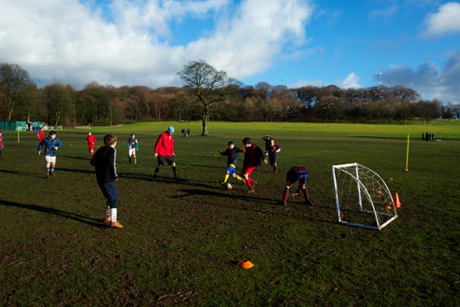
A further £10.5m over three years goes into the schools programme that produced 125,000 PE lessons funded by the Premier League last year through community coaches from 67 clubs in England.
Then there is the £34m invested in facilities through the Football Foundation, belatedly in recent years also targeting those areas where 3G pitches are needed most. Of that, the Premier League puts in £12m a year. In all, the contribution to so-called good causes totals £56m a year.
Yet the question must be whether any of this is remotely enough in an era when the club who finish bottom in 2016-17 are in line to receive £99m. Is the investment a result of a deeply held philosophical belief or a fig leaf? The sums involved are small as a percentage of the huge riches that funnel into the game from media giants.
You will hear Premier League executives complain, with some justification, that it is not for them to remedy long-standing failings of government policy.
Is it time to ask whether age-specific coaches employed by Premier League clubs could have a much greater role in primary school PE and nurturing schools football in general? Or whether clubs should see vastly increased investment in local facilities as a prerequisite to remaining an integral part of their communities in an era when they are focused on global brand building?
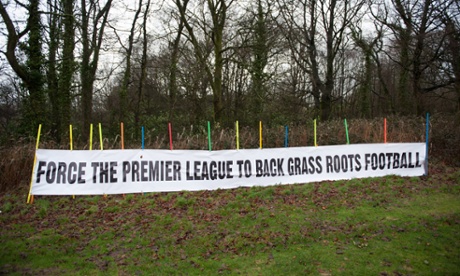
Or, conversely, whether a greater sum top-sliced from the Premier League’s broadcasting income and distributed by an independent body could act as an endowment to improve dire facilities up and down the country immediately?
The clubs – many with laudable foundations and community departments – need to do more to better nurture their own staff and schemes. Perhaps just as important, they need to articulate better what they are doing and why.
Meanwhile, the fraying patchwork of community facilities and coaching schemes needs urgent attention. The Premier League would argue that is what the Football Association is for. The governing body, however, is relatively impoverished and years of infighting and petty warfare have left it enfeebled. The chairman, Greg Dyke, and the new chief executive, Martin Glenn, are embarked on a cost‑cutting plan to save money to pour into a scheme for 3G “hubs” across the country. The Premier League could bridge the funding gap in an instant.
The new sports minister, Tracey Crouch, who has said she is appalled by the amount the “very wealthy” Premier League gives to the grassroots and will force them to contribute much more, has in effect ripped up the existing government sports policy and vowed to start again.
Richard Scudamore, more pivotal than ever in his new role as the Premier League’s executive chairman, is likely to take control of making the league’s case. He will doubtless argue that it is more redistributive than any other major league. Once Football League parachute and so-called solidarity payments are taken into account, it distributes more than a sixth of its overall income outside the top flight. It has promised that figure will total at least £1bn over the course of the next deal from 2016-17.
It is time to stop conflating the money that filters through to the rest of the professional game and the proportion that goes to the grassroots.
Critics have long pointed to a deal with government in 1999, when the Football Task Force made a recommendation for the Premier League to give 5% of its broadcasting take to the grassroots. Some at the league have always argued the figure should apply only to its domestic TV income.
Furthermore, it insists that no formal deal was ever done on the basis of the 5% figure and that discussions instead morphed into how the nascent Football Foundation should be funded on a tripartite basis with the FA and the government.

Either way, the sums are large enough to invest in the product on the pitch and play a wider role in the communities in which clubs are based.
It will need both a less combative approach from Scudamore and an understanding from politicians that looking to the Premier League alone to solve complex, deeply entrenched problems is not the whole answer.
It should start with a recognition of the excellent community work some clubs do and an attempt to celebrate and replicate it, so that it can become more than the sum of its too often disjointed and disconnected parts.