An advisory board of the Health, Labor and Welfare Ministry reported Wednesday that 80% of confirmed new cases of novel coronavirus infection were found in Tokyo and the 10 other prefectures currently subject to a state of emergency, including seven that were newly added.
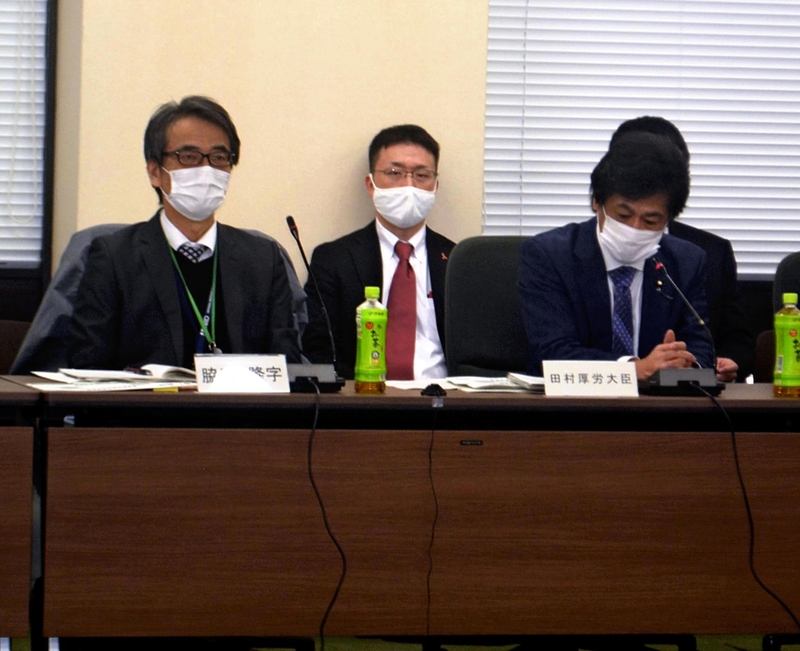
The advisory board, which examines measures against the virus, said the number of new infection cases nationwide has been on an upward trend since the year-end and is at a record high level. During a weeklong period through Monday, Tokyo and the 10 other prefectures accounted for 80% of the total infection cases across the nation. The board stressed the importance of reducing the number of infections in metropolitan areas.
According to data from the Cabinet Secretariat, the number of new infections per 100,000 people in Tokyo and the 10 other prefectures covered by the state of emergency in the week through Tuesday reached 25 -- the level equivalent to Stage 4, the most serious stage of infection. The figures for Osaka, Fukuoka and Tochigi exceeded 40, while Kyoto and Hyogo saw their figures top 30. The advisory board said that the medical systems in many places have come under increasingly severe stress amid the spike in the number of infections.
At a meeting of the advisory board, data was also presented showing that among the newly infected people whose cases were reported in Tokyo during the week of Jan. 3-9, there were 6,106 who could not find a place to be hospitalized or to stay for recuperation on the same day they learned they had contracted the virus. This figure had doubled from 3,056 the previous week.
According to Hideo Maeda, head of the public health center in Kita Ward, Tokyo, who reported the infection situation, the Tokyo metropolitan government cannot help but change its policy of hospitalizing the elderly in principle to prepare for sudden changes of their condition, because both medical institutions and accommodation facilities for recuperation are already occupied to near capacity.
Tokyo continues to face problems such as difficulty in transferring seriously ill patients to other hospitals. Due to the surge in the number of COVID-19 patients, it has become difficult for the metropolitan government's task force, which coordinates hospitalization destinations, to carry out such coordination, forcing hospitals to contact each other directly to find places that will accept patients.
At Tokyo Rinkai Hospital, a core hospital in Edogawa Ward that has been accepting COVID-19 patients with severe and moderate symptoms, the 39 beds set aside for virus patients were almost fully occupied during the past week. Providing appropriate care has been difficult as the hospital cannot transfer seriously ill patients who require extracorporeal membrane oxygenation (ECMO) machines to university hospitals, as beds at those institutions are also fully occupied.
"I've heard that there are dozens of patients waiting to be hospitalized in Edogawa Ward," said Tomoyoshi Yamaguchi, a doctor at Tokyo Rinkai Hospital. "We've been receiving calls every day, such as from Ota and Setagaya wards where there are many infected people, asking for transfers of patients. But we can't accept transfers even from hospitals in [Edogawa] ward."
-- Tokyo, 10 prefectures account for 60% of Japan's GDP
Tokyo and the other 10 prefectures that are subject to the state of emergency account for about half of the nation's population and play a central role in economic activities.
According to ***Cabinet Office data,*** Tokyo and the other prefectures account for about 60% of Japan's gross domestic product. Tokyo and ***three neighboring*** prefectures, where the state of emergency was declared on Jan. 7, account for about 30%, and the figure doubled with the seven prefectures newly covered by the state of emergency.
Not only commercial facilities but also headquarters and production bases of major companies are concentrated in these metropolitan areas. If economic activities slow down in the areas, it will inevitably have a negative impact on the whole nation.
Read more from The Japan News at https://japannews.yomiuri.co.jp/