Measures to deter non-essential travel across prefectural borders during the Golden Week block of holidays have been intensified, mainly in rural areas, amid the continuing spread of the new coronavirus.
Various "border control" measures to mitigate the spread of the virus are being implemented by prefectural governments across the country, such as taking the temperature of people who have come from other prefectures and closing publicly operated parking lots. There have also been excessive reactions from local residents, such as harassing visitors from other prefectures.
The government of Yamagata Prefecture on Saturday began taking the temperature of people entering from neighboring prefectures at seven locations, including expressway parking areas and railway stations within the prefecture.
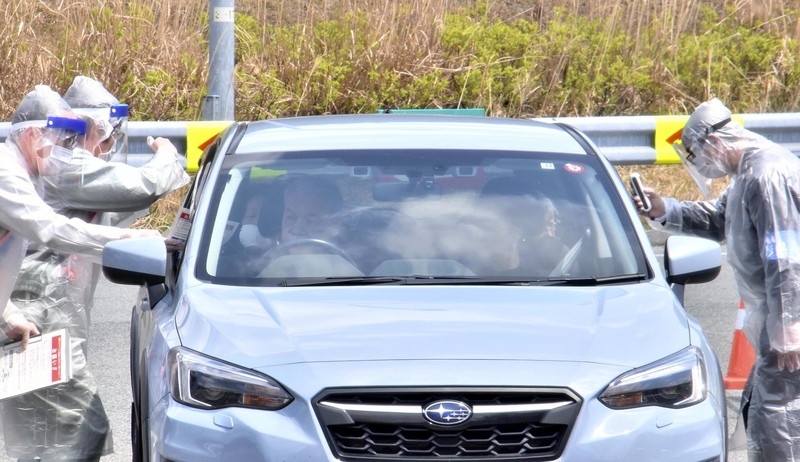
At the Yamagata-Zao Parking Area of the Yamagata Expressway on Saturday, prefectural government staffers and others wearing face shields and masks guided vehicles that had crossed the border into their prefecture to a special lane, asking the drivers and passengers to cooperate in taking their temperature.
They took the temperature of visitors, who remained seated inside their vehicles, with non-contact thermometers. When someone was confirmed to have a fever exceeding 37.5 C, staffers urged the person to contact such places as a consultation center for those with symptoms of coronavirus infections.
Yamagata Gov. Mieko Yoshimura emphasized that such action would "have a deterrent effect on those who plan to cross our prefectural border."
The temperatures of people coming from other prefectures are being checked, or are scheduled to be checked, in Hokkaido and 11 other prefectures. In Ehime Prefecture, visitors' temperatures are being taken at Matsuyama Airport.
In Kagoshima Prefecture, prefectural government staffers are taking the temperature of visitors at JR Kagoshima's Kagoshima-Chuo Station, mainly passengers on the Kyushu Shinkansen.
A 70-year-old woman from Shizuoka Prefecture who came to the station on Sunday said: "I came to [Kagoshima] prefecture on personal business. I'm grateful to have my temperature taken, since the people around me worry about it [infection]."
Such precautions are spreading because there has been a succession of cases of infection spreading across prefectural borders.
The first confirmed case in Toyama Prefecture, identified on March 30, was a female former resident of Kyoto Prefecture who had returned to her parents' house. After that visit, she dined with friends and three people who ate with her and members of their families were later found to be infected with the virus.
In Okinawa Prefecture, nine out of the first 10 patients who tested positive are said to have been infected outside the prefecture.
Yet some people have no choice but to travel to areas outside their prefecture. A 50-year-old company employee from Suita, Osaka Prefecture, who changed Shinkansen trains at JR Tokyo Station on Sunday, said: "I went to Aomori, with my company's permission, to attend the funeral of my father-in-law. I feel guilty about the trip but I have to go to a relative's funeral."
Trouble linked to non-essential outings has occurred. In Ito, Shizuoka Prefecture, four vehicles parked at a hot spa facility were found to have been damaged last Thursday. Three of the four vehicles had license plates from areas outside the prefecture, and city government officials believe the damage was possibly inflicted to harass visitors coming from outside the prefecture.
In Tokushima Prefecture, complaints such as "I was tailgated" and "I was verbally assaulted" have been submitted to the prefectural government by drivers of cars with license plates from outside the prefecture.
Tokushima Mayor Sawako Naito said at a press conference last Thursday: "Even some people who live in Tokushima Prefecture have cars with license plates from elsewhere. Discriminatory or divisive acts are inexcusable."
Read more from The Japan News at https://japannews.yomiuri.co.jp/