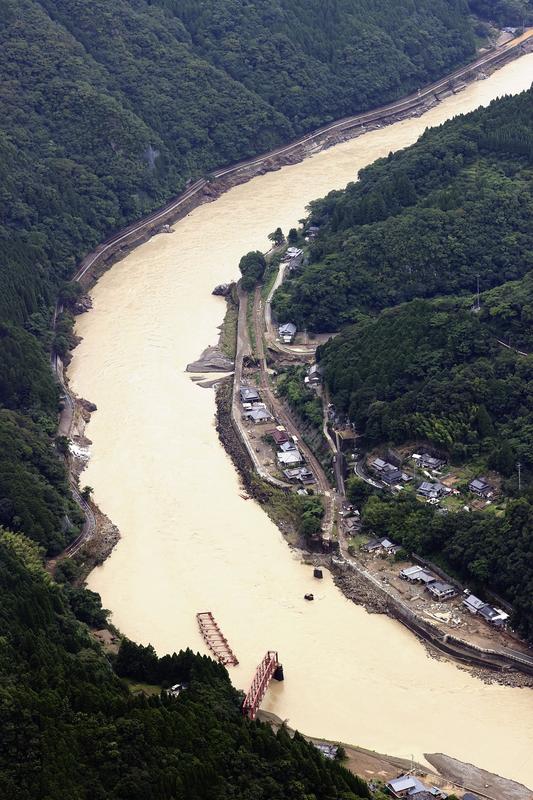
KUMAMOTO -- The latest torrential rain that has triggered massive flooding in Kumamoto Prefecture occurred before dawn, making it difficult for people to evacuate and leading to enormous damage.
As the long spell of rainy weather in early summer is heading into typhoon season, it is necessary to think anew about preparedness for localized downpours.
--Just 30 minutes
"I knew it would rain," said a 73-year-old man who lives in Hitoyoshi, Kumamoto Prefecture. "But I didn't imagine such heavy rainfall."
The falling rain made unusual sounds that woke him before dawn Saturday. As he went outside, it was raining intensely, so he decided to wait out the rain at home. It was around 6 a.m. when the water from the Kuma River, about 100 meters away, descended upon the house. In less than no time, his house was flooded up to the second floor, so he fled to the third floor.
As he had also experienced flooding that occurred in July 1965, he said, choking back tears, "I thought I had been on the alert, but..."
The Japan Meteorological Agency on Friday had forecast heavy rain for the Kyushu region, calling on local residents and communities to take precautions. The agency forecast rainfall of 200 millimeters in a 24-hour period for Kumamoto Prefecture, and 250 millimeters in the same period for Kagoshima Prefecture. In the evening, the agency also notified local governments in the region of its forecast.
The situation changed at around 2 a.m. Saturday. The seasonal rain front went northward further than expected, and rain clouds, reckoned to be linear precipitation bands where cumulonimbus clouds form in succession, developed over Kumamoto. The amount of rainfall rose suddenly and in a matter of about 30 minutes from 4 a.m. it exceeded the announcement standards for an emergency warning on heavy rain.
At 4:50 a.m., the agency announced the emergency warning for Kumamoto and Kagoshima prefectures. Meanwhile, the local governments of the city of Hitoyoshi and the village of Kuma issued evacuation notices around the time of the agency's announcement.
"We assumed heavy rain on a warning level expected during the rainy season, but it exceeded our assumptions by far," said an official in charge at the agency. "It is difficult to forecast an isolated heavy downpour that falls in a short period of time."
--Rampaging river
The Kuma River, with a total length of 115 kilometers, meanders through local communities, including Hitoyoshi and Kuma. The river has been known as one prone to rampage when it floods after several such instances in the past. In the July 1965 flood, about 12,000 houses experienced flooding in such cities as Hitoyoshi and Yatsushiro.
Using that flood as a lesson, local governments in the river basin drew up an anti-disaster action plan in the form of a timeline, which sets out evacuation actions each resident should take in advance. The prefectural government of Kumamoto, for its part, has also repeatedly called on local residents to evacuate before sunset in preparation for a disaster that might occur at night. So residents' awareness of disaster prevention runs high.
This time, however, fatalities occurred at a home for elderly people requiring special care that stands along the river in the village of Kuma. There are believed to be a large number of those who were unable to take shelter.
"We had not assumed that such rain clouds would develop in such a short period of time," said an official in charge at the Kumamoto prefectural government.
--Helping each other
How can preparations be made for such disasters that are difficult to forecast?
The central government, in the revised City Planning Law that passed in June, has decided to forbid or restrict the construction of hospitals, social welfare facilities and the like in an area vulnerable to landslides or flooding. It is aimed at reducing the risks of disasters from the stage of town building, but it will take quite some time to realize.
"When dealing with heavy rain that is difficult to forecast, it is important for residents and families to always share information and have a sense of alarm," said Takehiko Yamamura, director of the Disaster Prevention System Institute. "Even if it is rain that is forecast to not require people to evacuate, people can deal with situations easier if they have a habit of getting in touch with each other even at a minor change in how the rain is falling and the situation around them.
"It is also necessary at an early stage to start building towns free from dangerous areas."
Read more from The Japan News at https://japannews.yomiuri.co.jp/