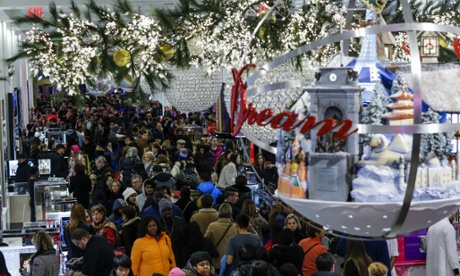
Shoppers who braved packed parking lots and wrap-around lines to score bargains over the Thanksgiving weekend may have noticed that the traditionally frenetic consumer experience was slightly less frenetic than usual. According to industry data, holiday weekend sales were down for a second consecutive year.
Collectively, sales were forecast to fall by an estimated 11% to $50.9bn, down from last year’s estimated $57.4bn, according to preliminary results from a spending survey released by the National Retail Federation (NRF). The survey, of 4,631 consumers between 28 and 29 November, was conducted by Prosper Insights & Analytics and had a 1.5% margin of error.
NRF president Matt Shay said the spending drop was partly to blame on early promotions – some sales began as early as Halloween this year – intense price competition and better online offerings.
“A strengthening economy that changes consumers’ reliance on deep discounts, a highly competitive environment, early promotions and the ability to shop 24/7 online all contributed to the shift witnessed this weekend,” he said.
Black Friday, traditionally the busiest shopping day of the year, drew the largest crowd of shoppers, with about 86.9 million buying online and in stores. Nearly a third of Black Friday shoppers said they also shopped on Thanksgiving Day, flat with last year’s 31.8%.
The survey predicted the average consumer would cut holiday spending over the long weekend to $380.95, down 6.4% from $407.02 last year. Shoppers were predicted to spend an average of $159.55 of their total shopping budget online, or approximately 41.9%. That was down 10.2% from $177.67 last year.
A separate report from ShopperTrak, which tracks brick-and-mortar retail traffic, also showed a sales drop over the long weekend, dipping by about 0.5% to $12.3bn. The report found that 27.3% more shoppers turned up at stores on Thanksgiving compared with last year while while 5.6% fewer people shopped on Friday.
Analysts said the economy likely played a role in the spending drop, but differed in their explanation of why. Some suggested consumers faring better financially this year may not have been compelled to fight the crowds for a discounted TV. Others suggested that consumers still worried about their financial situation might not be ready to splurge.
In a conference call with reporters, Shay offered his assessment of why consumer spending dropped again despite an improving economy.
“Historically people didn’t feel the need to shop [for bargains] when the economy was in a better position,” he said.
Shoppers who missed – or avoided – the weekend shopping rush did not miss the chance to score great deals, Shay said. He said consumers should look out for deep discounting all season long.
The holiday shopping season, which traditionally kicks off with Black Friday and runs until Christmas Eve, accounts for roughly 20% of the retail industry’s annual sales.
Referring to Monday’s final day of the extended holiday weekend, Shay said: “Every day will be Black Friday. Every minute will be Cyber Monday.”