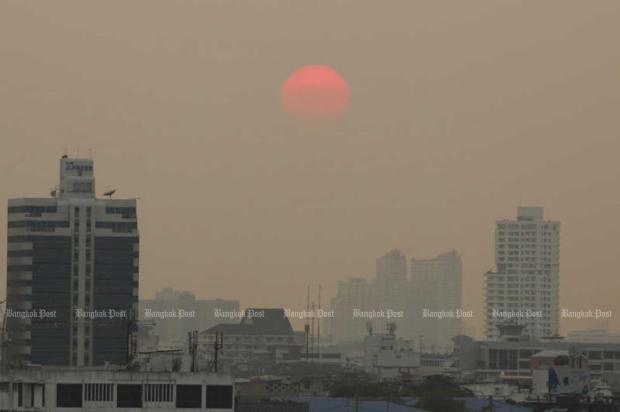
The government is considering whether to impose a ban on personal car use in affected areas to cope with high levels of PM2.5 dust particles in the air, if levels exceed 100 microgrammes per cubic metre (µg/m³).
The harsh proposal was on Tuesday unveiled by Prime Minister Prayut Chan-o-cha, who said only public transport services will be allowed to use the roads during a ban.
"Is that what we want? Do we really have to go that far?" asked Gen Prayut.
However, the extreme measure would only be employed on a case-by-case basis to avoid an unnecessarily negative impact, he said.
"If the dust levels rise to more than 100 µg/m³, the government will take over all the work and everyone will be affected," said Gen Prayut.
He was responding to questions about both calls for tougher measures to deal with sources of PM2.5 and accusations that it hasn't done enough to deal with the problem.
The PM also explained that, when PM2.5 levels hit around 50 µg/m³, all concerned agencies begin stepping up screening for sources of the dust including vehicles emitting black smoke.
In areas where the PM2.5 levels rise to between 50 and 75 µg/m³, the provincial governor is responsible for targeting the key sources of the pollution, said the PM.
Traffic emissions are the primary source of PM2.5, followed by biomass burning and industrial emissions, said Gen Prayut.
In areas where the PM2.5 levels rise to between 75 and 100 µg/m³ the provincial governor will have to implement more stringent measures such as prohibiting heavy trucks from entering certain inner areas of the province at certain times, he said.
And in the event the PM2.5 levels exceed 100 µg/m³, the government will then take control and may implement even tougher regulations, which may affect everyone, according to the PM.
He said the government has begun working on a long-term masterplan to combat pollution which includes the development of the electric rail network and replacing diesel-powered public buses with electric ones.
Natural Resources and Environment Minister Varawut Silpa-archa, meanwhile, hinted that if measures against lorries emitting black smoke prove to be insufficient, personal cars could be targeted next.
"It has been found that 72% of the PM2.5 dust particles come from traffic emissions," he said.
Among the short-term measures to be implemented next in Bangkok is a ban on heavy trucks from entering certain parts of the city every other day, possibly in February only, he said.