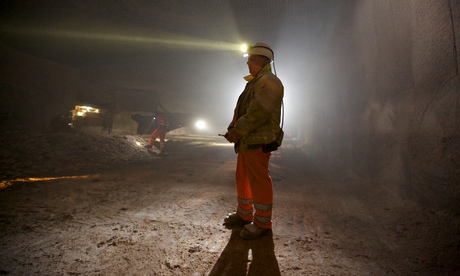
“Down here we want it to snow,” noted salt miner Graham Gibbons as he operated the 96 tungsten-tipped cutting picks of a continuous mining machine in the Winsford Rock Salt Mine, 200m underneath the Cheshire plains.
“I will do a snow dance if the weather is too warm. Last winter it was no good – just wet and mild. Three weeks of non-stop snow and frost, that’s probably the best scenario to keep the mine going for 12 months a year.”
Famed as Winsford’s “overtime king”, Gibbons, 58, has been known to put in an extra 30 hours on top of his regular 40-hour week during prolonged cold snaps, when the mine can produce up to 8,000 tonnes a day. When the Guardian met him underground, back in November, his prospects for overtime were looking poor after an unusually balmy year: according to the Met Office, 2014 has been the eighth warmest year since 1659.
Around 50% of the rock salt sprinkled on UK roads as “grit” comes from Winsford. It has operated as a mine since 1844 when rock salt deposits were discovered by local prospectors searching for coal. The salt beds are a hangover from the Triassic era, when Cheshire was under the sea. It’s long been known as a salty county – the “wich” appended to many town names in the area, such as Middlewich and Northwich, indicates the presence of brine. In summer you can even swim in Nantwich’s brine pool.
Production at Winsford was small scale until the explosion of motoring last century when salt began to be sprinkled on the roads to reduce both the freezing and melting points of water, speeding up the rate at which snow turns to water.
The mine has since grown steadily and today stretches 5km east to west and 3km north to south. At least 150 miles of roads now exist under the ground, navigated in minibuses via a strictly enforced one-way system. There is even a graveyard for old vehicles. The subterranean air is so salty that any car used underground would rust almost as soon as it reached the surface – it is also difficult to move them above ground – so they are instead abandoned in a dark and salty chamber.
Mining salt might not be as hot and dirty as mining coal, but anyone who goes underground needs a good bath afterwards. Stand too close to the mining machine and you end up covered in salty crust - not pure white, but a dirty beige.
It is a supremely dry environment, with a constant temperature of 14C – perfect for storing delicate manuscripts and books. A number of years ago the mine branched out into “deep storage”, taking advantage of the excavated voids between the salt stacks. Historic archive materials from scientific charity the Wellcome Trust are held down there, as well as documents from the National Archive.
Two other, newer salt mines also exist in the UK: Cleveland Potash mine near Boulby on the north-east coast of the North York Moors, and the Kilroot mine in Northern Ireland, which is operated by a US firm as Irish Salt Sales.
For decades, the mines went largely unmentioned, as the UK experienced ever warmer climates. Then the big freeze of February 2009 happened and many councils got caught out, having not ordered enough salt to get them through the extended cold period. London ground to a halt following the first big snow dump, with most trains and buses not leaving their depots for 24 hours.
Salt production is a continuous operation, but demand is highly seasonal. The Highways Agency, which manages the motorways and major A roads in England, learnt its lesson after 2009. This year the agency began the winter with more than a quarter of a million tonnes of salt, ready to be spread by a fleet of 437 salt spreaders (or gritters), all fitted with snow ploughs, along with 23 snow blowers. Since 2009, when local authorities claimed they couldn’t get enough salt because the Highways Agency had nabbed it all, the barns used to store it have been enlarged with “crowns”, allowing them to cram more in.
Though few motorists relish snowy weather, Andrew Olive loves it. As the severe weather manager for the Highways Agency, he works all year preparing for extreme heat as well as cold, but winter is his favourite season because it’s more “challenging”. When the nights start drawing in and the frost starts to nip, he is in his element: “Come October I’m like a giddy kipper.”